🇨🇦 Fish of Canada
20 fish from Canada, best known first.
Canada’s fishing sector is a major economic driver, valued at $36.1 billion in 2018 and employing roughly 300,000 people. The industry relies heavily on exports, with over 75% of harvested seafood sold internationally to markets like the United States and China.
- In 2018, the industry was worth $36.1 billion and employed 300,000 people.
- Over 75% of harvested seafood is exported to international markets.
- The United States accounts for 64% of Canada's seafood trade.
- Aquaculture generated over $1 billion in GDP in 2015.
- 37.1% of Canadian fisheries had uncertain health status as of 2022.
Fish of Canada
Canada possesses extensive marine and freshwater resources along its Atlantic, Pacific, and Arctic coasts, as well as within the Great Lakes system. These waters support a diverse commercial industry that supplies domestic consumers and international buyers. In 2018, the sector generated significant revenue and employment, reflecting its importance to the national economy. The government manages these aquatic resources through Fisheries and Oceans Canada, aiming to balance economic activity with ecological sustainability. Export volumes exceed domestic consumption, creating a trade surplus in fish and seafood products. This global reach positions Canada among the top exporters worldwide, demonstrating the scale and competitiveness of its harvest operations.
Seas and rivers
The Canadian fishing industry operates across three primary regions: the Atlantic coast, the Pacific coast, and the inland waters including the Great Lakes and Hudson Bay. These diverse environments provide abundant habitats for various fish and shellfish species. The Atlantic region has historically been central to the industry, particularly around Newfoundland. The Pacific coast offers different ecological conditions supporting distinct harvests. Inland fisheries contribute significantly to freshwater production. The variety of water bodies allows for a wide range of seafood products, from cold-water cod to salmon and shellfish, catering to both local demand and international export requirements.
Fishing and farming
Aquaculture represents a rapidly expanding segment of the Canadian food production landscape, contributing over $1 billion to GDP in 2015. Commercial harvesting involves catching wild fish and shellfish, which are then processed in registered establishments. Sustainability is enforced through strict inspection protocols and certification programs that verify origin and handling practices. Traceability systems track products from catch to consumer to prevent illegal or mislabeled goods. The government implements quotas and vessel limits to manage stock levels and ensure long-term viability. Despite these measures, challenges such as climate change impacts and fluctuating market prices continue to affect industry stability and fish population health.
Today
Current management strategies focus on maintaining healthy ecosystems while supporting economic interests. Certification and traceability frameworks help Canadian exporters meet international standards, particularly in the European Union. However, recent data indicates that a significant portion of fisheries have uncertain health statuses, highlighting ongoing conservation challenges. The industry faces pressure to adapt to environmental changes and maintain sustainable harvest levels. Government initiatives aim to improve monitoring and support fishermen through advisory committees and financial mechanisms. Balancing ecological integrity with commercial success remains a central priority for policymakers and industry stakeholders alike.
The facts in this overview come from the Wikipedia article "Fishing industry in Canada", written by its contributors and used under the CC BY-SA 4.0 licence. EveryFish rewrote the text in its own words, with AI assistance, and compares every page with the article to make sure no passage is copied. It may be reused under the same CC BY-SA 4.0 licence with a link back.
Fish places in Canada
 🇺🇸 United States and 4 moreSea lamprey
A jawless, parasitic fish native to the Northern Hemisphere that attacks other fish.Ancient · Rivers and lakes · 1758
 🇺🇸 United States and 3 moreSockeye salmon
Anadromous Pacific salmon known for red spawning colour and zooplankton diet.Salmonid · Rivers and lakes · 1792
 🇺🇸 United States and 1 moreLake sturgeon
A large, long-lived freshwater fish native to North America.Ancient · Rivers and lakes
 🇺🇸 United States and 1 moreAtlantic sturgeon
A large anadromous fish native to the western Atlantic Ocean and its river systems.Ancient · Rivers and lakes
 🇺🇸 United States and 1 moreShortnose sturgeon
A small, endangered North American sturgeon with a short snout.Ancient · Rivers and lakes · 1818
 🇺🇸 United States and 4 moreLargemouth bass
A large freshwater predator native to North America, prized by anglers and invasive in many regions.Other · Rivers and lakes · 1802
 🇺🇸 United States and 2 morePumpkinseed
A small freshwater fish native to eastern North America, known for its bright colours and red ear flap.Perch-like · Rivers and lakes · 1793
 🇺🇸 United States and 3 moreBlack crappie
A spotted freshwater sunfish native to North America, prized by anglers for its sport and table fare.Perch-like · Rivers and lakes · 1856
 🇺🇸 United States and 2 moreGreen sunfish
A small, aggressive freshwater fish native to North America, known for its blue-green colour and invasive potential in nPerch-like · Rivers and lakes
 🇺🇸 United States and 1 moreSauger
A freshwater perch species native to North American rivers.Perch-like · Rivers and lakes · 1834
 🇺🇸 United States and 1 moreMuskellunge
Large freshwater predatory fish native to North America and the largest member of the pike family.Other · Rivers and lakes
 🇨🇦 Canada and 1 moreBigmouth buffalo
A long-lived North American freshwater fish known for its terminal mouth and exceptional lifespan.Catfish · Rivers and lakes
 🇨🇦 Canada and 1 moreGoldeye
A silver freshwater fish known for its smoked culinary form.Other · Rivers and lakes
 🇨🇦 Canada and 1 moreLake chub
A small cold-water minnow native to Canada and the northern US.Carp · Rivers and lakes
 🇺🇸 United States and 1 moreGreen sturgeon
A large anadromous fish native to the northern Pacific Ocean.Shark · Coasts and shelves
 🇺🇸 United States and 2 moreBluegill
A common North American sunfish known for its blue gill covers and popularity with anglers.Perch-like · Rivers and lakes · 1854
 🇷🇺 Russia and 3 moreBurbot
A coldwater freshwater fish with a chin whisker, native to the Northern Hemisphere.Other · Rivers and lakes · 1758
 🇺🇸 United States and 2 moreRock bass
A small, red-eyed freshwater sunfish native to North America.Perch-like · Rivers and lakes
 🇺🇸 United States and 1 moreSpotted gar
A small North American freshwater fish with a long snout and spotted scales.Ancient · Rivers and lakes · 1860
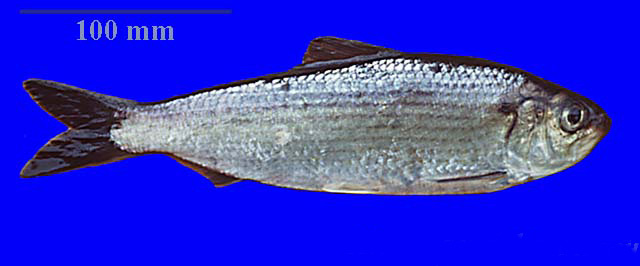 🇺🇸 United States and 1 moreAlewife
A small North American herring that migrates between sea and rivers.Herring · Coasts and shelves
Photo credits on this page
The small pictures above come from Wikimedia Commons under free licences. Some are cropped to fit.
- Sea lamprey: Fernando Losada Rodríguez, CC BY-SA 4.0, source
- Sockeye salmon: Timothy Knepp of the Fish and Wildlife Service., Public domain, source
- Lake sturgeon: USFWS Mountain-Prairie, Public domain, source
- Atlantic sturgeon: Jiaqian AirplaneFan, CC BY 3.0, source
- Shortnose sturgeon: Unknown author, Public domain, source
- Largemouth bass: Totti, CC BY-SA 4.0, source
- Pumpkinseed: Cephas, CC BY-SA 3.0, source
- Black crappie: USFWS Mountain-Prairie, Public domain, source
- Green sunfish: Duane Raver, Public domain, source
- Muskellunge: Engbretson, Eric / U.S. Fish and Wildlife Service, Public domain, source
- Sauger: Duane Raver, Public domain, source
- Bigmouth buffalo: Unknown author, Public domain, source
- Goldeye: USFWS Mountain-Prairie, Public domain, source
- Lake chub: Konrad P. Schmidt, Public domain, source
- Green sturgeon: Muséum d'histoire Naturelle, Public domain, source
- Bluegill: Fredlyfish4, CC BY-SA 3.0, source
- Burbot: Unknown author, CC BY-SA 3.0, source
- Rock bass: Cephas, CC BY-SA 3.0, source
- Spotted gar: Brian.gratwicke on English Wikipedia, CC BY 2.5, source
- Alewife: Unknown author, CC BY-SA 3.0, source