
Burbot
A coldwater freshwater fish with a chin whisker, native to the Northern Hemisphere.
The burbot is the only freshwater member of the order Gadiformes and the sole species in its genus. It inhabits cold rivers and lakes across the Northern Hemisphere, where it plays a role in local ecosystems and traditional food cultures.
- Only freshwater fish in the cod order Gadiformes.
- Spawns under ice in winter at near-freezing temperatures.
- Liver oil has three to four times more vitamin D than cod oil.
- Meat tastes similar to American lobster.
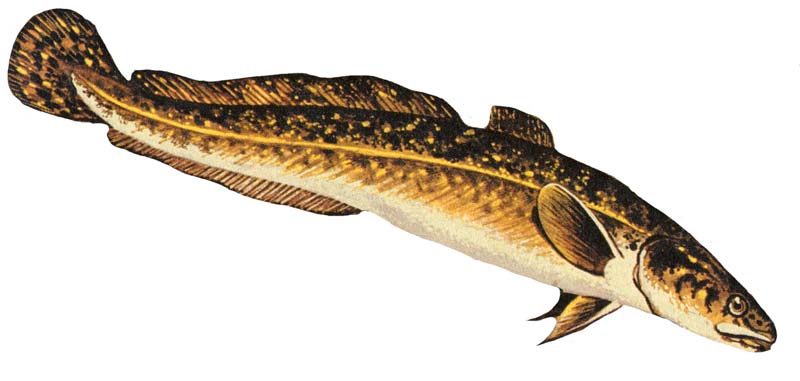
- Has a single whisker on its chin called a barbel.
What it is
The burbot is a slender, eel-shaped fish that lives in cold northern waters. It has a flattened head and a single whisker on its chin, which helps identify it. The body is covered in tiny scales that are hard to see. It has two soft dorsal fins and rounded tail fins. Adults can grow up to 120 centimetres long and weigh over 12 kilograms. Despite looking like an eel or catfish, it belongs to the cod family.
Where it lives
This fish lives in a wide band across the Northern Hemisphere above 40 degrees north latitude. Populations stretch from France through Europe and Russia to Alaska and Canada. They live in large rivers, lakes, and reservoirs. Some groups move between fresh and salty water to breed. In North America, they are common in the Great Lakes. Genetic studies suggest there may be separate European and North American types.
How it lives
Burbot prefer very cold water and often hide under ice during winter. They hunt at dawn and dusk, using their whiskers to find food in mud or gravel. Young fish eat small insects and plankton. Adults eat other fish, lampreys, frogs, and even birds. They are aggressive predators and will attack prey nearly their own size. Larger fish are hunted by pike and muskellunge. Their slow growth means they live for decades.
Breeding and life cycle
Unlike most fish, burbot spawn in winter when ice covers the water. Temperatures stay near freezing. Males gather around females to release eggs and sperm into the water. The eggs drift until they settle in cracks on the river bottom. Larvae hatch and float freely before moving to the bottom. Growth is fast in the first year but slows later. Fish reach maturity between four and seven years old.
Fish and people
People eat burbot meat, which tastes similar to lobster. In Finland, the liver and roe are considered delicacies. Historically, the oil from the liver was used for health because it contains high levels of vitamins A and D. Anglers target them for sport fishing tournaments. In some areas, they are viewed as nuisance predators that eat other game fish. Reintroduction plans have been discussed in places like the United Kingdom.
Status and threats
Global populations are generally stable, but many local groups face threats. Pollution, habitat loss, and dams reduce numbers in rivers. Invasive species also impact lake populations. Management is often low priority because commercial fishing interest is limited. Conservation groups work to protect specific regional stocks. Genetic research indicates distinct species, which may affect how they are protected and studied in the future.



Questions people ask about Burbot
What does burbot meat taste like?
When cooked, the flesh of the burbot is described as tasting very similar to American lobster. This unique flavour has earned the fish the nickname 'poor man's lobster' among anglers and consumers who enjoy its mild, sweet taste.
Why is the burbot called a lawyer?
The name comes from the Latin word 'barba', meaning beard. This refers to the single whisker on its chin. Old French names like 'lotte' and 'barbot' also relate to this feature, leading to various nicknames including 'the lawyer' in English-speaking regions.
Do burbot spawn in summer?
No, burbot spawn in mid to late winter, often under ice. This is unusual for freshwater fish. They release eggs and sperm into the water column when temperatures are between one and five degrees Celsius, ensuring larvae develop in cold conditions.
Is the burbot dangerous to humans?
Burbot are not dangerous to humans. They do not have venom or sharp teeth capable of harming people. However, they are aggressive predators that eat other fish, frogs, and birds. Anglers must handle them carefully to avoid being bitten.
Good reading and sources
- The decline of the 'disgusting' burbotBBC, Article
- Return of the burbot:The Guardian, Article
- BBC Radio 4 - Natural Histories, BurbotBBC, Article
The facts on this page come from the Wikipedia article "Burbot", written by its contributors and used under the CC BY-SA 4.0 licence, and from its Wikidata record (CC0). EveryFish rewrote the text in its own words, with AI assistance, and compares every page with the article to make sure no passage is copied. It may be reused under the same CC BY-SA 4.0 licence with a link back.
It may contain mistakes, and figures change over time. Nothing here is investment or buying advice. If something is wrong, tell us. Last refreshed 2026-11-15.
Like Burbot
All other fish 🇺🇸 United States and 2 moreLongnose gar
A primitive ray-finned fish with a long snout and armored scales found in North America.Other · Rivers and lakes · 1758
 🇺🇸 United States and 2 moreGar
Ancient armored fish with lung-like swim bladders found in North American waters.Ancient · Rivers and lakes · 1758
 🇧🇼 Botswana and 1 moreAfrican tigerfish
Predatory freshwater fish known for sharp teeth and leaping hunting behaviour.Other · Rivers and lakes · 1861
 WorldNile perch
Large freshwater predator native to Africa, now invasive in many lakes.Other · Rivers and lakes