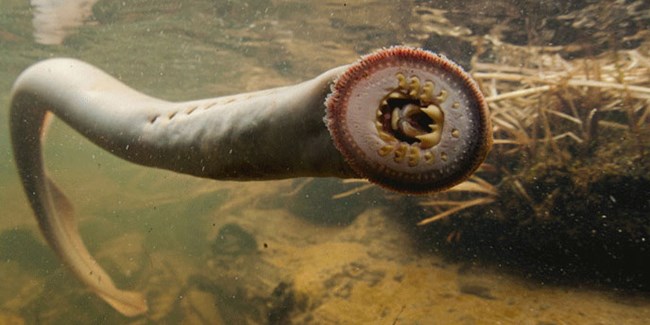
Sea lamprey
A jawless, parasitic fish native to the Northern Hemisphere that attacks other fish.
The sea lamprey is a jawless vertebrate found in the Atlantic and Mediterranean. It feeds on the blood of other fish using a sucker-like mouth and has become a destructive pest in the Great Lakes.
- Adults use a sucker mouth to attach to fish and rasp away tissue.
- One lamprey can kill up to 40 pounds of fish in a single feeding period.
- They were introduced to the Great Lakes via canals in the nineteenth century.
- Adults die immediately after spawning in freshwater streams.
- Their genome was sequenced in 2013, revealing unique genetic features.
What it is
This ancient fish lacks jaws and paired fins, giving it an eel-like shape. Its most striking feature is a round, sucker-shaped mouth filled with concentric rows of sharp teeth and a rasping tongue. The body is typically olive or brown-yellow with black markings on top and a lighter belly. Seven gill openings sit behind the eye. Adults can grow up to 120 centimetres long and weigh over two kilograms, living for about seven years.
Where it lives
Native populations inhabit the northern and western Atlantic Ocean along Europe and North America, as well as the western Mediterranean and Black Seas. In North America, they are native to the Connecticut River basin but have invaded the Great Lakes and Lake Champlain. European populations are largest in southwestern regions including Portugal, Spain, and France. They tolerate temperatures between one and twenty degrees Celsius and can survive at depths reaching four thousand metres.
How it lives
Sea lampreys are anadromous, meaning they migrate from saltwater or lake habitats into freshwater rivers to reproduce. As larvae, they burrow in sand and silt, filtering plankton from the water. After several years, they metamorphose into adults and begin a parasitic lifestyle. They attach to other fish using their suction-cup mouth, rasping flesh and preventing clotting with a special fluid. This feeding lasts twelve to eighteen months, often killing the victim through blood loss or infection.
Breeding and life cycle
Males construct nests in stream substrates with moderate currents. Females deposit large numbers of eggs in these nests. Following spawning, all adult sea lampreys die naturally. The larvae remain in quiet downstream waters for several years before transforming. Once mature, they migrate back to marine environments to feed before returning to rivers to spawn and perish, completing their life cycle.
Fish and people
In parts of Europe, particularly France, Spain, and Portugal, sea lampreys are considered a culinary delicacy and are sold seasonally. They may be served pickled or grilled. In Finland, they are traditionally pickled. However, in the Great Lakes region, they are viewed as a severe agricultural pest due to their impact on native fish stocks like lake trout. Control programs involving chemical lampricides and barriers are active to protect local fisheries.
Status and threats
While listed as least concern globally, the species is a major invasive threat in the Great Lakes. There, native fish lack evolutionary defenses against them, leading to population collapses of species like lake trout. Conservation efforts focus on controlling their spread through chemical treatments, physical barriers, and research into pheromones. Genetic studies aim to understand their unique biology to develop more targeted and environmentally friendly management strategies.


Questions people ask about Sea lamprey
How does the sea lamprey feed?
It attaches to other fish using a round, sucker-like mouth. Inside, sharp teeth and a rasping tongue allow it to remove tissue. It produces a fluid that stops the victim's blood from clotting, allowing it to drink blood until the host dies from loss or infection.
Why is the sea lamprey a problem in the Great Lakes?
Native Great Lakes fish never evolved defenses against this parasite. The lamprey attacks species like lake trout, causing massive population declines. Since the lamprey arrived via canals in the 1800s, it has disrupted the ecosystem balance by decimating apex predators.
Where do sea lampreys live?
They live in the northern Atlantic, Mediterranean, and Black Seas. In North America, they are native to the Connecticut River but also inhabit the Great Lakes. They can survive in both fresh and saltwater, tolerating a wide range of salinities and temperatures.
Are sea lampreys eaten by humans?
Yes, in parts of Europe such as France, Spain, and Portugal, they are considered a delicacy. They are sometimes served pickled in Finland or grilled. In the Great Lakes, however, they are primarily controlled as pests rather than harvested for food.
Good reading and sources
The facts on this page come from the Wikipedia article "Sea lamprey", written by its contributors and used under the CC BY-SA 4.0 licence, and from its Wikidata record (CC0). EveryFish rewrote the text in its own words, with AI assistance, and compares every page with the article to make sure no passage is copied. It may be reused under the same CC BY-SA 4.0 licence with a link back.
It may contain mistakes, and figures change over time. Nothing here is investment or buying advice. If something is wrong, tell us. Last refreshed 2026-11-15.
Like Sea lamprey
All ancient fish WorldLamprey
Jawless fish with a sucking mouth found in temperate waters worldwide.Ancient · Rivers and lakes
 🇺🇸 United States and 2 moreGar
Ancient armored fish with lung-like swim bladders found in North American waters.Ancient · Rivers and lakes · 1758
 🇺🇸 United StatesAmerican paddlefish
Ancient freshwater fish with a sensory snout and filter-feeding habits.Ancient · Rivers and lakes · 1792
 🇺🇸 United States and 1 moreShortnose sturgeon
A small, endangered North American sturgeon with a short snout.Ancient · Rivers and lakes · 1818