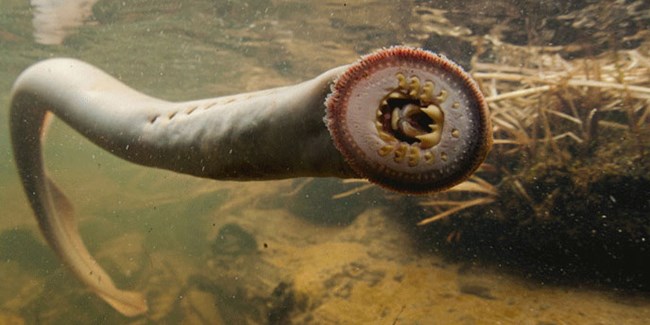
Pacific lamprey
An anadromous parasitic jawless fish found along the Pacific Rim.
The Pacific lamprey is a migratory species native to the Pacific Coast of North America and Asia. It spends its early life in freshwater streams before maturing at sea and returning to spawn, playing a key role in local ecosystems and indigenous cultures.
- Adults grow to 80 cm and have three sharp teeth above the mouth.
- Larvae live in freshwater burrows for up to 17 years before metamorphosis.
- Females lay over 100,000 eggs in gravel nests before dying.
- Smoked lamprey is a staple ceremonial food for Pacific Northwest tribes.
- Classified as Near Threatened due to dams and climate change impacts.
What it is
The Pacific lamprey is a jawless, ancient fish belonging to the family Petromyzontidae. Adults reach lengths of about 80 centimetres and possess slender, elongated bodies. They feature two dorsal fins positioned far back on their backs, which split during metamorphosis from a single connected fin in the larval stage. Their skin colour shifts based on their environment: bluish-black or greenish above and pale below when at sea, but turning brown in fresh water. A distinctive trait is the presence of three sharp teeth on the supraoral bar above the mouth. These creatures are semelparous, meaning they reproduce only once in their lifetime before dying.
Where it lives
This species inhabits the Pacific Rim, spanning from the Bering Sea coasts of Asia down the North American coast to Baja California in Mexico. In North America, they occupy major river systems including the Fraser, Columbia, Klamath-Trinity, Eel, and Sacramento-San Joaquin rivers. While primarily coastal, they can be found far offshore and at depths ranging from the surface to 1,508 metres. The population has seen recolonization efforts in Southern California, with returns to San Luis Obispo Creek and the Santa Margarita River in recent years following habitat restoration.
How it lives
Lampreys spend most of their lives as larvae called ammocoetes, living in freshwater for three to seven years or longer. These larvae are filter feeders that burrow into soft substrates, consuming algae and detritus. After metamorphosis, juveniles migrate to the ocean, attaching to other fish and even sperm whales to feed on blood and body fluids. As adults, they face predation from sharks, sea lions, and marine mammals. Despite their high caloric value, they lack strong swimming capabilities to evade these predators effectively. They live one to two years in the ocean before returning to freshwater to spawn.
Breeding and life cycle
Spawning occurs in small gravel beds in rivers, similar to salmon habitats. Females construct nests and lay over 100,000 eggs, which are fertilized externally by males. Embryos hatch approximately nineteen days after spawning once water temperatures reach 15 degrees Celsius. Adults do not feed during their upstream migration and typically die within four days of spawning. The species exhibits semelparity, completing its entire life cycle in seven to eleven years before the next generation begins.
Fish and people
Pacific lamprey holds significant cultural importance for Native American tribes in the Pacific Northwest, including the Yurok, Karuk, and Wiyot peoples. Traditionally, it serves as ceremonial food and is often smoked over open fires for preservation. Tribes have historically fed this fatty fish to infants due to its high caloric content. Harvesting methods include snagging lampreys in surf zones using hand-carved wooden hooks. Conservation initiatives like the Pacific Lamprey Conservation Initiative aim to restore populations and support traditional tribal use amid declining numbers caused by dams and pollution.
Status and threats
The Pacific lamprey is classified as Near Threatened due to declining abundance across its range. Human infrastructure, such as dams and channelization, has severely impacted habitat connectivity and water quality. Climate change poses additional risks, as rising water temperatures can impair larval burrowing habits and prove lethal. Conservation efforts involve collaborative agreements between tribes, federal agencies, and NGOs to improve habitats, remove barriers, and monitor population demographics through regional management units.


Questions people ask about Pacific lamprey
What does the Pacific lamprey eat?
As larvae, they filter-feed on algae and microorganisms while buried in stream bottoms. As adults, they attach to other fish and sperm whales, feeding on their blood and body fluids until they return to freshwater to spawn, at which point they stop eating entirely.
How long does the Pacific lamprey live?
The species completes its life cycle in seven to eleven years. Larvae remain in freshwater for three to seven years or longer, followed by one to two years in the ocean as parasitic adults before returning to spawn and dying shortly after reproduction.
Why is the Pacific lamprey important to Native American tribes?
It serves as a vital ceremonial food source and cultural symbol for tribes like the Yurok and Karuk. Traditionally smoked and fed to children for its high caloric value, it remains central to tribal identity and ecological balance despite population declines from dam construction.
What threatens the survival of Pacific lamprey?
Primary threats include dams blocking migration routes, water quality degradation, and climate change. Rising water temperatures can kill larvae or impair their ability to burrow, while habitat loss reduces available spawning grounds across their native range.
Good reading and sources
- Pacific lamprey on WikipediaEncyclopedia
- More photos on Wikimedia CommonsPhotos
- Wikidata recordOpen data
The facts on this page come from the Wikipedia article "Pacific lamprey", written by its contributors and used under the CC BY-SA 4.0 licence, and from its Wikidata record (CC0). EveryFish rewrote the text in its own words, with AI assistance, and compares every page with the article to make sure no passage is copied. It may be reused under the same CC BY-SA 4.0 licence with a link back.
It may contain mistakes, and figures change over time. Nothing here is investment or buying advice. If something is wrong, tell us. Last refreshed 2026-11-15.
Like Pacific lamprey
All ancient fish 🇺🇸 United States and 1 moreShortnose sturgeon
A small, endangered North American sturgeon with a short snout.Ancient · Rivers and lakes · 1818
 🇺🇸 United StatesAmerican paddlefish
Ancient freshwater fish with a sensory snout and filter-feeding habits.Ancient · Rivers and lakes · 1792
 🇺🇸 United States and 4 moreSea lamprey
A jawless, parasitic fish native to the Northern Hemisphere that attacks other fish.Ancient · Rivers and lakes · 1758
 🇺🇸 United States and 1 moreAtlantic sturgeon
A large anadromous fish native to the western Atlantic Ocean and its river systems.Ancient · Rivers and lakes
