
Atlantic sturgeon
A large anadromous fish native to the western Atlantic Ocean and its river systems.
The Atlantic sturgeon is a long-lived species found along the eastern coast of North America. It has faced severe population declines from historical overfishing and habitat loss, leading to legal protection in the United States.
- Reaches lengths of 4.6 metres and weighs over 360 kg.
- Spawns every two to six years in freshwater rivers.
- Protected under the U.S. Endangered Species Act since 2012.
- Possesses five rows of bony scutes instead of scales.
- Caviar production caused severe historical population declines.
What it is
The Atlantic sturgeon is a large ancient fish belonging to the family Acipenseridae. Instead of typical scales, it possesses five longitudinal rows of bony plates called scutes. Its colour ranges from bluish-black or olive green on the back to white underneath. The species features a distinctively long snout equipped with four sensory barbels near the mouth. Adults typically measure between 1.8 and 2.4 metres, though records indicate individuals can reach 4.6 metres in length and weigh over 360 kilograms. They are often described as living fossils due to their ancient lineage.
Where it lives
This species inhabits the western Atlantic Ocean and associated river basins along the eastern coast of North America. Its natural range extends from New Brunswick in Canada down to Florida in the United States. A separate, disjunct population exists in the Baltic Sea region, established through recent reintroduction efforts using American donor stock. Historically, the species occupied a much wider area, but many original habitats have been lost. The fish utilises coastal waters, estuaries, and freshwater rivers for different stages of its life cycle.
How it lives
Atlantic sturgeons are anadromous, meaning they migrate between saltwater and freshwater environments. They generally live solitarily or in small groups, occupying shallow coastal shelves and soft-bottomed areas up to 49 metres deep. Adults feed primarily on crustaceans, worms, and molluscs found on the sea floor. Juveniles remain in brackish or fresh water for two to five years before migrating to the ocean. Large individuals may establish dominance hierarchies when competing for foraging space. The species is also known for leaping completely out of the water, a behaviour possibly used for communication.
Breeding and life cycle
Mature adults migrate upstream into freshwater rivers during the spring to spawn. Females produce between 800,000 and 3.75 million eggs per spawning event, occurring every two to six years. After releasing eggs, females return downstream, while males may remain in the river until cold water forces them back to the ocean. Sexual maturity is reached late in life, contributing to slow population recovery. Young sturgeons stay in their natal brackish waters for several years before joining adult migrations.
Fish and people
Historically harvested for food, leather, and isinglass, the primary commercial value was caviar, referred to as black gold. By the late nineteenth century, millions of pounds were exported annually, leading to drastic population collapses. Modern use focuses on conservation research and limited sport fishing. The species holds cultural significance in early North American history, having been the first cash crop harvested in Jamestown. Today, it is protected under various environmental laws, restricting commercial harvest to prevent extinction.
Status and threats
The Atlantic sturgeon is classified as Vulnerable by the IUCN and receives protection under the U.S. Endangered Species Act. Four distinct population segments are listed as endangered, while one is threatened. Major threats include dam construction, water pollution, dredging, and habitat fragmentation. Overfishing for caviar caused historic declines, and current populations face risks from bycatch in coastal fisheries. Hypoxia in summer months further endangers young sturgeons in nursery habitats like Chesapeake Bay. Conservation programmes aim to restore spawning grounds and monitor genetic diversity.


Questions people ask about Atlantic sturgeon
How big does an Atlantic sturgeon get?
Adults typically grow to 1.8–2.4 metres and weigh up to 140 kg. However, recorded specimens have reached 4.6 metres in length and weighed over 360 kg. They can live for up to sixty years.
What do Atlantic sturgeons eat?
They feed on bottom-dwelling organisms including crustaceans, worms, and molluscs. They use their four barbels to locate prey in soft sediments along coastal shelves and river bottoms.
Why are Atlantic sturgeons endangered?
Populations declined due to heavy historical fishing for caviar and meat. Current threats include dams blocking migration routes, water pollution, habitat destruction, and accidental capture in commercial fisheries.
Where do Atlantic sturgeons live?
They inhabit the western Atlantic Ocean and rivers along the eastern coast of North America, from Canada to Florida. A reintroduced population also exists in the Baltic Sea region of Europe.
How often do they reproduce?
Females spawn every two to six years, laying hundreds of thousands to millions of eggs in freshwater rivers during spring. Males may spawn more frequently, every one to five years.
Good reading and sources
- Atlantic sturgeon on WikipediaEncyclopedia
- More photos on Wikimedia CommonsPhotos
- Wikidata recordOpen data
The facts on this page come from the Wikipedia article "Atlantic sturgeon", written by its contributors and used under the CC BY-SA 4.0 licence, and from its Wikidata record (CC0). EveryFish rewrote the text in its own words, with AI assistance, and compares every page with the article to make sure no passage is copied. It may be reused under the same CC BY-SA 4.0 licence with a link back.
It may contain mistakes, and figures change over time. Nothing here is investment or buying advice. If something is wrong, tell us. Last refreshed 2026-11-15.
Like Atlantic sturgeon
All ancient fish 🇺🇸 United States and 1 moreShortnose sturgeon
A small, endangered North American sturgeon with a short snout.Ancient · Rivers and lakes · 1818
 🇲🇽 Mexico and 2 moreTropical gar
A small freshwater predator from Central America known for its armored scales and air-breathing ability.Ancient · Rivers and lakes
 WorldLamprey
Jawless fish with a sucking mouth found in temperate waters worldwide.Ancient · Rivers and lakes
 🇸🇳 Senegal and 3 moreSenegal bichir
Ancient African fish that breathes air and walks on landAncient · Rivers and lakes
More from Acipenseridae
All of them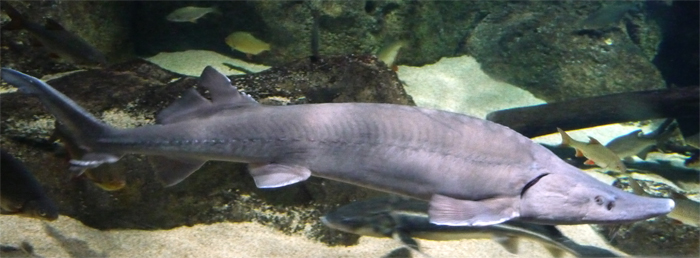 🇷🇺 Russia and 4 moreSiberian sturgeon
Large freshwater sturgeon native to Siberian riversAncient · Rivers and lakes
 🇺🇸 United States and 1 moreLake sturgeon
A large, long-lived freshwater fish native to North America.Ancient · Rivers and lakes
 🇺🇸 United States and 1 moreGreen sturgeon
A large anadromous fish native to the northern Pacific Ocean.Shark · Coasts and shelves
 🇷🇺 RussiaSterlet
A small Eurasian sturgeon found in rivers flowing to the Black, Azov, and Caspian seas.Ancient · Rivers and lakes · 1758