
Lake sturgeon
A large, long-lived freshwater fish native to North America.
The lake sturgeon is a primitive freshwater fish found in the rivers and lakes of central North America. It is one of the largest species in its region and holds significant cultural value for Indigenous peoples. Conservation efforts are ongoing due to historical overfishing and habitat loss.
- One of the largest freshwater fish in North America.
- Can live for over one hundred fifty years.
- Spawns only every three to nine years.
- Critical to Native American cultural traditions.
- Classified as Endangered by the IUCN.
What it is
The lake sturgeon is an ancient freshwater fish belonging to the family Acipenseridae. It is one of the largest species in North America, reaching lengths of over two metres and weights exceeding one hundred kilograms. The body features five rows of bony plates called scutes along its sides and back. It has a pointed snout with four sensory barbels near its mouth, which it uses to detect food in the sediment. Its tail fin is asymmetrical, known as heterocercal, with the upper lobe being larger than the lower one. This distinct appearance sets it apart from most other fish in its range.
Where it lives
This species inhabits the water systems of central North America. Its historical range extends from Hudson Bay south through the Laurentian Great Lakes and into the Mississippi River Basin. Populations are found in major rivers such as the St. Lawrence, Detroit, and St. Clair, as well as in Lake Winnebago and Black Lake. They prefer deep waters during juvenile stages but migrate to shallow gravel shoals and rapids for spawning. Glacial lakes from the last ice age historically connected these habitats.
How it lives
Lake sturgeon are opportunistic feeders that rely on sensory receptors to find prey within the riverbed substrate. Their diet consists mainly of benthic macroinvertebrates like mayflies, stoneflies, and chironomids. They also consume small fish, mussels, and crustaceans when available. These fish are highly migratory, traveling long distances to find food or suitable environmental conditions. As larvae, they hide among rocks and drift downstream at night to avoid predators. Adults have very few natural predators due to their size and hardy scales.
Breeding and life cycle
Reproduction is slow and intermittent. Males reach maturity between fifteen and twenty years, while females take twenty to twenty-five years. Spawning occurs every three to nine years, typically between April and June when water temperatures are between thirteen and eighteen degrees Celsius. Fish migrate to clean gravel shoals to spawn. Females release thousands of eggs per pound of body weight. Only a small percentage of adults breed in any given season, and they remain polygamous to maximize genetic diversity.
Fish and people
The lake sturgeon has been a vital resource for Native American communities for millennia, featuring prominently in spirituality, clan systems, and traditional ways of life. Historically, commercial fisheries targeted them for meat and roe, leading to severe population declines. The fish is still valued as a gourmet food source and for specialty products like caviar and isinglass. Today, limited sport fishing is permitted in specific areas under strict regulations. Restoration programs involving hatcheries and habitat protection aim to rebuild stocks.
Status and threats
The species is classified as Endangered by the IUCN. Historical overfishing, particularly in the nineteenth century, caused massive population collapses. Habitat destruction from dams, pollution, and siltation further threatened their survival. Many states list the fish as threatened or endangered. Conservation efforts include harvest restrictions, dam removal, and stocking programs run by tribal nations and government agencies. Some populations in the Great Lakes region have shown signs of recovery due to these collaborative restoration initiatives.


Questions people ask about Lake sturgeon
How long does a lake sturgeon live?
Validated ages show individuals living up to sixty-eight years, but estimates suggest they can reach one hundred fifty years or more. Some statistical models predict lifespans of up to four hundred twenty-seven years for large females.
What do lake sturgeon eat?
They are generalist feeders that primarily consume benthic macroinvertebrates such as mayflies, stoneflies, and chironomids. They also eat small fish, mussels, and other crustaceans found in the river substrate.
Why is the lake sturgeon endangered?
Historical overfishing for meat and roe, combined with habitat loss from dams and pollution, caused severe population declines. Their slow reproductive cycle makes recovery difficult, leading to current endangered status.
Where can you find lake sturgeon?
They are found in North America from Hudson Bay to the Mississippi River Basin. Key habitats include the Great Lakes, St. Lawrence River, Detroit River, and various tributaries and lakes across the United States and Canada.
Good reading and sources
- Lake sturgeon on WikipediaEncyclopedia
- More photos on Wikimedia CommonsPhotos
- Wikidata recordOpen data
The facts on this page come from the Wikipedia article "Lake sturgeon", written by its contributors and used under the CC BY-SA 4.0 licence, and from its Wikidata record (CC0). EveryFish rewrote the text in its own words, with AI assistance, and compares every page with the article to make sure no passage is copied. It may be reused under the same CC BY-SA 4.0 licence with a link back.
It may contain mistakes, and figures change over time. Nothing here is investment or buying advice. If something is wrong, tell us. Last refreshed 2026-11-15.
Like Lake sturgeon
All ancient fish 🇺🇸 United StatesAmerican paddlefish
Ancient freshwater fish with a sensory snout and filter-feeding habits.Ancient · Rivers and lakes · 1792
 🇧🇷 Brazil and 1 moreArapaima
Large freshwater fish from the Amazon basin known for its size and air-breathing ability.Ancient · Rivers and lakes
 WorldLamprey
Jawless fish with a sucking mouth found in temperate waters worldwide.Ancient · Rivers and lakes
 🇸🇳 Senegal and 3 moreWest African lungfish
Air-breathing freshwater fish from AfricaAncient · Rivers and lakes
More from Acipenseridae
All of them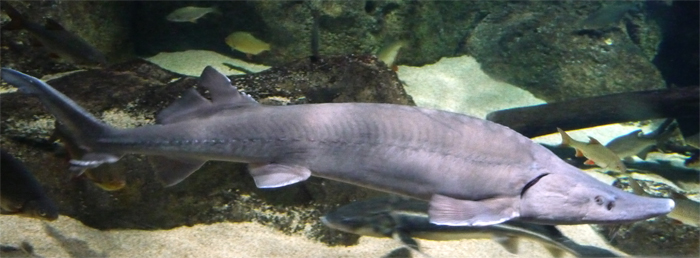 🇷🇺 Russia and 4 moreSiberian sturgeon
Large freshwater sturgeon native to Siberian riversAncient · Rivers and lakes
 🇺🇸 United States and 1 moreAtlantic sturgeon
A large anadromous fish native to the western Atlantic Ocean and its river systems.Ancient · Rivers and lakes
 🇺🇸 United States and 1 moreGreen sturgeon
A large anadromous fish native to the northern Pacific Ocean.Shark · Coasts and shelves
 🇷🇺 RussiaSterlet
A small Eurasian sturgeon found in rivers flowing to the Black, Azov, and Caspian seas.Ancient · Rivers and lakes · 1758