
American paddlefish
Ancient freshwater fish with a sensory snout and filter-feeding habits.
The American paddlefish is the sole surviving member of its family, distinguished by a long rostrum used to detect zooplankton. It inhabits major North American river systems but faces threats from habitat loss and historical overfishing.
- Sole surviving species of the Polyodontidae family.
- Rostrum contains tens of thousands of electroreceptors.
- Lives over 30 years, with some reaching 60 years.
- Feeds by filtering zooplankton from water columns.
- Spawns only when specific temperature and flow conditions align.
What it is
This ancient ray-finned fish possesses a smooth body supported largely by cartilage rather than bone. Its most striking feature is a paddle-shaped rostrum extending nearly one-third of its total length. The tail fin resembles that of a shark, being deeply forked and heterocercal. Adults typically reach lengths around 1.5 metres and weigh approximately 27 kilograms, though they can grow significantly larger. Their skin is dull, often displaying mottled grey or black tones on top with a lighter underside. Small eyes sit on the sides of their head, while large mouth openings facilitate their unique feeding style.
Where it lives
Native to the Mississippi River basin, this species also occupies adjacent Gulf Coast drainages. Historically, its range extended into the Great Lakes, including Lake Huron and Lake Erie, until populations disappeared there around 1917. Today, it persists across twenty-two U.S. states, primarily within the Mississippi and Missouri River tributaries and the Mobile Bay drainage. Populations have vanished from peripheral areas like New York, Maryland, Virginia, and Pennsylvania, though reintroduction efforts exist in western Pennsylvania rivers.
How it lives
These fish are slow-moving filter feeders that rely on electroreception rather than sight to locate prey. Tens of thousands of sensory receptors on their rostrum detect weak electrical fields generated by swimming zooplankton. When a swarm is found, the fish swims forward with its mouth open, filtering water through comb-like gill rakers. They inhabit deep, low-current zones such as side channels, oxbow lakes, and backwaters. Despite poor vision, they navigate effectively using these sensors. Juveniles hunt individual plankton before adopting adult filter-feeding techniques.
Breeding and life cycle
Spawning occurs in early spring when water temperatures rise between 13 and 16 degrees Celsius and river flows increase due to snowmelt or rain. Fish migrate upstream to lay eggs on clean gravel bars. Females mature late, often waiting seven to ten years before their first spawn, and reproduce only every two or three years. Males begin breeding earlier and more frequently. Eggs are released into the water and stick to the substrate. Larvae hatch after about a week and drift downstream to feed on plankton, growing rapidly during their first year to avoid predators.
Fish and people
Historically hunted for meat and highly prized caviar, the species suffered severe declines due to commercial fishing pressure. Poaching remains a concern where demand for roe persists. It is also targeted by sport fishermen, particularly during snagging seasons. Conservation laws at state, federal, and international levels now protect the species. Reintroduction programmes have been attempted in specific river systems to restore lost populations. Research into their electroreception and longevity continues to provide scientific insights.
Status and threats
Populations have dropped dramatically due to overfishing, pollution, and habitat destruction. Dams and altered river flows disrupt the specific environmental conditions required for successful spawning. While protected by various laws, the species is considered Near Threatened. Natural occurrences have been eliminated from much of its former peripheral range. Current conservation efforts focus on habitat preservation and regulated fishing practices to prevent further decline and support recovery in remaining strongholds.


Questions people ask about American paddlefish
How does the American paddlefish find food?
It uses electroreception. Thousands of sensory receptors on its long snout detect weak electrical fields produced by swimming zooplankton, allowing it to filter-feed without relying on sight.
Is the American paddlefish related to sharks?
No. Although it has a similar forked tail fin, it is a ray-finned fish. Its closest relatives are sturgeons, and both belong to the ancient order Acipenseriformes.
Why do paddlefish populations decline?
Declines result from overfishing for caviar and meat, habitat destruction from dams, pollution, and altered river flows that prevent successful spawning on gravel bars.
How long do American paddlefish live?
They are long-lived, often exceeding thirty years. Dentary studies suggest some individuals may live up to sixty years, with females generally living longer than males.
Good reading and sources
- American paddlefish on WikipediaEncyclopedia
- More photos on Wikimedia CommonsPhotos
- Wikidata recordOpen data
The facts on this page come from the Wikipedia article "American paddlefish", written by its contributors and used under the CC BY-SA 4.0 licence, and from its Wikidata record (CC0). EveryFish rewrote the text in its own words, with AI assistance, and compares every page with the article to make sure no passage is copied. It may be reused under the same CC BY-SA 4.0 licence with a link back.
It may contain mistakes, and figures change over time. Nothing here is investment or buying advice. If something is wrong, tell us. Last refreshed 2026-11-15.
Like American paddlefish
All ancient fish 🇺🇸 United StatesShovelnose sturgeon
Smallest North American freshwater sturgeon, known for its shovel-shaped snout and caviar production.Ancient · Rivers and lakes · 1820
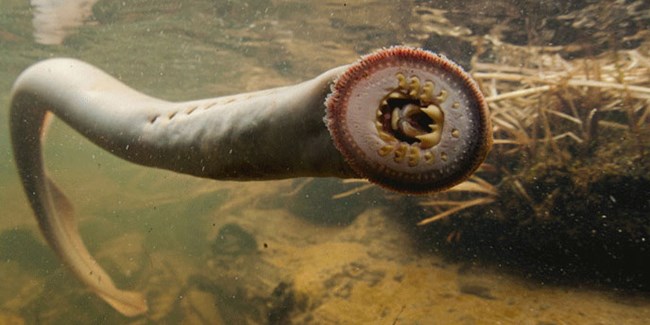
 🇺🇸 United States and 4 moreSea lamprey
A jawless, parasitic fish native to the Northern Hemisphere that attacks other fish.Ancient · Rivers and lakes · 1758
 🇺🇸 United States and 1 morePacific lamprey
An anadromous parasitic jawless fish found along the Pacific Rim.Ancient · Rivers and lakes · 1872
 🇺🇸 United States and 1 moreLake sturgeon
A large, long-lived freshwater fish native to North America.Ancient · Rivers and lakes
