
Shovelnose sturgeon
Smallest North American freshwater sturgeon, known for its shovel-shaped snout and caviar production.
The shovelnose sturgeon is a small freshwater fish native to major river systems in the United States. It was historically harvested for food and roe but faces conservation challenges due to its similarity to endangered relatives.
- Smallest freshwater sturgeon in North America
- Harvested for hackleback caviar and smoked meat
- Listed as threatened under U.S. Endangered Species Act
- Reaches sexual maturity at eight to ten years old
- Inhabits swift-flowing sections of Missouri and Mississippi Rivers
What it is
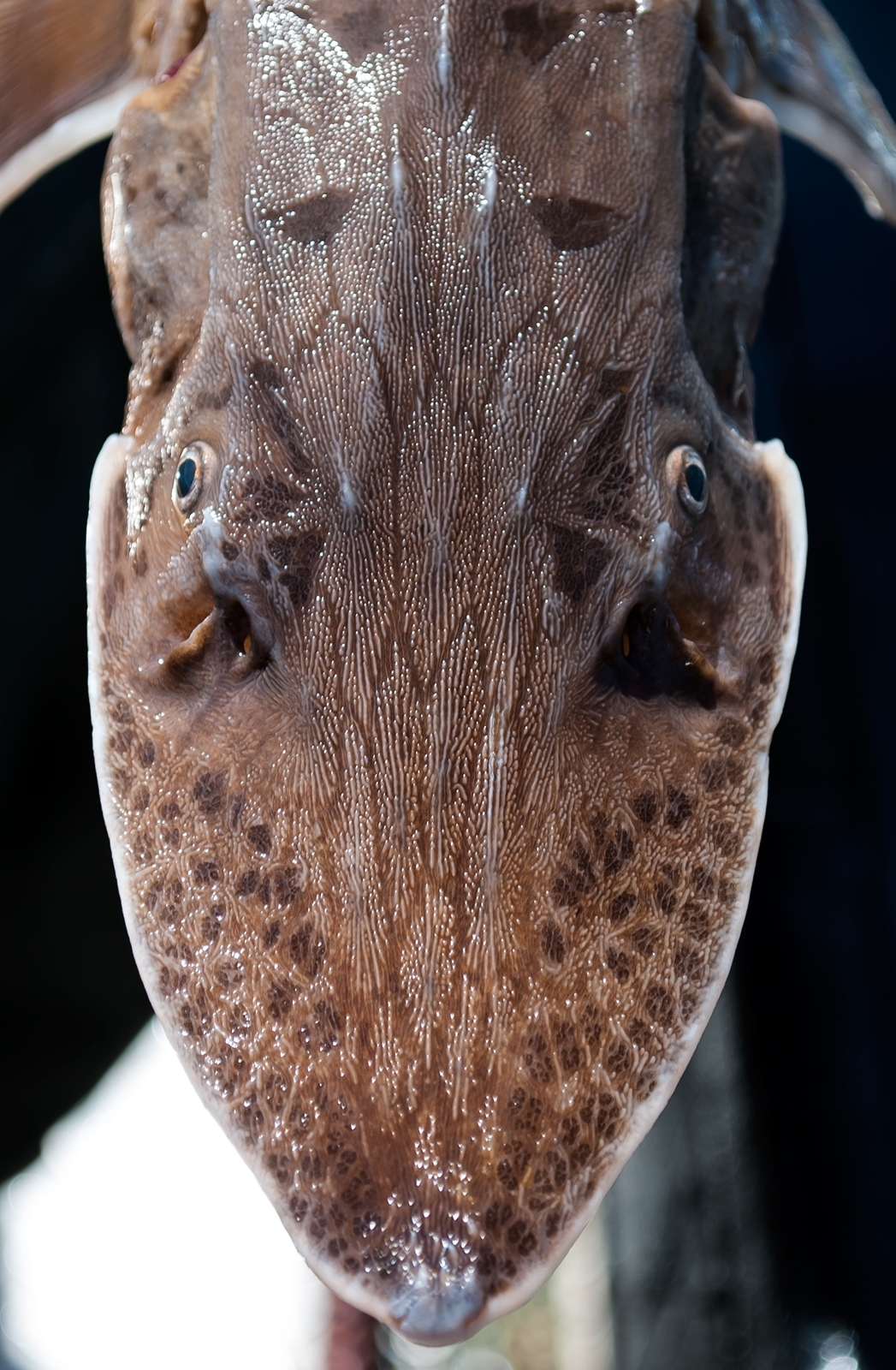
The shovelnose sturgeon is a distinct species of ancient fish found in North American rivers. It possesses a flattened, shovel-like snout and four fringed barbels on its underside used for sensing food. The body features bony scutes along the back and sides, with a belly covered in scale-like plates. Adults typically display light-brown to buff coloring with a white underbelly. A key identifier is a long filament on the upper lobe of the tail fin, which often breaks off as the fish matures. This species represents the smallest sturgeon native to the continent, distinguishing it from larger marine relatives.
Where it lives
This fish inhabits the main channels of the Missouri and Mississippi River systems. It thrives in areas with high sediment loads and swift currents, preferring sandy or gravel riverbeds. Unlike many restricted-range species, shovelnose sturgeon travel long distances within these large waterways. They are not significantly affected by water turbidity. Their distribution is sympatric with the endangered pallid sturgeon, leading to identification challenges. Historically, they were abundant in these specific river networks across the United States.
How it lives
Shovelnose sturgeon feed on the river bottom using a protrusible mouth to suck up prey. Their diet consists mainly of aquatic insect larvae, including mayflies, true flies, and caddisflies. They also consume crustaceans, worms, and small fish. As bottom feeders, they serve as hosts for freshwater mussel larvae. Growth is relatively slow, reaching about 54 cm in five years. They do not have a fixed home range and migrate between feeding and breeding grounds.
Breeding and life cycle
Spawning occurs over gravel in fairly swift water during migration periods. Females do not spawn annually, and the exact timing is not clearly defined. Eggs hatch within three to five days after fertilization. The resulting larvae are approximately one centimetre long and drift downstream to rearing areas. Sexual maturity is reached late, requiring eight to ten years before spawning can occur. This delayed reproduction rate contributes to population vulnerability and slow recovery from declines.
Fish and people
Historically, this species was commercially fished for its flesh and roe. The roe was marketed as hackleback caviar, gaining importance when Old World sources declined. Smoked sturgeon flesh is considered a delicacy. Poaching remains a concern due to the long maturation period required for spawning. There is some interest in keeping them as aquarium specimens. Conservation efforts include listing under the U.S. Endangered Species Act in 2010, partly due to confusion with the endangered pallid sturgeon.
Status and threats
The shovelnose sturgeon is listed as threatened under the U.S. Endangered Species Act since 2010. This status arises largely because it resembles the endangered pallid sturgeon, complicating management. Overfishing for caviar and meat has impacted populations. Poaching persists despite regulations. The species requires eight to ten years to mature, making it susceptible to harvest pressure. Conservation measures aim to protect these riverine habitats and manage fishing activities to ensure population stability.



Questions people ask about Shovelnose sturgeon
What distinguishes the shovelnose sturgeon from the pallid sturgeon?
The shovelnose sturgeon has a belly covered with scale-like plates and four fringed barbels arranged in a straight line. In contrast, the pallid sturgeon has primarily scaleless bellies and different barbel placement. These physical differences help separate the two sympatric species.
Why is the shovelnose sturgeon listed as threatened?
It was listed as threatened in 2010 under the U.S. Endangered Species Act. This status results partly from its close resemblance to the endangered pallid sturgeon, which complicates conservation management and enforcement efforts in shared river habitats.
What is hackleback caviar?
Hackleback caviar refers to the roe of the shovelnose sturgeon. It became commercially important when traditional Caspian and Black Sea sturgeon sources declined. The flesh is also widely consumed, particularly when smoked.
How fast does the shovelnose sturgeon grow?
Growth is relatively slow. Research indicates they reach approximately 54 cm in length after five years. They require eight to ten years to reach sexual maturity, which impacts their ability to recover from population declines.
Good reading and sources
- Shovelnose sturgeon on WikipediaEncyclopedia
- More photos on Wikimedia CommonsPhotos
- Wikidata recordOpen data
The facts on this page come from the Wikipedia article "Shovelnose sturgeon", written by its contributors and used under the CC BY-SA 4.0 licence, and from its Wikidata record (CC0). EveryFish rewrote the text in its own words, with AI assistance, and compares every page with the article to make sure no passage is copied. It may be reused under the same CC BY-SA 4.0 licence with a link back.
It may contain mistakes, and figures change over time. Nothing here is investment or buying advice. If something is wrong, tell us. Last refreshed 2026-11-15.
Like Shovelnose sturgeon
All ancient fish 🇧🇷 Brazil and 1 moreArapaima
Large freshwater fish from the Amazon basin known for its size and air-breathing ability.Ancient · Rivers and lakes
 🇺🇸 United StatesAmerican paddlefish
Ancient freshwater fish with a sensory snout and filter-feeding habits.Ancient · Rivers and lakes · 1792
 🇷🇺 RussiaSterlet
A small Eurasian sturgeon found in rivers flowing to the Black, Azov, and Caspian seas.Ancient · Rivers and lakes · 1758
 🇧🇯 Benin and 4 moreSaddled bichir
A large African freshwater fish with primitive lungs and multiple dorsal finlets.Ancient · Rivers and lakes · 1845
More from Acipenseridae
All of them 🇺🇸 United States and 1 moreShortnose sturgeon
A small, endangered North American sturgeon with a short snout.Ancient · Rivers and lakes · 1818
 🇷🇺 Russia and 2 moreKaluga
A massive semi-anadromous sturgeon from the Amur River basin hunted for caviar.Ancient · Rivers and lakes · 1872
 🇺🇸 United StatesPallid sturgeon
An endangered North American sturgeon species native to the Missouri and Mississippi river basins.Ancient · Rivers and lakes · 1905
 🇺🇸 United States and 1 moreAtlantic sturgeon
A large anadromous fish native to the western Atlantic Ocean and its river systems.Ancient · Rivers and lakes