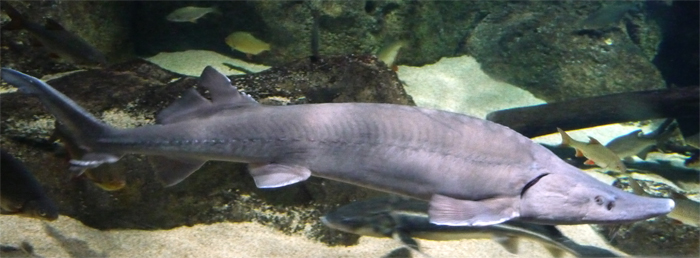
Siberian sturgeon
Large freshwater sturgeon native to Siberian rivers
The Siberian sturgeon is a long-lived fish found in major Siberian river basins. It faces wild population declines from dams and pollution but is widely farmed for meat and caviar, particularly in France, Russia and China.
- Can weigh up to 210 kg and live for 60 years
- Females do not reach sexual maturity until 20 to 28 years
- France is the leading producer of Siberian sturgeon caviar
- Dams have blocked 40% of natural spawning habitats
- Escaped specimens found in tropical Mekong River
What it is
This large sturgeon belongs to the family Acipenseridae. It typically weighs around 65 kg, though specimens can reach 210 kg. The body shape is typical of sturgeons, adapted for bottom feeding. Recent taxonomic changes place it in the genus Huso rather than Acipenser. It is a long-lived species that takes decades to reach sexual maturity. Males mature between 11 and 24 years, while females take 20 to 28 years. This slow growth makes the species vulnerable to overfishing and environmental changes.
Where it lives
The fish inhabits major Siberian river basins that flow north into the Kara, Laptev and East Siberian Seas. Key rivers include the Ob, Yenisei, Lena and Kolyma. The Yenisei system connects to Lake Baikal via the Angara River. It was historically present in the Irtysh River in Kazakhstan and China, but wild populations in China are now extirpated. Populations show genetic connectivity across this vast range, suggesting they form a single continuous group rather than distinct subspecies.
How it lives
It feeds on benthic organisms living on the river bed, such as crustaceans and chironomid larvae. Some populations migrate thousands of kilometres upstream to spawn, while others remain sedentary. The Ob River population moves to the river mouth in winter to avoid low oxygen levels. Pollution in certain areas has negatively affected reproductive development. Damming has blocked access to up to 40 per cent of its spawning habitat, contributing to a steep decline in wild numbers.
Breeding and life cycle
Spawning occurs in main river channels with strong currents and stone or gravel bottoms. The late age of sexual maturity means recovery from population loss is slow. The Baikal population migrates up the Selenga River to reproduce. Eastern Siberian populations display both migratory and sedentary life histories. The Lena population matures relatively early compared to others, which has made it the preferred broodstock for aquaculture programmes aiming to produce caviar and meat.
Fish and people
Wild catches have declined, but farming has increased significantly. France is the main producer of caviar from this species, while Russia and China lead in meat production. In Thailand, it is bred in high mountain areas under the Royal Project initiative. Escaped farm fish have been found in the Mekong River, raising concerns about invasive potential in tropical waters. Local fishermen in Chiang Rai have captured several individuals, though their survival in such warm climates remains unclear.
Status and threats
Wild populations are in steep decline due to habitat loss, degradation and poaching. Dams have rendered much of the spawning habitat inaccessible. Pollution impacts gonad development and reproductive success. While not currently listed with a specific conservation status in the provided data, the combination of late maturity and habitat fragmentation poses significant threats. Aquaculture provides an alternative source for commercial products, potentially reducing pressure on wild stocks.


Questions people ask about Siberian sturgeon
Where does the Siberian sturgeon live?
It lives in major Siberian river basins draining into the Kara, Laptev and East Siberian Seas, including the Ob, Yenisei, Lena and Kolyma Rivers. It is also found in Lake Baikal.
Why is it farmed so widely?
It is farmed for its meat and roe, which is processed into caviar. The Lena population matures relatively early, making it ideal for captive breeding programmes in countries like France, Russia and China.
Is it endangered in the wild?
Wild populations are in steep decline due to damming, pollution and poaching. Up to 40% of spawning habitat is inaccessible, and pollution affects reproductive health, though specific conservation status is not provided here.
Good reading and sources
- Siberian sturgeon on WikipediaEncyclopedia
- More photos on Wikimedia CommonsPhotos
- Wikidata recordOpen data
The facts on this page come from the Wikipedia article "Siberian sturgeon", written by its contributors and used under the CC BY-SA 4.0 licence, and from its Wikidata record (CC0). EveryFish rewrote the text in its own words, with AI assistance, and compares every page with the article to make sure no passage is copied. It may be reused under the same CC BY-SA 4.0 licence with a link back.
It may contain mistakes, and figures change over time. Nothing here is investment or buying advice. If something is wrong, tell us. Last refreshed 2026-11-15.
Like Siberian sturgeon
All ancient fish WorldLamprey
Jawless fish with a sucking mouth found in temperate waters worldwide.Ancient · Rivers and lakes
 🇧🇷 Brazil and 1 moreArapaima
Large freshwater fish from the Amazon basin known for its size and air-breathing ability.Ancient · Rivers and lakes
 🇺🇸 United States and 1 moreAtlantic sturgeon
A large anadromous fish native to the western Atlantic Ocean and its river systems.Ancient · Rivers and lakes
 🇦🇴 Angola and 3 moreMarbled lungfish
African lungfish with the largest known animal genome, found in East and Central Africa.Ancient · Rivers and lakes
More from Acipenseridae
All of them 🇺🇸 United States and 1 moreGreen sturgeon
A large anadromous fish native to the northern Pacific Ocean.Shark · Coasts and shelves
 🇺🇸 United States and 1 moreLake sturgeon
A large, long-lived freshwater fish native to North America.Ancient · Rivers and lakes
 🇷🇺 RussiaSterlet
A small Eurasian sturgeon found in rivers flowing to the Black, Azov, and Caspian seas.Ancient · Rivers and lakes · 1758
 🇺🇸 United States and 1 moreShortnose sturgeon
A small, endangered North American sturgeon with a short snout.Ancient · Rivers and lakes · 1818