
Green sturgeon
A large anadromous fish native to the northern Pacific Ocean.
The green sturgeon is a cartilaginous fish found from Alaska to Baja California. It was moved to the genus Sinosturio in 2025 based on genetic data. The southern population faces threats and has protected status.
- Maximum recorded length is 210 centimetres.
- Moved to genus Sinosturio in 2025.
- Southern population listed as threatened in 2006.
- Uses electroreceptors to find prey.
- Spawns in deep fast water over cobble.
What it is
This ancient ray-finned fish belongs to the infraclass Chondrostei. It possesses a skeleton made of cartilage rather than bone. Large bony plates called scutes cover its body instead of scales. A heterocercal tail and a spiracle are ancestral features retained by this species. Adults reach lengths of 210 centimetres and weights of 160 kilograms. They resemble white sturgeon but have sharper scutes and barbels positioned closer to the mouth.
Where it lives
Native populations inhabit the northern Pacific Ocean. The geographic range extends from eastern Kamchatka through the Bering Sea and Alaska. Populations also exist along the Pacific coasts of the United States and Canada. The southern limit reaches northern Baja California. Two distinct population segments exist within North America, separated geographically.
How it lives
These fish are benthic feeders that detect prey using sensitive barbels on their snouts. They use flexible lips to suction food from the river bottom. Diet includes crustaceans, clams, amphipods, and worms. Adults rely heavily on marine food sources compared to related species. They possess electroreceptors and mechanoreceptors to sense electric fields and water movement. This sensory system aids in foraging and navigation in dark or murky environments.
Breeding and life cycle
Green sturgeon are anadromous, entering freshwater rivers primarily to spawn. Females produce between 59,000 and 242,000 eggs per cycle. Spawning occurs in deep, fast-moving water over large cobble substrates. Eggs are broadcast and fertilized externally. Larvae remain under rocks initially rather than drifting downstream. Juveniles grow rapidly, reaching significant sizes within two to three years.
Fish and people
Commercial fishing value is low for this species. Sport fishing occurs in specific regions where populations are abundant. Conservation efforts focus on protecting critical spawning habitats in rivers like the Klamath and Sacramento. The southern population receives legal protection due to habitat reduction and declining juvenile numbers. Research continues to understand their life history and thermal tolerance limits.
Status and threats
The southern distinct population segment is listed as threatened under the US Endangered Species Act. Critical habitat was designated in 2009 to protect spawning and rearing areas. Threats include reduced spawning habitat and high mortality rates. The northern population is classified as a species of concern by federal agencies. Recovery plans aim to improve habitat quality and reduce human-caused mortality.
Questions people ask about Green sturgeon
What is the scientific name of the green sturgeon?
The current scientific name is Sinosturio medirostris. It was previously classified under the genus Acipenser until genetic analysis prompted a reclassification in 2025.
Where does the green sturgeon live?
It inhabits the northern Pacific Ocean. Range extends from Kamchatka to Baja California. It enters rivers in the United States and Canada to spawn.
Is the green sturgeon endangered?
The southern population is listed as threatened under the US Endangered Species Act. The northern population is considered a species of concern. Habitat loss and low recruitment drive these classifications.
What do green sturgeons eat?
They feed on bottom-dwelling organisms. Diet includes clams, shrimp, amphipods, and worms. Adults rely more on marine prey than juveniles.
Good reading and sources
- Green sturgeon on WikipediaEncyclopedia
- More photos on Wikimedia CommonsPhotos
- Wikidata recordOpen data
The facts on this page come from the Wikipedia article "Green sturgeon", written by its contributors and used under the CC BY-SA 4.0 licence, and from its Wikidata record (CC0). EveryFish rewrote the text in its own words, with AI assistance, and compares every page with the article to make sure no passage is copied. It may be reused under the same CC BY-SA 4.0 licence with a link back.
It may contain mistakes, and figures change over time. Nothing here is investment or buying advice. If something is wrong, tell us. Last refreshed 2026-11-15.
Like Green sturgeon
All sharks WorldGreat white shark
A large, globally distributed predator known for its size and apex status in marine ecosystems.Shark · Coasts and shelves · 1758
 WorldBasking shark
The second-largest living fish, a slow-moving filter feeder found in temperate oceans worldwide.Shark · Coasts and shelves · 1765
 🇿🇦 South Africa and 4 moreWhale shark
The largest living fish species, a gentle giant of tropical oceans.Shark · Open ocean · 1829
 🇺🇸 United StatesCladoselache
Extinct Late Devonian shark-like fish known for well-preserved fossils and streamlined body.Shark · Coasts and shelves
More from Acipenseridae
All of them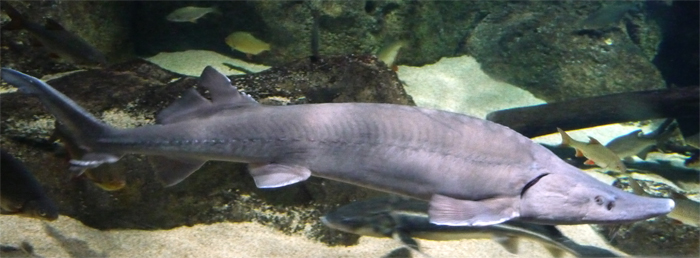 🇷🇺 Russia and 4 moreSiberian sturgeon
Large freshwater sturgeon native to Siberian riversAncient · Rivers and lakes
 🇺🇸 United States and 1 moreLake sturgeon
A large, long-lived freshwater fish native to North America.Ancient · Rivers and lakes
 🇺🇸 United States and 1 moreAtlantic sturgeon
A large anadromous fish native to the western Atlantic Ocean and its river systems.Ancient · Rivers and lakes
 🇷🇺 RussiaSterlet
A small Eurasian sturgeon found in rivers flowing to the Black, Azov, and Caspian seas.Ancient · Rivers and lakes · 1758