
Whale shark
The largest living fish species, a gentle giant of tropical oceans.
The whale shark is a massive filter-feeding shark found in warm seas worldwide. It holds the record for the largest known extant fish, reaching lengths over eighteen metres.
- Largest known extant fish species, reaching 18.8 m.
- Filter feeder consuming plankton and small fish.
- Listed as Endangered due to population decline.
- Unique spot patterns identify individual sharks.
- Can dive deeper than 1,900 metres.
What it is
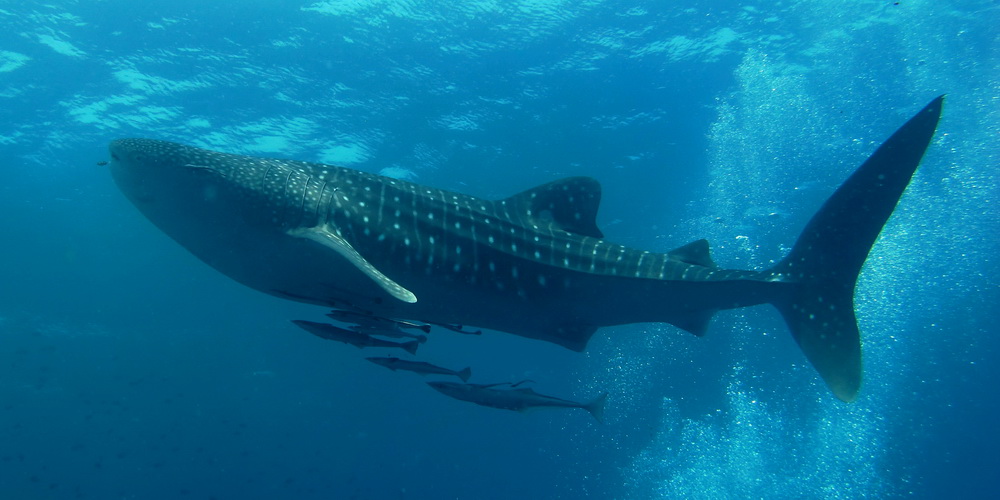
This enormous shark is the biggest fish alive today. Its body is dark grey on top with a white belly covered in unique pale spots and stripes. The head is broad and flat, featuring a huge mouth at the front rather than underneath. Inside, it has over three hundred rows of tiny teeth and twenty filter pads. These structures help strain food from the water. The skin is thick, hard, and rough. Three ridges run along its sides. Two dorsal fins sit far back on the body. The tail has a larger upper lobe. Despite its size, it is not aggressive toward humans.
Where it lives
These sharks roam all tropical and warm-temperate seas. They typically stay between thirty degrees north and thirty-five degrees south latitude. They avoid waters colder than twenty-one degrees Celsius. Tracking shows they move thousands of kilometres to find food. Major groups live in the Indo-Pacific region. Another group lives in the Atlantic Ocean. They visit specific coastal areas like Ningaloo Reef in Australia and the Yucatan Peninsula in Mexico. Some have been seen near Canada and Japan. Deep dives below five hundred metres are common during their travels.
How it lives
They feed by filtering plankton, krill, and small schooling fish like sardines. A single shark can process six thousand litres of water each hour. This active feeding strategy supports their massive size. They are highly migratory, following seasonal food sources. Aggregations form at predictable coastal sites. They exhibit vertical movement patterns, swimming near the surface before diving deep. Their eyes have special pigments adapted for blue light in deep water. In shallow, bright water, they deactivate this pigment to see clearly. They can recover from injuries and regenerate small fin sections.
Breeding and life cycle
Reproduction details remain poorly understood. Mating has been filmed off Ningaloo Reef and St Helena. Pups have never been observed being born in the wild. Growth studies suggest late sexual maturity, occurring around twenty-five years of age. Males grow faster initially but reach a smaller maximum size than females. Females may mature at similar or larger sizes. Vertebral growth bands indicate annual layer formation. This method helps estimate age, showing individuals can live up to one hundred and thirty years.
Fish and people
Ecotourism drives interest in these gentle giants. Divers swim alongside them at aggregation sites. However, tourism levels have grown unsustainable in some areas. Historically, they were targeted for fishing. Bycatch in other fisheries poses a significant threat. Collisions with large ships also cause mortality. Conservation efforts aim to protect their habitats. Cultural significance varies across regions where they appear. Research programmes study their migration and genetics. The complete genome was published in two thousand seventeen.
Status and threats
The International Union for Conservation of Nature lists this species as Endangered. Populations have declined by more than fifty percent over the last seventy-five years. Primary threats include targeted fishing and accidental bycatch. Ship strikes add to the mortality rate. Habitat degradation affects feeding grounds. Protection measures are critical for recovery. Scientific monitoring tracks population trends. Public awareness campaigns highlight conservation needs. Sustainable tourism practices are encouraged to reduce stress on aggregations.


Questions people ask about Whale shark
How big does a whale shark get?
The largest reliably recorded individual measured 18.8 metres. Estimates suggest asymptotic lengths range from fifteen to twenty-two metres. Females generally grow larger than males.
What do whale sharks eat?
They are filter feeders. Their diet consists mainly of plankton, krill, fish eggs, and small schooling fish like sardines and anchovies.
Are whale sharks dangerous to humans?
No. Despite their immense size, they are docile and pose no significant threat to humans. They are gentle giants of the ocean.
Where can I see whale sharks?
They inhabit tropical oceans worldwide. Key aggregation sites include Ningaloo Reef in Australia, the Yucatan Peninsula in Mexico, and coasts of India.
How long do whale sharks live?
Studies estimate their lifespan between eighty and one hundred and thirty years. Growth bands in vertebrae help determine their age.
Good reading and sources
- BBC NEWS | Science & Environment | Shark-cam captures ocean motionBBC, Article
- Drive to conserve whale sharkThe Hindu, Article
The facts on this page come from the Wikipedia article "Whale shark", written by its contributors and used under the CC BY-SA 4.0 licence, and from its Wikidata record (CC0). EveryFish rewrote the text in its own words, with AI assistance, and compares every page with the article to make sure no passage is copied. It may be reused under the same CC BY-SA 4.0 licence with a link back.
It may contain mistakes, and figures change over time. Nothing here is investment or buying advice. If something is wrong, tell us. Last refreshed 2026-11-15.
Like Whale shark
All sharks WorldGreat white shark
A large, globally distributed predator known for its size and apex status in marine ecosystems.Shark · Coasts and shelves · 1758
 WorldBasking shark
The second-largest living fish, a slow-moving filter feeder found in temperate oceans worldwide.Shark · Coasts and shelves · 1765
 WorldMegalodon
Extinct giant mackerel shark from the Miocene to Pliocene epochs.Shark · Coasts and shelves · 1843
 WorldChaunax
A genus of deep-sea anglerfishes known for their large mouths and luring habits.Shark · Deep sea · 1846