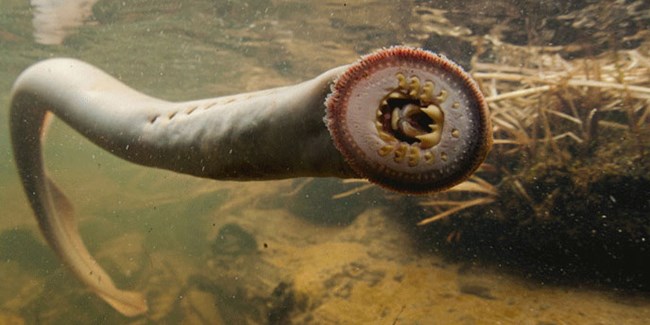
Lamprey
Jawless fish with a sucking mouth found in temperate waters worldwide.
Lampreys are ancient jawless vertebrates known for their circular, toothed mouths. They live in coastal and freshwater habitats across temperate regions, playing roles as parasites or filter feeders depending on the species.
- Jawless vertebrates with circular, toothed sucking mouths
- Larvae filter-feed in sediment for up to eight years
- Adults can reach 1.2 metres in length
- Semelparous: adults die after spawning
- Found in temperate waters across multiple continents
What it is
These jawless vertebrates possess elongated, scaleless bodies that resemble eels but lack paired fins. Adults feature a distinctive funnel-shaped oral disc lined with horny teeth for attachment. Most species display countershading, with dark backs and light bellies for camouflage. The largest species reaches one point two metres. They have seven gill pores on each side of the head and a single nostril on top. Their skeletons consist of cartilage rather than bone.
Where it lives
Species inhabit temperate zones across the globe, including landlocked lakes and open oceans. Larvae avoid tropical waters due to low temperature tolerance. Populations face threats from river pollution, habitat destruction, and dam construction blocking migration routes. In North America, introduced sea lampreys became pests in the Great Lakes. Recovery efforts in Britain show improved water quality allowing return to rivers like the Thames.
How it lives
Juveniles, called ammocoetes, burrow in sediment and filter-feed on organic matter. Adult carnivorous species attach to other fish or marine mammals to consume blood and flesh using rasping tongues. Non-carnivorous adults do not eat, relying on energy stored during larval stages. They are efficient swimmers, generating low-pressure zones to pull themselves forward. Some species exhibit unique photoreceptor structures and high chromosome counts.
Breeding and life cycle
Adults migrate upstream to spawn in nests made of sand and gravel. Females lay thousands of eggs while males fertilize them simultaneously. This process is semelparous, meaning both parents die shortly after reproduction. Males may use heat-producing fat tissues to stimulate females. Larvae drift downstream to settle in silt beds, where they remain for several years before metamorphosing into predatory forms.
Fish and people
Historically valued as food in parts of the United States and Europe. Modern control programs target invasive populations in the Great Lakes due to their impact on native fish stocks. Research into their unique immune systems provides insights into vertebrate evolution. Conservation efforts focus on removing barriers to migration and reducing water pollution to restore natural populations.
Status and threats
Assessment varies by species and region. Many populations decline due to habitat loss, pollution, and obstruction of spawning grounds by dams. Invasive species like the sea lamprey cause ecological damage in new environments. Conservation strategies include habitat restoration and targeted removal programs. Data deficiency exists for some taxa, limiting comprehensive global status evaluations.


Questions people ask about Lamprey
Are lampreys actually eels?
No. Lampreys are jawless fish belonging to the order Petromyzontiformes. Eels are bony fish with jaws. Lampreys lack paired fins and have a cartilaginous skeleton, distinguishing them from true eels despite superficial similarities in body shape.
What do lampreys eat?
Diet depends on life stage and species. Larvae (ammocoetes) are filter feeders, consuming detritus and microorganisms from sediment. Adult carnivorous species attach to other fish or marine mammals, using rasping tongues to consume blood and flesh. Some non-carnivorous adults do not feed at all.
How long do lampreys live?
Lives vary significantly. Larvae may spend one to eight years in the sediment before metamorphosis. After becoming adults, many species live only briefly to spawn. Being semelparous, most adult lampreys die shortly after reproducing, completing their lifecycle within a few years total.
Why are lampreys important scientifically?
They provide key insights into vertebrate evolution and immunity. Their unique adaptive immune system uses different receptors than jawed vertebrates. Studying their genetics and physiology helps scientists understand the development of complex biological systems and the transition from jawless to jawed ancestors.
Good reading and sources
- Mixture of new sulfated steroids functions as a migratory pheromone in the sea lampreyNature, Article
- Lamprey pie is fit for the QueenBBC, Article
The facts on this page come from the Wikipedia article "Lamprey", written by its contributors and used under the CC BY-SA 4.0 licence, and from its Wikidata record (CC0). EveryFish rewrote the text in its own words, with AI assistance, and compares every page with the article to make sure no passage is copied. It may be reused under the same CC BY-SA 4.0 licence with a link back.
It may contain mistakes, and figures change over time. Nothing here is investment or buying advice. If something is wrong, tell us. Last refreshed 2026-11-15.
Like Lamprey
All ancient fish 🇺🇸 United States and 4 moreSea lamprey
A jawless, parasitic fish native to the Northern Hemisphere that attacks other fish.Ancient · Rivers and lakes · 1758
 🇧🇷 Brazil and 1 moreArapaima
Large freshwater fish from the Amazon basin known for its size and air-breathing ability.Ancient · Rivers and lakes
 🇺🇸 United States and 1 moreAtlantic sturgeon
A large anadromous fish native to the western Atlantic Ocean and its river systems.Ancient · Rivers and lakes
 🇺🇸 United StatesAmerican paddlefish
Ancient freshwater fish with a sensory snout and filter-feeding habits.Ancient · Rivers and lakes · 1792