
Black crappie
A spotted freshwater sunfish native to North America, prized by anglers for its sport and table fare.
The black crappie is a popular freshwater fish found across the United States and Canada. It is a key target for recreational fishing due to its abundance and fighting ability.
- Dorsal fin has seven or eight spines, distinguishing it from white crappie.
- Maximum recorded length is 49 cm with a weight just under 2.7 kg.
- Females produce approximately 40,000 eggs per spawning event.
- Native to eastern North America but introduced across most of the US.
- Feeds on plankton when young, shifting to small fish and insects as adults.
What it is
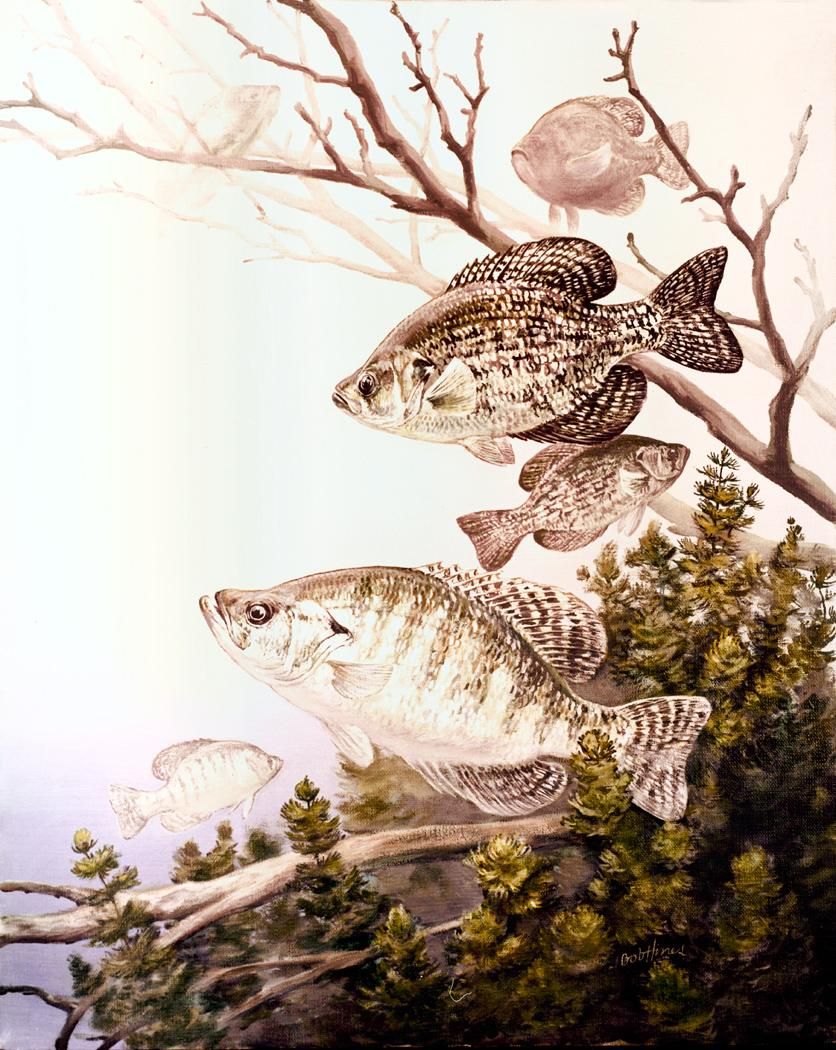
The black crappie is a deep-bodied freshwater fish belonging to the sunfish family. Its body is compressed laterally, meaning it is tall and thin from side to view. The colour ranges from silvery-gray to green, covered in irregular black splotches. A key identifier is the dorsal fin, which holds seven or eight spines, unlike its relative the white crappie. Adults typically measure between ten and twenty centimetres long, though they can reach nearly fifty centimetres. The species name reflects its dark spots, while the genus name references the sharp gill covers.
Where it lives
This fish is native to eastern North America, likely originating in the eastern United States and southern Canada. Human activity has spread it far beyond this origin. By 2005, populations existed in all contiguous US states. Introduced groups also live in Mexico and Panama. The original range remains somewhat unclear because people have moved them so often. They thrive in many different water bodies across these regions.
How it lives
Black crappies feed during low-light periods, such as early morning and late night. Small individuals eat plankton and tiny crustaceans. Larger adults switch to eating small fish like shad, along with insects and larvae. Their diet shifts based on local food availability and competition. They prefer habitats with little current, clear water, and plenty of cover like submerged trees or plants. These structures provide shelter and hunting grounds near sand or mud bottoms.
Breeding and life cycle
Maturity occurs between two and four years of age. Spawning happens in spring and early summer when water temperatures reach fourteen to twenty degrees Celsius. Males prepare nests by sweeping clean patches of sand or mud in shallow water near vegetation. Females lay around forty thousand spherical eggs in these nests. The male guards the eggs until they hatch after two to three days. Young larvae start translucent and stay near the nest before moving to shallower waters.
Fish and people
Anglers highly value this species for sport fishing. Regulations are usually minimal regarding catch limits. Common techniques include using small jigs, minnow rigs, or spider rigging with multiple rods. Dock shooting with arrows is another popular method. The fish is also eaten as food. While prolific and sometimes overpopulating ponds, they remain a staple of recreational fisheries. Commercial suppliers often stock them in small ponds for management purposes.


Questions people ask about Black crappie
How can I tell a black crappie from a white crappie?
Count the spines on the front dorsal fin. Black crappies have seven or eight spines, while white crappies have five or six. Black crappies also tend to be darker with distinct spots rather than vertical bars.
What do black crappies eat?
Young crappies eat plankton and tiny crustaceans. As they grow, they consume more insects, larvae, and small fish like shad. Their specific diet changes based on what is available in their habitat.
Where is the best place to find black crappies?
Look for them in lakes, reservoirs, and slow-moving rivers. They prefer clear water with abundant cover like submerged timber, aquatic vegetation, or structures near shorelines where they can ambush prey.
Is the black crappie endangered?
No, the black crappie is listed as Least Concern by the IUCN. It is widespread and abundant across North America, with stable populations in both native and introduced ranges.
Good reading and sources
- Black crappie on WikipediaEncyclopedia
- More photos on Wikimedia CommonsPhotos
- Wikidata recordOpen data
The facts on this page come from the Wikipedia article "Black crappie", written by its contributors and used under the CC BY-SA 4.0 licence, and from its Wikidata record (CC0). EveryFish rewrote the text in its own words, with AI assistance, and compares every page with the article to make sure no passage is copied. It may be reused under the same CC BY-SA 4.0 licence with a link back.
It may contain mistakes, and figures change over time. Nothing here is investment or buying advice. If something is wrong, tell us. Last refreshed 2026-11-15.
Like Black crappie
All perches, basses and snappers 🇺🇸 United States and 2 moreBluegill
A common North American sunfish known for its blue gill covers and popularity with anglers.Perch-like · Rivers and lakes · 1854
 🇺🇸 United States and 2 morePumpkinseed
A small freshwater fish native to eastern North America, known for its bright colours and red ear flap.Perch-like · Rivers and lakes · 1793
 🇺🇸 United States and 2 moreRock bass
A small, red-eyed freshwater sunfish native to North America.Perch-like · Rivers and lakes
 🇺🇸 United StatesCrappie
Two species of North American freshwater sunfish prized by anglers for sport and food.Perch-like · Rivers and lakes
More from Centrarchidae
All of them 🇺🇸 United States and 4 moreLargemouth bass
A large freshwater predator native to North America, prized by anglers and invasive in many regions.Other · Rivers and lakes · 1802
 🇺🇸 United StatesSpotted bass
A North American freshwater fish known for dark spots below its lateral line.Other · Rivers and lakes
 🇺🇸 United StatesGuadalupe bass
A rare Texas endemic black bass prized by anglers for its fighting spirit.Other · Rivers and lakes
 🇺🇸 United States and 2 moreGreen sunfish
A small, aggressive freshwater fish native to North America, known for its blue-green colour and invasive potential in nPerch-like · Rivers and lakes