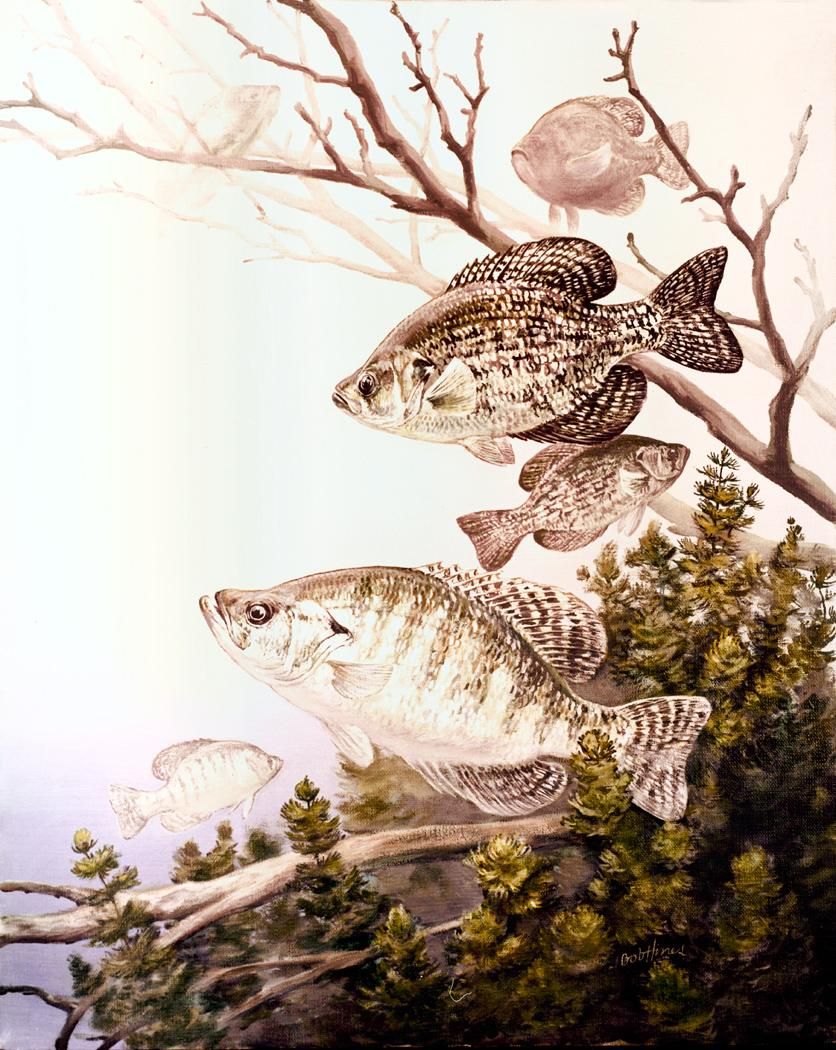
Crappie
Two species of North American freshwater sunfish prized by anglers for sport and food.
Crappies belong to the genus Pomoxis within the sunfish family. They are popular game fish in North America, valued for their taste and the challenge they present to recreational anglers using various techniques.
- Genus name Pomoxis means 'sharp cover' from Greek words for cover and sharp.
- World record black crappie weighs 2.47 kg, caught in Tennessee in 2018.
- Commercial fishery at Reelfoot Lake, Tennessee operated until 2003.
- Spider rigging is a popular but restricted angling method using multiple rods.
- Hybrid crappie show better survival rates when black females mate with white males.
What it is
Crappies are two species of freshwater fish belonging to the genus Pomoxis in the Centrarchidae family, commonly known as sunfishes. The name Pomoxis translates from Greek as 'sharp cover', referring to their spiny gill covers. These fish are highly regarded panfish, often considered among the best-tasting freshwater food fish. Adults typically feed on smaller fish, including young predators like northern pike and walleye, as well as zooplankton and insects. During the day, they remain less active near weed beds or submerged structures, feeding at dawn and dusk.
Where it lives
These fish are found throughout much of North America, with significant populations in the United States and Canada. Historically, commercial harvesting was substantial in Mississippi River states, with annual catches reaching millions of pounds. A notable commercial fishery existed at Reelfoot Lake in Tennessee until 2003. World records for black and white crappie were set in Tennessee and Mississippi respectively, indicating strong presence in these regions.
How it lives
Adult crappies exhibit diverse diets, consuming small fish, zooplankton, insects, and crustaceans. Larval stages rely heavily on crustacean zooplankton, which influences population numbers. Hybrids between black and white crappie occur naturally and through culture, with specific crosses showing better survival rates. These hybrids are fertile but difficult to distinguish from black crappie visually. Predators include northern pike, muskellunge, and walleye.
Breeding and life cycle
Hybrid crappie result from crossing black and white species, with female black and male white crosses yielding superior growth and survival. These hybrids are fertile, though fingerling yields vary in cultured settings. Natural spawning occurs during specific periods, allowing fly fishermen to target them. Winter ice fishing also targets spawning activity in frozen ponds and lakes.
Fish and people
Crappies are popular game fish, attracting recreational anglers worldwide. Fishing methods include spider rigging, casting light jigs, trolling with minnows, and ice fishing. Commercial fishing peaked in the 19th and early 20th centuries, particularly in the US. Conservation efforts include promotional programs by apparel companies to encourage catch-and-release tagging. They are also valued for their culinary reputation as excellent table fare.
Status and threats
Conservation initiatives aim to balance fishing enthusiasm with sustainability. In 2023, Crappie Forever launched a promotion rewarding tagged catch-and-release in Mississippi lakes. Historical overharvesting led to stricter regulations by state fisheries departments. Hybridization presents management challenges due to difficulty in distinguishing species. Ongoing efforts focus on maintaining healthy populations while supporting angler interests.


Questions people ask about Crappie
What does the name crappie mean?
The common name derives from Canadian French crapet, referring to sunfish family members. The genus Pomoxis means 'sharp cover' in Greek, describing their spiny gill covers. Regional names include sacalait in Louisiana and calico bass in New England.
Are crappies good to eat?
Yes, they are highly regarded as panfish and considered among the best-tasting freshwater food fish. Their mild flavour and firm texture make them popular for consumption across North America, often prepared fried or baked.
How do you catch crappies?
Popular methods include spider rigging with multiple rods, casting light jigs, trolling with minnows, and ice fishing. Anglers use plastic jigs, crankbaits, live minnows, or bobbers with hookbaits, often chumming water to attract fish.
Do crappies hybridize?
Yes, black and white crappie can produce fertile hybrids naturally or in culture. Crosses between black females and white males yield better survival and growth rates. These hybrids are difficult to distinguish from pure black crappie visually.
Where are crappies found commercially?
Historical commercial harvesting focused on Mississippi River states, with annual catches reaching three million pounds. Reelfoot Lake in Tennessee hosted one of the last major commercial fisheries, operating until 2003 before conservation regulations tightened.
Good reading and sources
The facts on this page come from the Wikipedia article "Crappie", written by its contributors and used under the CC BY-SA 4.0 licence, and from its Wikidata record (CC0). EveryFish rewrote the text in its own words, with AI assistance, and compares every page with the article to make sure no passage is copied. It may be reused under the same CC BY-SA 4.0 licence with a link back.
It may contain mistakes, and figures change over time. Nothing here is investment or buying advice. If something is wrong, tell us. Last refreshed 2026-11-15.
Like Crappie
All perches, basses and snappers 🇺🇸 United States and 2 moreRock bass
A small, red-eyed freshwater sunfish native to North America.Perch-like · Rivers and lakes
 🇺🇸 United States and 2 morePumpkinseed
A small freshwater fish native to eastern North America, known for its bright colours and red ear flap.Perch-like · Rivers and lakes · 1793
 🇺🇸 United States and 2 moreBluegill
A common North American sunfish known for its blue gill covers and popularity with anglers.Perch-like · Rivers and lakes · 1854
 🇺🇸 United States and 3 moreBlack crappie
A spotted freshwater sunfish native to North America, prized by anglers for its sport and table fare.Perch-like · Rivers and lakes · 1856
More from Centrarchidae
All of them 🇺🇸 United StatesSpotted bass
A North American freshwater fish known for dark spots below its lateral line.Other · Rivers and lakes
 🇺🇸 United StatesGuadalupe bass
A rare Texas endemic black bass prized by anglers for its fighting spirit.Other · Rivers and lakes
 🇺🇸 United States and 2 moreGreen sunfish
A small, aggressive freshwater fish native to North America, known for its blue-green colour and invasive potential in nPerch-like · Rivers and lakes
 🇺🇸 United States and 4 moreLargemouth bass
A large freshwater predator native to North America, prized by anglers and invasive in many regions.Other · Rivers and lakes · 1802