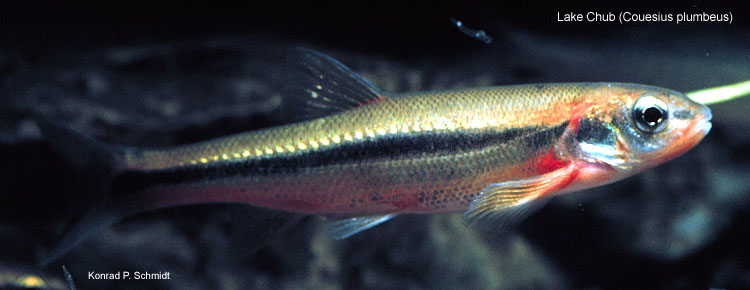
Lake chub
A small cold-water minnow native to Canada and the northern US.
The lake chub is a freshwater fish found across Canada and parts of the northern United States. It holds the record for the most northerly range of any North American minnow. This species lives in cold lakes and streams, feeding on insects and plankton while serving as prey for larger predators.
- Northernmost distribution of any North American minnow
- Only minnow species known to live in Alaska
- Possesses superior hearing capacity among freshwater fishes
- Displays highly precise circadian rhythms in laboratory studies
- Breeding males develop bright orange patches on fins
What it is
This fish has an elongated, spindle-shaped body that typically measures between 100 and 175 millimetres. The largest individuals reach about 225 millimetres. Its back appears olive or dark brown, while the sides shine with a leaden silver colour. Small scales cover the body, sometimes showing isolated dark spots. The snout is blunt and extends slightly past the upper lip, with tiny barbels at the mouth corners. It lacks teeth, spines, and an adipose fin. Breeding males develop bright orange or red patches near their pectoral fins and small bumps on their heads.
Where it lives
The species inhabits waters throughout Canada, extending as far north as the Arctic Circle. In the United States, scattered populations exist in New England, the Midwest, and mountain states such as Montana and Colorado. It is the only minnow known to reside in Alaska. Relict groups survive in the upper Missouri River drainage. These fish prefer cold, clear lakes with gravel bottoms but also inhabit rivers and streams. During hot summer months, they often move from shallow areas to deeper, cooler water.
How it lives
Lake chubs feed on zooplankton, aquatic insect larvae, algae, and occasionally small fish. Large predatory fishes eat them, making them useful as bait. They possess large optic lobes, suggesting strong vision, yet they also feed at night. Studies show they have superior hearing compared to other freshwater species like pike or sculpin. In laboratory settings, they display highly precise daily rhythms. While diurnal in controlled environments, wild individuals may be active during the day, at dusk, or at night.
Breeding and life cycle
Spawning occurs in early summer, triggered by water temperature. Fish migrate from lakes into tributary streams to mate. Males chase females, causing them to swim upward, sometimes breaking the surface. Multiple males may compete alongside a single female. The male positions himself against her until she releases eggs over gravel or rocks. There is no parental care after spawning. Migration and mating often take place during dusk or nighttime hours.
Fish and people
Anglers use this species as bait due to its availability and size. It is not a primary food fish for humans but supports local ecosystems. In Quebec, it is known as mené de lac. Confusion sometimes arises with cisco species in Lake Michigan, which are incorrectly called Michigan Lake chubs. The genus name honours Elliott Coues, who collected the original specimen.
Questions people ask about Lake chub
Where does the lake chub live?
It is found throughout Canada up to the Arctic Circle and in scattered populations across the northern United States. It is the only minnow species known to inhabit Alaska. The fish prefers cold-water lakes with clean gravel but also lives in rivers and streams.
What does the lake chub eat?
Its diet varies and includes zooplankton, insects, aquatic insect larvae, and algae. Larger individuals are capable of capturing small fishes. Because it is eaten by large predatory fishes, it is often used as bait for fishing.
How can you identify a breeding male lake chub?
During the breeding season, males develop patches of bright orange or red at the base of their pectoral fins and sometimes near the mouth. They also grow small nuptial tubercles on the top of the head and on the belly near the pectoral fins.
Good reading and sources
The facts on this page come from the Wikipedia article "Lake chub", written by its contributors and used under the CC BY-SA 4.0 licence, and from its Wikidata record (CC0). EveryFish rewrote the text in its own words, with AI assistance, and compares every page with the article to make sure no passage is copied. It may be reused under the same CC BY-SA 4.0 licence with a link back.
It may contain mistakes, and figures change over time. Nothing here is investment or buying advice. If something is wrong, tell us. Last refreshed 2026-11-15.
Like Lake chub
All carps and minnows 🇮🇳 India and 4 moreRohu
A large silver carp from South Asian rivers, farmed for food and prized as a game fish.Carp · Rivers and lakes
 🇹🇭 Thailand and 2 moreSiamese mud carp
Freshwater cyprinid native to Mekong and Chao Phraya riversCarp · Rivers and lakes
 🇷🇺 RussiaCaspian roach
A brackish water fish from the Caspian Sea region, widely consumed as a dried snack.Carp · Estuaries and mangroves
 🇯🇵 JapanNigorobuna
Wild carp from Lake Biwa used for fermented sushi.Carp · Rivers and lakes
