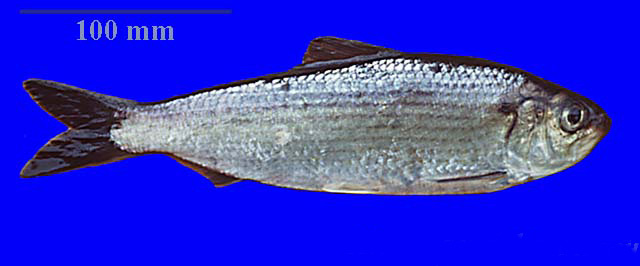
Alewife
A small North American herring that migrates between sea and rivers.
The alewife is a herring species native to the western Atlantic coast of North America. It lives in coastal waters but swims upstream to spawn, though some groups stay in lakes forever. This fish shaped local economies and ecosystems through its abundance and migration patterns.
- Reaches a maximum length of 40 centimetres.
- Colonized the Great Lakes via the Welland Canal.
- Known locally as Gaspereau in Atlantic Canada.
- Used as bait for the Maine lobster fishery.
- Listed as a Species of Concern by US fisheries.
What it is
The alewife is a slender fish belonging to the herring family. Adults measure up to forty centimetres long, with a deep front body section. Their heads appear bronze, while the back shows grey-blue or green tones. A humeral spot often marks the shoulder area. The tongue lacks teeth, and the eye is notably large. Internal features like a light-coloured belly lining help distinguish this species from similar herring types found in the same waters.
Where it lives
This fish inhabits the northern West Atlantic Ocean. It moves into estuaries and swims upstream to breed in freshwater habitats. Some populations live entirely in fresh water without returning to the sea. In the Great Lakes region, they colonized via the Welland Canal. They are abundant in Lake Huron and Lake Michigan, having spread from Lake Erie through the Detroit River.
How it lives
Alewife feed on zooplankton and smaller aquatic creatures. They often form large schools near the surface. Seasonal die-offs occur when populations become too dense, leaving washed-up remains on shorelines. Pacific salmon were introduced to control their numbers in the Great Lakes. These predators eat alewives, creating a sport fishing industry for anglers targeting the larger salmon species.
Breeding and life cycle
Adults migrate upstream during spring to spawn in freshwater areas. Fishermen scoop them from shallow constricted areas using large dip nets. The eggs hatch into young fish that grow within the river or lake environments. Landlocked forms complete their entire life cycle without entering the ocean, relying solely on freshwater spawning grounds.
Fish and people
Humans catch alewives for food and bait. They are commonly smoked and eaten by people. In Maine, they serve as preferred bait for the spring lobster fishery. The name Gaspereau appears in many place names across Nova Scotia and New Brunswick. Local culture remembers the fish through rivers, lakes, and community names derived from Acadian French origins.
Status and threats
Populations have declined due to habitat loss and dam construction blocking migration routes. Overfishing and increased predation from striped bass also threaten them. Several US states have banned taking or possessing these fish. The US National Marine Fisheries Service lists them as a Species of Concern. Habitat restoration projects aim to improve river access and increase numbers.

Questions people ask about Alewife
What is the difference between an alewife and a blueback herring?
The alewife has a light-coloured belly lining and a larger eye relative to its snout. The blueback herring possesses a dark peritoneum and a differently shaped otolith bone. These internal features allow scientists to tell them apart despite their similar external appearance.
How did alewives get into the Great Lakes?
They entered the Great Lakes system by swimming through the Welland Canal. This artificial waterway allowed them to bypass Niagara Falls. Once inside, they spread to Lake Huron and Lake Michigan, becoming extremely abundant in those waters.
Why are alewives important to lobster fishermen?
Fresh alewives are the preferred bait for the spring lobster fishery in Maine. Fishermen catch them during their upstream spawning migration using large dip nets. This provides a reliable food source for trapping lobsters along the coast.
What does the name Gaspereau mean?
Gaspereau comes from the Acadian French word gasparot. It was first recorded by Nicolas Denys in 1672. The name now identifies various rivers, lakes, and communities in Nova Scotia and New Brunswick.
Good reading and sources
- Alewife (fish) on WikipediaEncyclopedia
- More photos on Wikimedia CommonsPhotos
- Wikidata recordOpen data
The facts on this page come from the Wikipedia article "Alewife (fish)", written by its contributors and used under the CC BY-SA 4.0 licence, and from its Wikidata record (CC0). EveryFish rewrote the text in its own words, with AI assistance, and compares every page with the article to make sure no passage is copied. It may be reused under the same CC BY-SA 4.0 licence with a link back.
It may contain mistakes, and figures change over time. Nothing here is investment or buying advice. If something is wrong, tell us. Last refreshed 2026-11-15.
