
Sturgeon
Ancient fish with bony plates and heterocercal tails, known for caviar.
Sturgeons are ancient ray-finned fishes in the family Acipenseridae, native to Eurasia and North America. They are long-lived bottom-feeders whose roe is harvested for caviar, a practice that has driven most species to critical endangerment.
- Fossils date back to the Early Jurassic, 174 to 201 million years ago.
- Largest recorded specimen was a 7.2 metre beluga captured in 1827.
- Body features five lateral rows of bony plates called scutes.
- Heterocercal tail shape resembles that of sharks.
- Roe harvest for caviar caused widespread critical endangerment.
What it is
Sturgeons belong to the family Acipenseridae, comprising twenty-seven living species. These fish possess an elongated, spindle-shaped body covered in smooth skin rather than scales. Their bodies are armored with five longitudinal rows of bony plates known as scutes. A defining feature is the heterocercal caudal fin, which resembles the asymmetrical tail of sharks. They range from two to three point five metres in length, with the largest recorded individual being a female beluga weighing over one and a half tonnes.
Where it lives
These fish inhabit subtropical, temperate, and sub-Arctic regions across Eurasia and North America. They are found in rivers, lakes, and coastal zones. Fossil evidence indicates they once lived in northern Africa during the Cretaceous period. Modern populations occupy diverse environments, from freshwater systems to marine coastal areas and open oceans. Their distribution spans multiple continents, reflecting their wide ecological tolerance throughout history.
How it lives
Most sturgeons are anadromous, meaning they migrate upstream to reproduce while spending most of their lives feeding in river deltas and estuaries. Some species remain exclusively in freshwater, while others stay near coasts or venture into the open ocean. As bottom-feeders, they consume prey from the benthic environment. Their large size and bony armor historically reduced predation risks. They exhibit slow evolution, retaining primitive traits like reduced squamation and unique jaw structures.
Breeding and life cycle
Sturgeons are late-maturing and long-lived, with long generation intervals. They migrate upstream to spawn, often traveling significant distances in river systems. The family produces reproductively viable hybrids even between different genera, complicating taxonomic classification. Spawning occurs in specific freshwater habitats required for egg development. The slow growth rate and delayed sexual maturity make population recovery difficult after disturbances.
Fish and people
The roe of several sturgeon species is processed into luxurious caviar, driving significant commercial harvesting. This demand has led to serious overexploitation, pushing many species toward extinction. Traditional trade in sturgeon influenced language roots across Europe and Asia. Conservation efforts are critical due to the high value of their eggs. Fishing practices and habitat loss have severely impacted wild populations, necessitating international protection measures.
Status and threats
Overexploitation for caviar, combined with habitat threats, has brought most sturgeon species to critically endangered status. One species may be extinct in the wild, while another is considered entirely extinct. The Adriatic sturgeon was presumed extinct but downgraded to critically endangered in twenty twenty-two. Conservation programs aim to protect remaining populations from further decline. Dams, pollution, and fishing pressures continue to threaten their survival in natural waterways.


Questions people ask about Sturgeon
What makes sturgeons look so different from other fish?
They lack typical scales, instead having smooth skin armored with five rows of bony plates called scutes. Their tail fin is heterocercal, meaning it is asymmetrical like a shark's, unlike the symmetrical tails of most bony fish.
Why are sturgeons considered living fossils?
Their morphology has changed remarkably little since the Upper Cretaceous period. This stability is attributed to their slow evolution, tolerance for varying temperatures and salinity, and effective defense provided by their bony armor against predators.
How does caviar production affect sturgeon populations?
Harvesting roe for caviar has led to severe overexploitation. This commercial pressure, combined with habitat destruction, has pushed most species to critically endangered status, placing them at the edge of extinction globally.
Where do sturgeons live and how do they move?
They inhabit rivers, lakes, and coasts across Eurasia and North America. Most are anadromous, migrating upstream to spawn while feeding in deltas or estuaries. Some species remain in freshwater only, while others enter the open ocean.
Good reading and sources
- OUTDOORS; The Lofty Mystery of Why Sturgeon Leap (Published 2001)The New York Times, Article
- BBC NEWS | UK | WalesBBC, Article
The facts on this page come from the Wikipedia article "Sturgeon", written by its contributors and used under the CC BY-SA 4.0 licence, and from its Wikidata record (CC0). EveryFish rewrote the text in its own words, with AI assistance, and compares every page with the article to make sure no passage is copied. It may be reused under the same CC BY-SA 4.0 licence with a link back.
It may contain mistakes, and figures change over time. Nothing here is investment or buying advice. If something is wrong, tell us. Last refreshed 2026-11-15.
Like Sturgeon
All ancient fish WorldPersian sturgeon
A large Caspian Sea fish prized for caviar.Ancient · Coasts and shelves
 WorldStarry sturgeon
Long-snouted sturgeon from the Caspian and Black Seas.Ancient · Rivers and lakes
 🇨🇳 ChinaChinese sturgeon
Critically endangered giant migratory fish of the YangtzeAncient · Rivers and lakes
 🇺🇸 United States and 4 moreSea lamprey
A jawless, parasitic fish native to the Northern Hemisphere that attacks other fish.Ancient · Rivers and lakes · 1758
More from Acipenseridae
All of them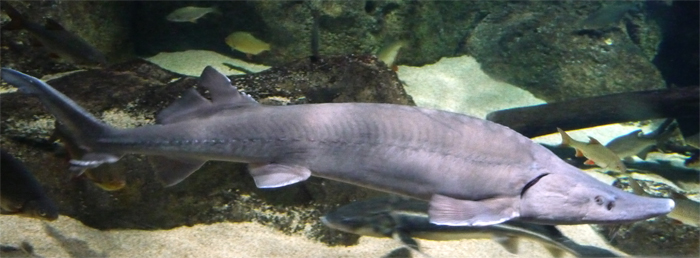 🇷🇺 Russia and 4 moreSiberian sturgeon
Large freshwater sturgeon native to Siberian riversAncient · Rivers and lakes
 🇺🇸 United States and 1 moreAtlantic sturgeon
A large anadromous fish native to the western Atlantic Ocean and its river systems.Ancient · Rivers and lakes
 🇺🇸 United States and 1 moreLake sturgeon
A large, long-lived freshwater fish native to North America.Ancient · Rivers and lakes
 🇺🇸 United States and 1 moreGreen sturgeon
A large anadromous fish native to the northern Pacific Ocean.Shark · Coasts and shelves