
Starry sturgeon
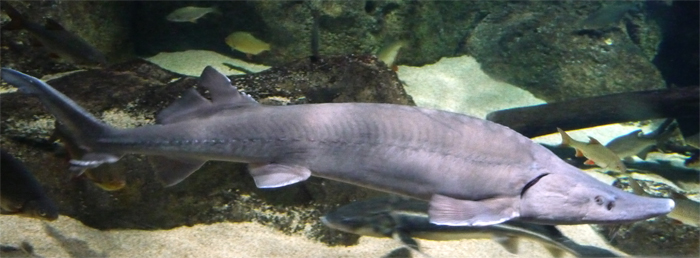
Long-snouted sturgeon from the Caspian and Black Seas.
The starry sturgeon is a slim, anadromous fish native to the Caspian, Black, Azov and Aegean seas. It faces critical endangerment due to overfishing for caviar and habitat loss, with international trade now restricted.
- Snout makes up 25% of total body length
- Population declined by 95% in three generations
- Males spawn every 2-3 years after maturing
- Juveniles grow best at 25-26°C water temperature
- International trade restricted by CITES regulations
What it is
This species is a slim-bodied sturgeon with a distinctive long, thin snout that comprises about a quarter of its total length. It reaches lengths of roughly 220 cm and weighs up to 80 kg. The fish displays dark greyish-green or brown colouring on top with a pale underside. Five small barbels sit closer to the mouth than the snout tip. Rows of bony scutes protect its back, sides and belly, distinguishing it from similar relatives like the Russian sturgeon.
Where it lives
Native populations inhabit the coastal and basin waters of the Caspian, Black and Azov seas. The species was once found in the Aegean Sea but has been extirpated there. As an anadromous fish, it migrates from marine environments into rivers during spring and winter to spawn. It prefers riverbeds with heavy currents and stone grounds, though it may use sandy flooded banks if optimal sites are unavailable.
How it lives
The starry sturgeon feeds on the seabed, consuming fish, worms, crustaceans and mollusks. It is largely nocturnal, resting on the bottom during daylight hours. This harmless species lacks significant natural defences against predators. During its migration to spawning grounds, it stops feeding entirely. It only resumes eating after the reproductive period is complete and it returns to marine or estuarine feeding areas.
Breeding and life cycle
Males reach sexual maturity between six and twelve years, spawning every two to three years. Females mature later, between eight and fourteen years, and spawn every three to four years. Reproduction requires specific hydrological conditions, including water flow velocities above one metre per second and depths up to five metres. Juveniles thrive in temperatures of 25 to 26 degrees Celsius, though higher heat reduces survival rates during their transition to adulthood.
Fish and people
This fish is a prized commercial species, particularly for its meat and roe. Sevruga caviar is a luxury product alongside Beluga and Ossetra varieties. In Caspian regions, the meat is considered a delicacy, often prepared in kababs, smoked or fried. Aquaculture attempts aim to meet global demand, yet wild stocks remain depleted. The slow population doubling time, ranging from 4.5 to 14 years, hinders rapid recovery from harvesting pressures.
Status and threats
Classified as Critically Endangered by the IUCN since 2019, the population has dropped by an estimated 95 percent over three generations. Overfishing, illegal trawling and gillnetting are primary threats. Habitat degradation and pollution further reduce numbers. International trade is restricted under CITES. Hatcheries in Ukraine, Kazakhstan and Azerbaijan release juveniles to support stocks, but limited wild broodstock risks reducing genetic diversity and adaptive capability.

Questions people ask about Starry sturgeon
What does the starry sturgeon eat?
It feeds on fish, worms, crustaceans and mollusks. The fish lies on the seabed during the day and hunts mostly at night. It stops eating completely while migrating to spawn.
Why is the starry sturgeon endangered?
Overfishing for caviar and meat caused a 95% population drop. Illegal fishing, habitat loss, pollution and invasive species also threaten its survival. Recovery is slow due to late maturity.
Where does the starry sturgeon live?
It lives in the Caspian, Black and Azov seas. It migrates up rivers with strong currents to spawn on stone riverbeds. It was removed from the Aegean Sea.
How big does the starry sturgeon get?
It grows up to 220 cm in length and can weigh as much as 80 kg. Its long, thin snout is a key feature, making up about a quarter of its total size.
Good reading and sources
- Starry sturgeon on WikipediaEncyclopedia
- More photos on Wikimedia CommonsPhotos
- Wikidata recordOpen data
The facts on this page come from the Wikipedia article "Starry sturgeon", written by its contributors and used under the CC BY-SA 4.0 licence, and from its Wikidata record (CC0). EveryFish rewrote the text in its own words, with AI assistance, and compares every page with the article to make sure no passage is copied. It may be reused under the same CC BY-SA 4.0 licence with a link back.
It may contain mistakes, and figures change over time. Nothing here is investment or buying advice. If something is wrong, tell us. Last refreshed 2026-11-15.
Like Starry sturgeon
All ancient fish WorldPersian sturgeon
A large Caspian Sea fish prized for caviar.Ancient · Coasts and shelves
 🇨🇳 ChinaChinese sturgeon
Critically endangered giant migratory fish of the YangtzeAncient · Rivers and lakes
 🇨🇦 Canada and 3 moreSturgeon
Ancient fish with bony plates and heterocercal tails, known for caviar.Ancient · Rivers and lakes
 🇷🇺 Russia and 4 moreSiberian sturgeon
Large freshwater sturgeon native to Siberian riversAncient · Rivers and lakes
More from Acipenseridae
All of them 🇺🇸 United States and 1 moreGreen sturgeon
A large anadromous fish native to the northern Pacific Ocean.Shark · Coasts and shelves
 🇺🇸 United States and 1 moreAtlantic sturgeon
A large anadromous fish native to the western Atlantic Ocean and its river systems.Ancient · Rivers and lakes
 🇺🇸 United States and 1 moreLake sturgeon
A large, long-lived freshwater fish native to North America.Ancient · Rivers and lakes
 🇮🇹 Italy and 4 moreAdriatic sturgeon
A critically endangered sturgeon native to the Adriatic basin.Ancient · Rivers and lakes