
Russian sturgeon
Large anadromous sturgeon of the Black and Caspian Seas.
The Russian sturgeon is a large fish native to the Black Sea, Sea of Azov and Caspian Sea basins. It migrates up rivers to spawn and faces high vulnerability due to slow maturity and heavy fishing pressure for its roe.
- Grows up to 235 cm and weighs 115 kg
- Migrates from sea to rivers to spawn in spring
- Successfully hybridised with American paddlefish in 2020
- Reclassified from Acipenser to Huso genus recently
What it is
This species belongs to the sturgeon family and grows to a maximum length of about 235 cm. Most adults measure between 110 and 140 cm. It features a short, rounded snout with three pairs of smooth barbels positioned near the tip rather than the mouth. The back appears greyish-green, while the belly is white and lateral scales are pale. Distinctive fin ray counts and scale patterns help separate it from similar species like the starry sturgeon.
Where it lives
Native waters include the Black Sea, the Sea of Azov and the Caspian Sea. The fish is anadromous, meaning it lives in marine environments but travels into freshwater river systems to reproduce. It inhabits shallow areas with sandy or muddy substrates, usually staying close to the bottom. Its range extends across nations bordering these seas, including Russia, Iran, Turkey and several Eastern European countries.
How it lives
Diet consists mainly of bottom-dwelling prey such as crustaceans, molluscs and small fish like gobies and sprats. In marine habitats, individuals tend to live alone. However, they become social and form groups when migrating upriver during spring months. This shift in behaviour coincides with their movement toward spawning grounds. They feed on available small fishes and invertebrates found in their benthic zone.
Breeding and life cycle
Reproduction involves migration into rivers during April, May and June. The species matures slowly, which increases its susceptibility to population decline. Spawning occurs upstream in freshwater systems. Recent scientific experiments have also shown that eggs from this sturgeon can successfully hybridise with American paddlefish sperm, producing viable offspring known as sturddlefish with high survival rates.
Fish and people
Fisheries target this species heavily, largely due to the value of its roe for caviar production. Its slow growth and late maturity make populations difficult to recover from overfishing. While primarily a food fish, it has also featured in scientific research regarding cross-family hybridisation. The creation of sturddlefish marks a notable event in aquaculture and genetic studies.
Status and threats
The species is considered highly vulnerable to fishing pressure because it reproduces slowly. Prior to 2025, taxonomic classification placed it in the genus Acipenser, but recent analysis moved it to Huso to reflect accurate evolutionary relationships. Conservation concerns stem from its life history traits which limit rapid population recovery after depletion.


Questions people ask about Russian sturgeon
How big does the Russian sturgeon get?
It can reach lengths of up to 235 cm and weigh as much as 115 kg. However, most adults are smaller, typically measuring between 110 and 140 cm in length.
Where does the Russian sturgeon live?
It is native to the Black Sea, Sea of Azov and Caspian Sea. It lives in shallow coastal waters but migrates up rivers to spawn, making it an anadromous species.
What is a sturddlefish?
A sturddlefish is a hybrid created by crossing Russian sturgeon eggs with American paddlefish sperm. This successful cross-genus breeding resulted in offspring with high survival rates.
Good reading and sources
- Russian sturgeon on WikipediaEncyclopedia
- More photos on Wikimedia CommonsPhotos
- Wikidata recordOpen data
The facts on this page come from the Wikipedia article "Russian sturgeon", written by its contributors and used under the CC BY-SA 4.0 licence, and from its Wikidata record (CC0). EveryFish rewrote the text in its own words, with AI assistance, and compares every page with the article to make sure no passage is copied. It may be reused under the same CC BY-SA 4.0 licence with a link back.
It may contain mistakes, and figures change over time. Nothing here is investment or buying advice. If something is wrong, tell us. Last refreshed 2026-11-15.
Like Russian sturgeon
All ancient fish WorldLamprey
Jawless fish with a sucking mouth found in temperate waters worldwide.Ancient · Rivers and lakes
 🇨🇳 ChinaChinese sturgeon
Critically endangered giant migratory fish of the YangtzeAncient · Rivers and lakes
 🇺🇸 United States and 4 moreSea lamprey
A jawless, parasitic fish native to the Northern Hemisphere that attacks other fish.Ancient · Rivers and lakes · 1758
 🇺🇸 United States and 1 moreAtlantic sturgeon
A large anadromous fish native to the western Atlantic Ocean and its river systems.Ancient · Rivers and lakes
More from Acipenseridae
All of them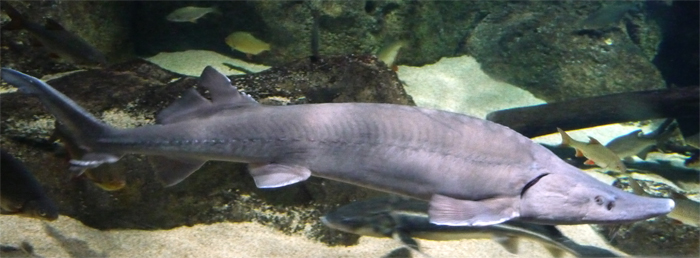 🇷🇺 Russia and 4 moreSiberian sturgeon
Large freshwater sturgeon native to Siberian riversAncient · Rivers and lakes
 🇺🇸 United States and 1 moreGreen sturgeon
A large anadromous fish native to the northern Pacific Ocean.Shark · Coasts and shelves
 🇺🇸 United States and 1 moreLake sturgeon
A large, long-lived freshwater fish native to North America.Ancient · Rivers and lakes
 🇮🇹 Italy and 4 moreAdriatic sturgeon
A critically endangered sturgeon native to the Adriatic basin.Ancient · Rivers and lakes