
Little skate
Small Atlantic skate known for walking on the sea floor.
The little skate is a small ray found in the western Atlantic from Canada to the US. It lives on sandy bottoms and uses modified fins to walk along the seabed. Scientists study it for insights into vertebrate evolution and genetics.
- Uses pelvic fins to walk on the sea floor.
- Generates weak electric fields for communication.
- Egg cases are known as mermaid's purses.
- Key model organism for biomedical research.
- Wings marketed as faux scallops.
What it is
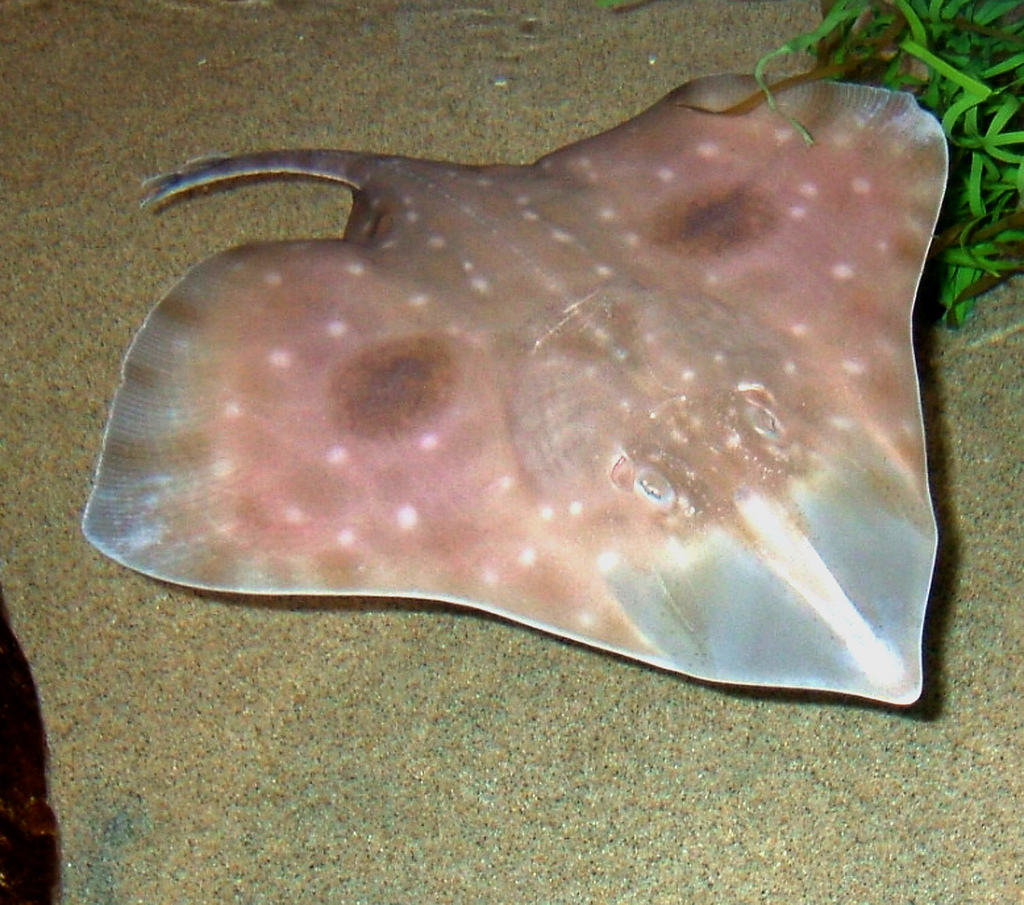
The little skate is a small member of the Rajidae family with a rounded body disk. Its snout is blunt, and its tail is shorter than the disk in adults. The upper side is grey or brown with dark spots, while the underside is pale. Strong spines cover the head and shoulders. This species typically reaches about 50 cm in length, though some grow slightly larger in northern waters.
Where it lives
This fish inhabits the western Atlantic Ocean, ranging from Nova Scotia down to Cape Hatteras. It prefers sandy or gravelly seabeds from the shoreline to depths of 90 metres, though it has been found deeper. Temperatures between 1 and 21 degrees Celsius suit it well. While it does not migrate long distances, it shifts between shallow and deep water with the seasons.
How it lives
Active at night, the little skate buries itself in sediment during the day. It moves across the sea floor using a unique walking motion called punting, driven by leg-like pelvic fin lobes. This method may help it hunt without disturbing prey. Its diet consists mainly of crustaceans and worms. Sharks, seals, and larger fish prey on it, while sea urchins eat its egg cases.
Breeding and life cycle
Females lay eggs year-round, with peaks in spring and autumn. They deposit paired amber capsules on sandy bottoms in shallow water. Each case holds one embryo and features horns that anchor it to the substrate. Hatching takes five to twelve months depending on temperature. Newborns are miniature versions of adults. Growth is rapid in the first three years before slowing down.
Fish and people
Fishermen often catch this skate as bycatch in trawls. Its wings are sometimes sold as food, cut into rounds that resemble scallops. It is also widely used as bait for lobster and eel traps. Beyond fishing, the species serves as a key model organism in biomedical research. Scientists study its genetics and unique locomotion to understand vertebrate evolution.
Status and threats
The little skate is not currently considered overfished. It faces threats from commercial trawling but remains abundant in its range. High mortality rates mean few individuals live beyond five years. Conservation efforts focus on monitoring bycatch levels. Its population stability allows it to remain a common subject for scientific study without immediate risk of decline.

Questions people ask about Little skate
How does the little skate move?
It uses a method called punting. Modified pelvic fins act like legs to push off the seabed. This allows the skate to glide short distances. Scientists believe this movement helps it hunt quietly by reducing water turbulence.
What do little skates eat?
Their diet focuses on decapod crustaceans and amphipods. Polychaete worms are also a major food source. As they grow larger, they consume more crustaceans. They rarely eat small fish or squid.
Are little skates dangerous to humans?
No, they are not dangerous. They have spines on their heads and tails but do not pose a threat to people. They are small bottom-dwellers that spend most of their time buried in sand or gravel.
Good reading and sources
The facts on this page come from the Wikipedia article "Little skate", written by its contributors and used under the CC BY-SA 4.0 licence, and from its Wikidata record (CC0). EveryFish rewrote the text in its own words, with AI assistance, and compares every page with the article to make sure no passage is copied. It may be reused under the same CC BY-SA 4.0 licence with a link back.
It may contain mistakes, and figures change over time. Nothing here is investment or buying advice. If something is wrong, tell us. Last refreshed 2026-11-15.
Like Little skate
All rays and skates 🇺🇸 United States and 2 moreRound stingray
A small coastal ray from the eastern Pacific known for its painful tail spine.Ray · Coasts and shelves
 🇺🇸 United States and 1 moreBat ray
A large eagle ray with wing-like fins found in the eastern Pacific.Ray · Coasts and shelves
 WorldSkate
Cartilaginous fish with flat bodies and egg cases, found on sea floors worldwide.Shark · Coasts and shelves
 WorldBluespotted ribbontail ray
A small, colourful reef stingray with electric blue spots.Ray · Coasts and shelves · 1775
More from Rajidae
All of them EuropeBlonde ray
A short-tailed skate found in the Eastern Atlantic and Mediterranean.Ray · Coasts and shelves
 🇨🇦 CanadaWinter skate
Endangered North Atlantic skate with eye-like spotsRay · Coasts and shelves
 EuropeThornback ray
A spiny-skinned ray found in European coastal waters.Ray · Coasts and shelves · 1758
EuropeBlue skate
A large, slow-growing ray native to the northeast Atlantic.Ray · Coasts and shelves · 1758