
Thornback ray
A spiny-skinned ray found in European coastal waters.
The thornback ray is a demersal fish with a kite-shaped body and thorny tail. It inhabits sandy seabeds across the Atlantic and Mediterranean. Fishermen target it for food, though heavy fishing pressure affects some populations.
- Females grow larger than males, reaching up to 139 cm.
- Lays up to 170 egg cases per year on sandy seabeds.
- Covered in thorny spines, with bucklers on mature females.
- Found in Atlantic, Mediterranean, and Black Sea waters.
What it is
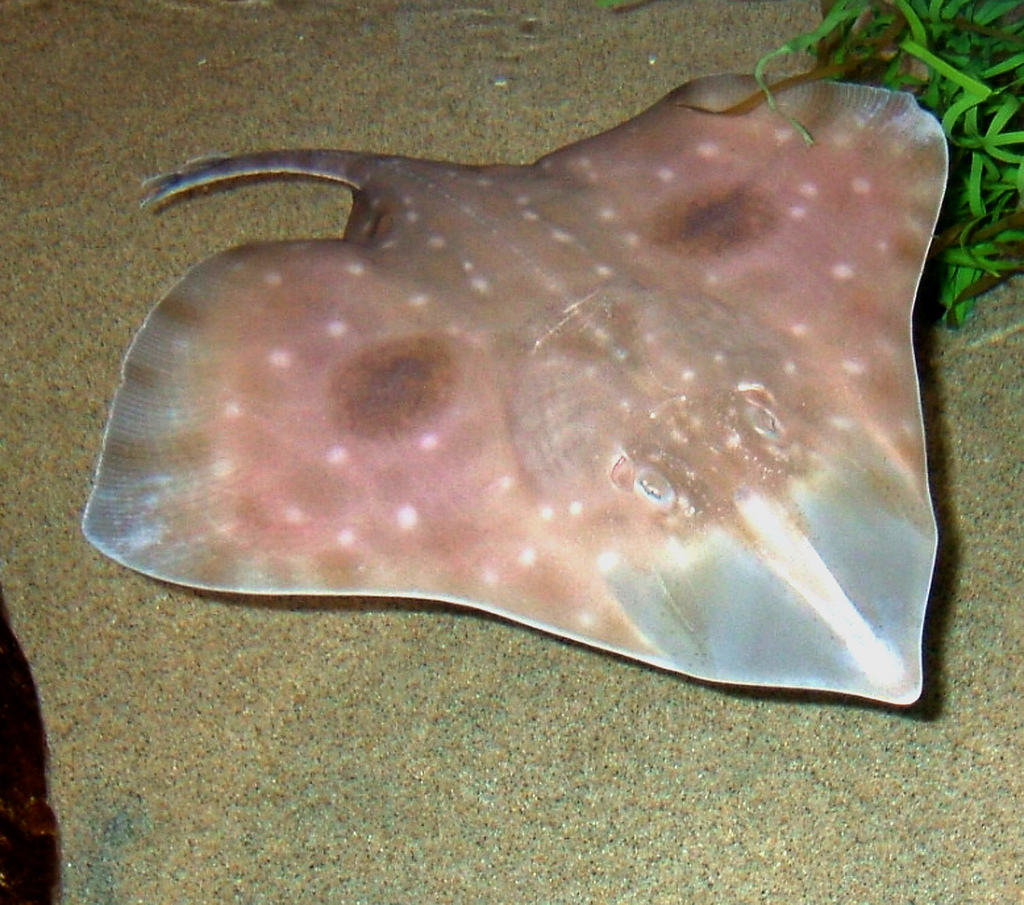
This ray features a flattened, kite-shaped body with broad pectoral fins that resemble wings. Its most distinct feature is a long tail covered in thorny spines. The upper surface displays light brown or grey colours with dark blotches and yellow patches. Older females develop thickened, button-like spines called bucklers on their backs and tails. Adults typically measure under 85 centimetres, though females can reach 139 centimetres. The underside is creamy-white with a greyish edge.
Where it lives
These fish inhabit the Atlantic coastal waters of Europe and western Africa. Their range extends into the Mediterranean and Black Seas. Some populations exist as far south as Namibia and South Africa in the Indian Ocean. They prefer sedimentary seabeds composed of mud, sand, or gravel. While usually found between 10 and 60 metres deep, they can live inshore or descend to 300 metres. Rare sightings occur at depths exceeding 1,000 metres.
How it lives
Juveniles feed on small crustaceans like amphipods and bottom-living shrimps. Adults consume crabs, shrimps, and small fish. This demersal species rests on the sea floor and is often encountered by divers. They may form same-sex aggregations during the mating season. The marine leech Pontobdella muricata uses this ray as a host. When threatened, the fish can appear black to deter predators.
Breeding and life cycle
Thornback rays are oviparous, meaning they lay eggs rather than giving birth to live young. Females deposit paired egg cases on shallow sandy or muddy bottoms. Each capsule contains one embryo that feeds on yolk. Hatching occurs after four to five months, producing pups about 11 to 13 centimetres long. A single female may lay up to 170 egg cases annually. Mating peaks in June, with females moving to shallower waters before males.
Fish and people
Fishermen catch this species for food in commercial fisheries. In the Solway Firth, unrestricted fishing has led to a high proportion of immature fish being retained. This pressure may be reducing the size at which females mature. The fish is known by various local names such as roker in English and raie bouclée in French. It is one of the most common rays seen by recreational divers in its range.
Status and threats
Heavy exploitation in areas like the Solway Firth threatens local populations. Nearly half of the caught fish in some regions are immature. Fishing pressure appears to influence the maturation size of females. No global conservation status is provided in the available data, but local stocks face significant stress from unrestricted commercial activity.


Questions people ask about Thornback ray
How big do thornback rays get?
Adults commonly measure around 85 centimetres in length. Females grow larger than males, with a maximum recorded length of 139 centimetres. They typically weigh between two and four kilograms.
What do thornback rays eat?
Juvenile rays feed on small crustaceans such as amphipods and shrimps. As they mature, their diet shifts to include crabs, larger shrimps, and small fish found on the seabed.
Are thornback rays dangerous to humans?
They possess thorny spines on their back and tail, which can cause injury if handled. However, they are not venomous. They are generally shy and are often seen by divers in coastal waters.
Where do thornback rays live?
They inhabit sedimentary seabeds of mud, sand, or gravel. Their range includes the Atlantic coasts of Europe and Africa, as well as the Mediterranean and Black Seas, usually at depths of 10 to 60 metres.
Good reading and sources
- Thornback ray on WikipediaEncyclopedia
- More photos on Wikimedia CommonsPhotos
- Wikidata recordOpen data
The facts on this page come from the Wikipedia article "Thornback ray", written by its contributors and used under the CC BY-SA 4.0 licence, and from its Wikidata record (CC0). EveryFish rewrote the text in its own words, with AI assistance, and compares every page with the article to make sure no passage is copied. It may be reused under the same CC BY-SA 4.0 licence with a link back.
It may contain mistakes, and figures change over time. Nothing here is investment or buying advice. If something is wrong, tell us. Last refreshed 2026-11-15.
Like Thornback ray
All rays and skates WorldSpotted eagle ray
Tropical ray with white spots and a long tail.Ray · Coasts and shelves · 1790
 WorldGiant oceanic manta ray
The world's largest ray, a massive filter-feeding predator of tropical oceans.Ray · Coasts and shelves · 1827
 Latin America and the CaribbeanMunk's pygmy devil ray
Smallest devil ray in the eastern Pacific OceanRay · Coasts and shelves · 1987
 WorldDevil fish
A large Mediterranean ray with a spiny tail and horn-like flaps.Ray · Coasts and shelves
More from Rajidae
All of them 🇺🇸 United StatesBig skate
Largest skate in North American Pacific watersRay · Coasts and shelves · 1855
 WorldSkate
Cartilaginous fish with flat bodies and egg cases, found on sea floors worldwide.Shark · Coasts and shelves
 EuropeBlonde ray
A short-tailed skate found in the Eastern Atlantic and Mediterranean.Ray · Coasts and shelves