
Big skate
Largest skate in North American Pacific waters
The big skate is the largest skate species found off the coast of North America. It inhabits the Pacific Ocean from Alaska to Baja California, living on sandy or muddy seabeds. This oviparous fish is notable for its large egg cases and commercial value as food.
- Largest skate in North American Pacific waters
- Egg cases can contain up to seven embryos
- Pectoral fins sold as skate wings or imitation scallops
- Lifespan up to 26 years off British Columbia
- Assessed as least concern by IUCN
What it is
The big skate is a large ray with a flattened, diamond-shaped body. Its pectoral fin disk is slightly wider than it is long, featuring a pointed snout that is semi-transparent near the tip. The skin of juveniles is smooth, but adults develop small prickles on their back and underside. Two prominent dark eyespots with pale borders sit on each wing, giving the species its name. The dorsal surface is mottled brown, olive, or grey with white spot rosettes, while the ventral side is white. It lacks an anal fin and has two small dorsal fins on its tail.
Where it lives
This species lives in the north-eastern Pacific Ocean. Its range extends from the eastern Bering Sea and Aleutian Islands south to Cedros Island in central Baja California. It is rare south of Point Conception in California. Big skates inhabit coastal bays, estuaries, and the continental shelf. They prefer sandy or muddy bottoms but may rest on kelp strands. While recorded at depths of 800 metres, they are typically found no deeper than 120 metres. In northern areas, they frequent shallower waters, particularly off British Columbia where temperatures range from 7.6 to 9.4 degrees Celsius.
How it lives
Big skates often bury themselves in sediment, leaving only their eyes exposed. They feed on benthic invertebrates such as polychaete worms, molluscs, and crustaceans, as well as small bottom-dwelling fishes. Younger individuals consume more worms and molluscs. The broadnose sevengill shark is a known predator. The eyespots on the wings likely act as decoys to confuse attackers. Juvenile northern elephant seals sometimes eat their egg cases. Parasites include the copepod Lepeophtheirus cuneifer. Growth rates vary by region, with those in the Gulf of Alaska differing from populations off British Columbia.
Breeding and life cycle
Females lay eggs year-round, with no distinct breeding season. They deposit oblong egg cases, known as mermaid's purses, in pairs on sandy or muddy flats. These cases are the largest of any skate, measuring up to 31 cm long. Each capsule can hold one to seven embryos, though three or four is common. This multi-embryo trait is unusual among skates. Young emerge after nine months, measuring 18 to 23 cm. Males mature at seven to eight years old, while females mature later, at twelve to thirteen years. Distinct spawning beds have been identified where egg cases accumulate.
Fish and people
This skate is one of the most commercially important species off California. It is often caught as bycatch in bottom trawls. The pectoral fins are sold as skate wings, which are baked or fried and sometimes labelled as imitation scallops. Market value increased significantly in the 1990s, leading to a ten-fold rise in catches. A targeted fishery began in the Gulf of Alaska in 2003. Recreational anglers frequently catch and release them. They adapt well to captivity and are common in public aquaria. Fisheries are managed separately in Alaska, British Columbia, and the US west coast.
Status and threats
The World Conservation Union assesses the big skate as least concern. Stock assessments in Alaska, British Columbia, and the contiguous United States have not found evidence of overfishing. However, estimates of sustainable catch and total stock size remain uncertain. The species faces pressure from commercial trawling, but current management appears to maintain stable populations across its range.


Questions people ask about Big skate
How big do big skates get?
The maximum known length is 2.4 metres, though they usually do not exceed 1.8 metres. They can weigh up to 91 kilograms. This makes them the largest skate species in North American waters and the third largest in the world.
What do big skates eat?
They feed on benthic invertebrates and small fishes. Their diet includes polychaete worms, molluscs, crustaceans, and small bottom-dwelling fish. Younger skates tend to eat a higher percentage of worms and molluscs compared to adults.
Are big skates endangered?
No, they are assessed as least concern by the World Conservation Union. Stock assessments in their main fishing areas have not found that overfishing is occurring, although exact stock sizes remain uncertain.
Why are they called big skates?
The name refers to their large size relative to other skates in the region. The scientific name binoculata means two-eyed, referring to the two prominent dark eyespots on each wing that help confuse predators.
Good reading and sources
The facts on this page come from the Wikipedia article "Big skate", written by its contributors and used under the CC BY-SA 4.0 licence, and from its Wikidata record (CC0). EveryFish rewrote the text in its own words, with AI assistance, and compares every page with the article to make sure no passage is copied. It may be reused under the same CC BY-SA 4.0 licence with a link back.
It may contain mistakes, and figures change over time. Nothing here is investment or buying advice. If something is wrong, tell us. Last refreshed 2026-11-15.
Like Big skate
All rays and skates 🇺🇸 United States and 2 moreRound stingray
A small coastal ray from the eastern Pacific known for its painful tail spine.Ray · Coasts and shelves
 🇺🇸 United States and 1 moreBat ray
A large eagle ray with wing-like fins found in the eastern Pacific.Ray · Coasts and shelves
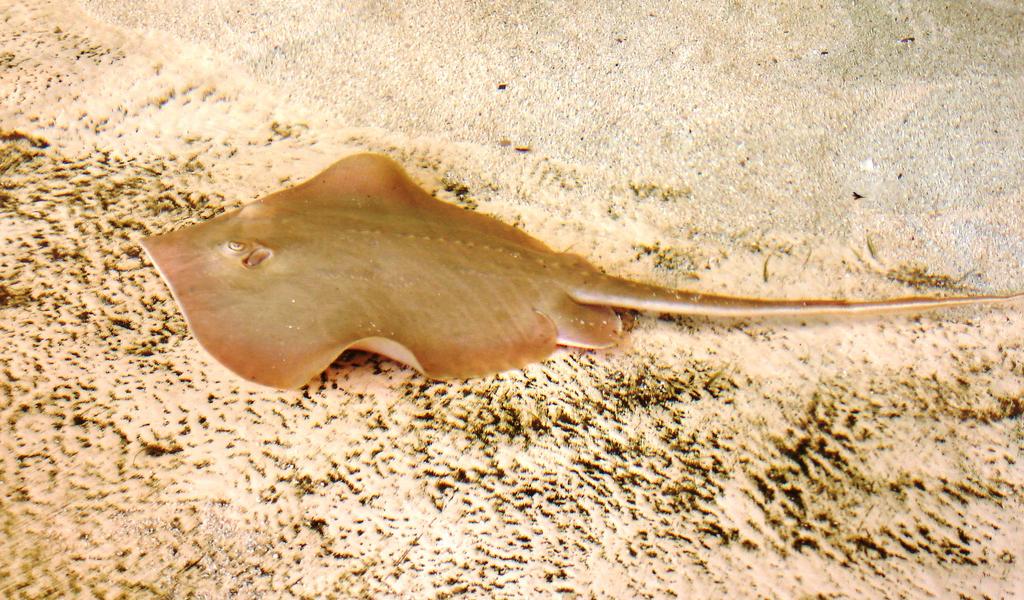 🇺🇸 United States and 1 moreAtlantic stingray
Small stingray found in Atlantic coastal waters and fresh rivers.Ray · Rivers and lakes · 1824
 WorldLionfish
Venomous marine fish of the genus Pterois known for striking stripes and invasive spread.Ray · Coral reefs · 1900
More from Rajidae
All of them EuropeThornback ray
A spiny-skinned ray found in European coastal waters.Ray · Coasts and shelves · 1758
EuropeBlue skate
A large, slow-growing ray native to the northeast Atlantic.Ray · Coasts and shelves · 1758
WorldSkate
Cartilaginous fish with flat bodies and egg cases, found on sea floors worldwide.Shark · Coasts and shelves
 EuropeBlonde ray
A short-tailed skate found in the Eastern Atlantic and Mediterranean.Ray · Coasts and shelves