
Lionfish
Venomous marine fish of the genus Pterois known for striking stripes and invasive spread.
Lionfish are venomous ray-finned fish native to Indo-Pacific coral reefs. They have become significant invasive species in the Atlantic and Mediterranean due to aquarium releases and rapid reproduction.
- Venomous dorsal spines deter predators and cause human injury.
- Invasive in Atlantic, Caribbean, and Mediterranean since late 20th century.
- Females produce up to 2 million eggs annually.
- Reduce local reef fish populations by up to 79%.
- Edible if prepared correctly despite venom risks.
What it is
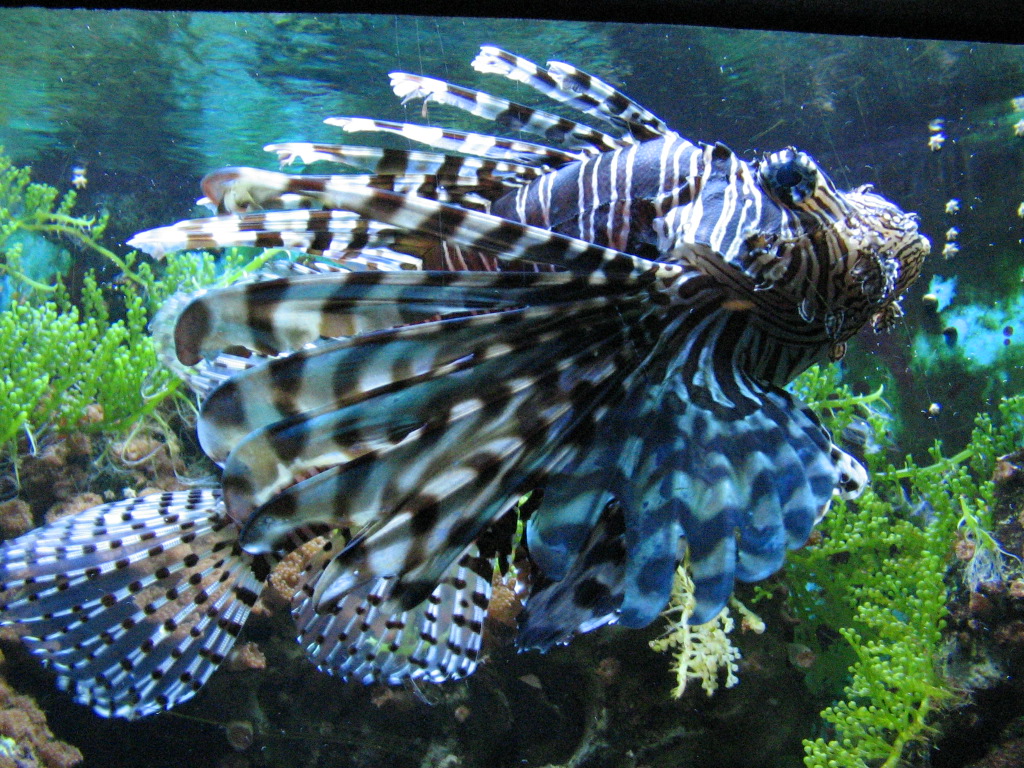
Lionfish belong to the genus Pterois within the family Scorpaenidae. These marine ray-finned fish display bold red or black bands against lighter backgrounds. Their most notable features include long, fan-like pectoral fins and dorsal spines tipped with venom. Adults reach lengths of approximately 18 inches. Juveniles possess unique tentacles above their eyes, which may aid in hunting or mating. The name derives from a French term meaning fins, referencing their elaborate fin structures.
Where it lives
Native ranges span the Indian Ocean and western Pacific, from Japan to Australia and the Red Sea. They inhabit shallow coral reefs, rocky substrates, and turbid inshore areas down to 300 meters. Invasive populations now exist in the Western Atlantic, Caribbean, and Mediterranean. They thrive in varying salinity and temperature conditions, allowing expansion into estuaries and coastal zones previously unsuitable for other reef species.
How it lives
These fish are apex predators on reefs, consuming small fish, invertebrates, and mollusks. They hunt actively in the morning using specialized swim bladder muscles for precise movement. Lionfish blow water jets to confuse prey before capturing them head-first. Natural predators include moray eels, sharks, and barracuda. Parasites such as isopods and leeches occasionally infest them, though this is rare.
Breeding and life cycle
Lionfish exhibit complex courtship behaviors and can live between five and fifteen years. Females produce mucus-filled egg clusters containing up to 15,000 eggs each. A single female may release millions of eggs annually. Larvae disperse via ocean currents like the Gulf Stream, facilitating rapid population growth and range expansion in non-native waters.
Fish and people
Lionfish are popular in the aquarium trade but require experienced care. Their venom causes severe pain, swelling, and potentially fatal allergic reactions in humans. Despite hazards, they are edible when prepared correctly. In invaded regions, divers harvest them for sport and food to control populations. Conservation efforts encourage removal to protect native reef ecosystems from decline.
Status and threats
Native populations face no major threats, but invasive groups cause ecological damage. They reduce juvenile reef fish numbers by up to 79 percent, threatening biodiversity. Control measures involve manual removal, requiring monthly harvesting of at least 27 percent of adults. Climate change and warming seas may further expand their range in the Mediterranean and Atlantic.


Questions people ask about Lionfish
Are lionfish dangerous to humans?
Yes. Their dorsal spines contain venom that causes pain, swelling, nausea, and potentially fatal allergic reactions. Healthy adults rarely die, but children, the elderly, or allergic individuals face higher risks including respiratory failure or anaphylaxis.
Where did lionfish come from originally?
They are native to the Indo-Pacific region, including the Indian Ocean and western Pacific. Ranges extend from southern Japan and Korea to Australia, Indonesia, Micronesia, and the western coast of Syria.
How did lionfish become invasive in the Atlantic?
Likely through aquarium releases in the 1980s or 1990s. Hurricane Andrew may have released some in 1992, but sightings date to 1985. Larval dispersal via ocean currents and ballast water aided their spread across the Caribbean and US East Coast.
Can you eat lionfish?
Yes, they are edible if prepared correctly. The venom is only dangerous when the spines penetrate skin. Culinary interest has grown in invaded regions to help control populations while providing a food source.
What do lionfish eat?
They primarily consume small fish, invertebrates, and mollusks. They use specialized swim bladder muscles for precise positioning and blow water jets to confuse prey before swallowing them whole.
Good reading and sources
- Eradicating Invasive Species One Sushi Roll at a Time (Published 2016)The New York Times, Article
- Poisonous tropical lionfish could be spreading through MediterraneanThe Guardian, Article
The facts on this page come from the Wikipedia article "Lionfish", written by its contributors and used under the CC BY-SA 4.0 licence, and from its Wikidata record (CC0). EveryFish rewrote the text in its own words, with AI assistance, and compares every page with the article to make sure no passage is copied. It may be reused under the same CC BY-SA 4.0 licence with a link back.
It may contain mistakes, and figures change over time. Nothing here is investment or buying advice. If something is wrong, tell us. Last refreshed 2026-11-15.
