
Giant oceanic manta ray
The world's largest ray, a massive filter-feeding predator of tropical oceans.
This large ray belongs to the Mobulidae family and holds the title for the biggest ray species on Earth. It inhabits warm seas globally and feeds primarily on zooplankton and small fish, facing significant threats from fisheries and pollution.
- Largest ray species, reaching nine metres in length.
- Has the largest brain of any fish, weighing up to 200 grams.
- Population declined drastically due to overfishing for gill rakers.
- Ingests microplastics that concentrate toxins like mercury.
- Gives birth to a single pup after a year-long pregnancy.
What it is
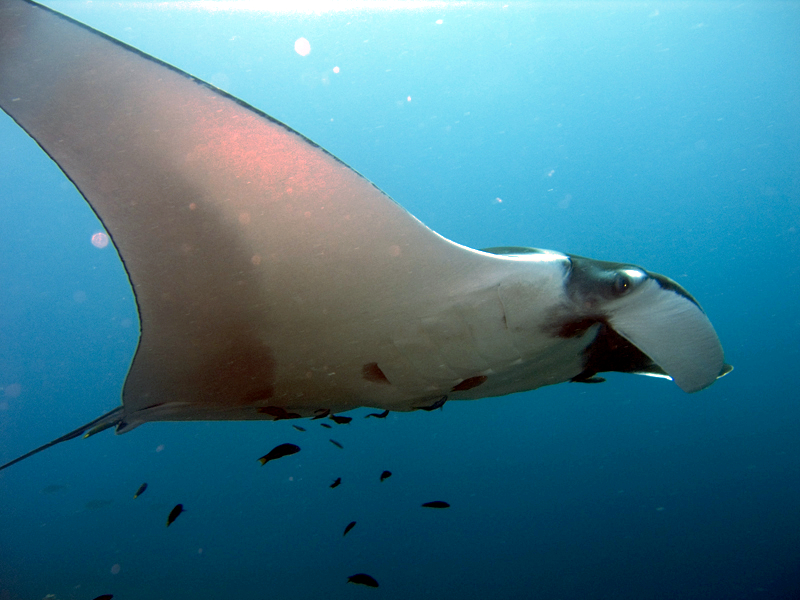
The giant oceanic manta ray is a massive cartilaginous fish belonging to the mobulid family. It is the largest ray species currently existing, capable of reaching lengths of nine metres and weights near three tonnes. The body is flattened with broad pectoral fins forming a disc up to seven metres wide. Distinctive horn-like cephalic fins extend forward to guide water into its mouth. The upper skin is dark blue or black, while the underside is white with unique spot patterns that identify individuals. A short tail ends in a knob rather than a stinger.
Where it lives
These rays inhabit tropical and subtropical oceans across the globe. They also venture into temperate zones, recorded as far north as California, Japan, and Egypt, and as far south as Peru, South Africa, and New Zealand. They prefer open ocean environments but often gather near offshore islands where nutrient-rich currents create feeding hotspots. Their distribution is widespread, following plankton blooms and upwelling zones throughout their range.
How it lives
They swim continuously to force water over their gills for breathing. Groups of up to fifty may gather at rich feeding sites to consume zooplankton and small fish. They use their cephalic fins to channel prey into their mouths before sifting particles through their gill arches. Larger sharks and killer whales are their main predators, though adults rarely fall victim due to their size. They visit coral reefs to allow cleaner fish to remove parasites from their skin.
Breeding and life cycle
Mating involves males following females in trains until one grips her fin to copulate. The species exhibits live birth after a lengthy gestation of twelve to thirteen months. Females typically give birth to a single pup measuring about fourteen decimetres wide. Young rays stay in shallow coastal waters for several years. Slow reproduction rates and late sexual maturity make populations slow to recover from declines.
Fish and people
Humans hunt these rays for their gill rakers, which are sold for traditional medicine tonics claiming health benefits. The trade value can reach four hundred dollars per kilogram. They are also caught accidentally in fishing nets used for other species. Some aquariums exhibit them, though identification in captivity has historically been confused with reef mantas. Local cultures in Asia utilize parts of the ray for medicinal practices.
Status and threats
The International Union for Conservation of Nature lists this species as vulnerable. Populations have dropped sharply over recent decades due to heavy fishing pressure. Their slow growth and low reproductive rate hinder recovery. Threats include bycatch in gillnets and ingestion of microplastics that carry toxic pollutants like mercury and arsenic. These contaminants accumulate in their tissues, posing risks to both the animals and humans who consume them.



Questions people ask about Giant oceanic manta ray
What is the scientific name of the giant oceanic manta ray?
Its scientific name is Mobula birostris. It belongs to the family Mobulidae and was formerly classified under the genus Manta before genetic studies showed closer ties to other Mobula species.
How big does a giant oceanic manta ray get?
They can grow up to nine metres in length with a disc width of seven metres. Adults may weigh around three thousand kilograms, though typical sizes are smaller, averaging four and a half metres.
Why are giant oceanic manta rays endangered?
Their populations have decreased significantly due to overfishing. They are targeted for their gill rakers used in traditional medicine and are often caught accidentally in fishing nets. Their slow reproduction rate makes recovery difficult.
What do giant oceanic manta rays eat?
They feed on zooplankton such as copepods and shrimp, as well as small fish. Research indicates a significant portion of their diet comes from deep-water sources, contrary to earlier beliefs that they only filter-feed on surface plankton.
Good reading and sources
- Giant oceanic manta ray on WikipediaEncyclopedia
- More photos on Wikimedia CommonsPhotos
- Wikidata recordOpen data
The facts on this page come from the Wikipedia article "Giant oceanic manta ray", written by its contributors and used under the CC BY-SA 4.0 licence, and from its Wikidata record (CC0). EveryFish rewrote the text in its own words, with AI assistance, and compares every page with the article to make sure no passage is copied. It may be reused under the same CC BY-SA 4.0 licence with a link back.
It may contain mistakes, and figures change over time. Nothing here is investment or buying advice. If something is wrong, tell us. Last refreshed 2026-11-15.