
Round stingray
A small coastal ray from the eastern Pacific known for its painful tail spine.
The round stingray lives in warm waters along the Americas. It is a common bottom-dweller that occasionally stings people on beaches.
- Females reach a maximum disc width of thirty-one centimetres.
- Venomous tail spines cause frequent painful injuries to beachgoers.
- Species reproduces via live birth with litters of one to six young.
- Assessed as Least Concern by the IUCN due to high abundance.
- Tail spines are shed and replaced annually throughout the year.
What it is
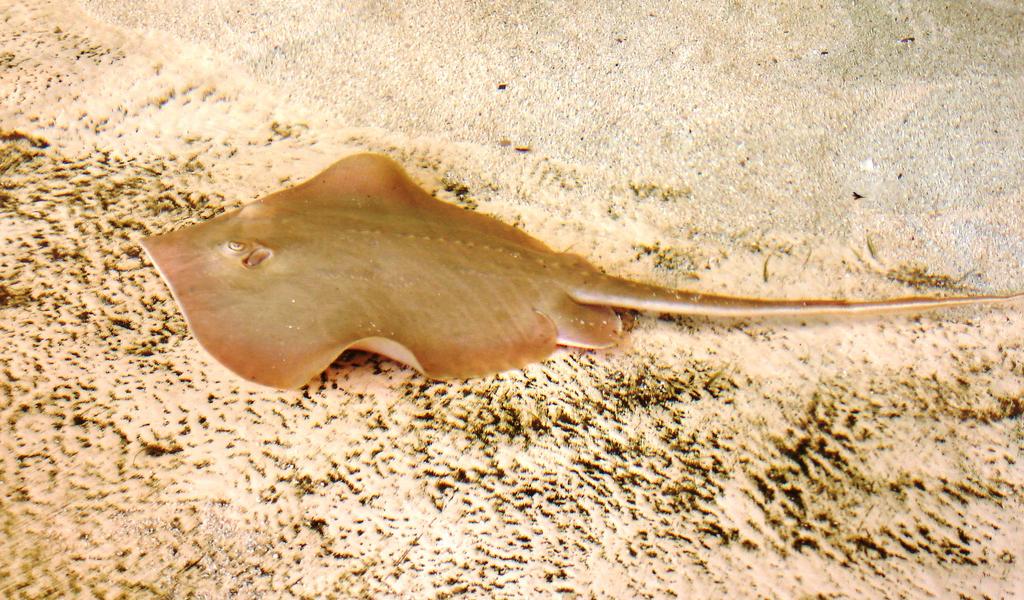
This species belongs to the family Urotrygonidae and possesses a nearly circular pectoral disc. Adults display brown or grayish-brown upper surfaces marked with pale yellow spots, while their undersides are white to yellow. A distinctive feature is the short, stout tail equipped with a long, serrated venomous spine. Males typically attain a disc width of twenty-five centimetres, whereas females grow slightly larger at thirty-one centimetres. The tail spine undergoes annual replacement, with new spines emerging in summer before the old ones fall off by winter.
Where it lives
The round stingray inhabits the eastern North Pacific Ocean. Its distribution extends from Humboldt Bay in California down to Panama. Populations are densest around southern California and the Baja Peninsula. These rays prefer tropical and warm-temperate coastal zones, typically dwelling in depths under fifteen metres. They favour soft substrates such as sand or mud, frequently utilizing eelgrass beds for concealment. In winter, they migrate to deeper waters to escape colder temperatures, sometimes gathering near warm industrial effluent.
How it lives
These rays segregate by age and sex, with females occupying deeper waters than males and juveniles. They forage during daylight hours, using their discs to dig pits in the sediment to uncover buried prey. Juveniles consume worms and small crabs, shifting to bivalves as they mature. Predators include elephant seals, giant sea bass, and large sharks. The species hosts numerous parasites, including copepods, leeches, and various tapeworms within its digestive tract.
Breeding and life cycle
Reproduction occurs via aplacental viviparity, resulting in litters of one to six offspring. Females store sperm year-round and move inshore to mate between April and June in southern California. Birth takes place from June to October, with newborns measuring six to eight centimetres across. In warmer regions further south, breeding happens earlier. After parturition, adults return to deeper water while juveniles remain in shallow nursery areas.
Fish and people
Hundreds of beachgoers suffer painful stings annually in southern California when stepping on these rays. The injury is non-fatal but requires care. The species is commercially undesirable due to its size and is often discarded by fisheries, though tail removal in Mexico increases mortality. It appears in the aquarium trade, where it is valued for hardiness but requires specific tank conditions. Public aquariums sometimes clip their spines for safe public interaction.
Status and threats
The International Union for Conservation of Nature lists this species as Least Concern. High reproductive rates and broad abundance contribute to this stable status. However, local populations face threats from recreational angling, artisanal gillnets, and shrimp trawlers. Bycatch remains a concern, particularly in Mexico where discarded individuals often suffer high mortality rates despite the overall species resilience.


Questions people ask about Round stingray
Is the sting of a round stingray fatal?
No, the sting is not fatal. However, it causes significant pain to humans who accidentally step on the ray. The wound results from the venomous spine located on the tail.
How does the round stingray reproduce?
It reproduces through aplacental viviparity. Females give birth to live young, typically one to six per litter. The gestation period lasts three months, and newborns measure six to eight centimetres across.
What food do round stingrays eat?
They feed on benthic invertebrates found on the sea floor. Juveniles eat polychaete worms and small crabs, while adults consume bivalve molluscs. They dig pits in the sediment to uncover this prey.
Can round stingrays be kept in home aquariums?
Yes, they are suitable for captivity if provided with proper conditions. They require fine sand substrate, ample swimming space, and careful filtration. Feeding should occur seven times weekly using appropriate foods without thiaminase.
Good reading and sources
- Round stingray on WikipediaEncyclopedia
- More photos on Wikimedia CommonsPhotos
- Wikidata recordOpen data
The facts on this page come from the Wikipedia article "Round stingray", written by its contributors and used under the CC BY-SA 4.0 licence, and from its Wikidata record (CC0). EveryFish rewrote the text in its own words, with AI assistance, and compares every page with the article to make sure no passage is copied. It may be reused under the same CC BY-SA 4.0 licence with a link back.
It may contain mistakes, and figures change over time. Nothing here is investment or buying advice. If something is wrong, tell us. Last refreshed 2026-11-15.
Like Round stingray
All rays and skates 🇺🇸 United States and 1 moreCownose ray
A migratory coastal ray with a distinctive head shape.Ray · Coasts and shelves
 🇺🇸 United States and 1 moreBat ray
A large eagle ray with wing-like fins found in the eastern Pacific.Ray · Coasts and shelves
 WorldBluespotted ribbontail ray
A small, colourful reef stingray with electric blue spots.Ray · Coasts and shelves · 1775
 🇺🇸 United States and 1 moreAtlantic stingray
Small stingray found in Atlantic coastal waters and fresh rivers.Ray · Rivers and lakes · 1824
