
Bluespotted ribbontail ray
A small, colourful reef stingray with electric blue spots.
The bluespotted ribbontail ray is a small stingray found in tropical Indo-Pacific reefs. It features bright blue spots on a yellow background and feeds on invertebrates at night. Though popular in aquariums, it struggles in captivity and faces threats from habitat loss.
- Identified by electric blue spots on yellow skin
- Feeds at night on sandy flats near reefs
- Gives birth to live young, up to seven per litter
- Popular in aquariums but difficult to keep alive
- Has venomous spines on its thick tail
What it is
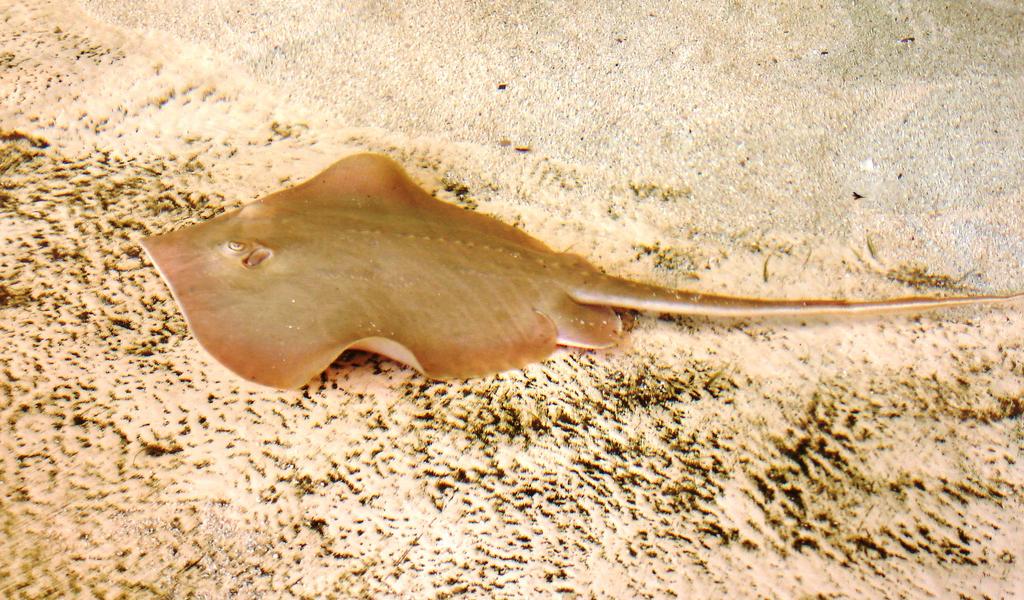
This species is a small stingray with an oval pectoral fin disc. It has large protruding eyes and a short, thick tail with a deep ventral fin fold. The skin is mostly smooth, marked by numerous electric blue spots on a yellowish or greenish background. Two blue stripes run along the tail sides. Adults reach about 35 cm in width and weigh up to 5 kg. It belongs to the family Dasyatidae and is easily recognised by its vivid colour pattern.
Where it lives
It inhabits nearshore waters across the tropical Indo-Pacific. Its range extends from South Africa and Madagascar around the Indian Ocean to the Arabian Peninsula and Southeast Asia. In the Pacific, it occurs from the Philippines to northern Australia and east to the Solomon Islands. It prefers coral reefs, adjacent sandy flats, and seagrass beds. It is rarely found deeper than 30 metres and often visits tidal pools and the intertidal zone.
How it lives
During the day, it hides alone in caves or under ledges. At night, small groups move onto shallow sandy flats with the rising tide to feed. It excavates sand pits to find molluscs, worms, crustaceans, and small fish. Other fishes often follow to scavenge missed prey. When threatened, it flees quickly in a zigzag pattern rather than burying itself. Predators include hammerhead sharks and bottlenose dolphins. It sometimes seeks cleaning from bluestreak cleaner wrasses.
Breeding and life cycle
Reproduction occurs from late spring to summer. Males bite and hold the female disc for copulation. The species is aplacental viviparous, meaning embryos develop inside the mother. They are initially sustained by yolk, then by uterine milk rich in fats and proteins. Gestation may last four to twelve months. Females give birth to litters of up to seven young, each measuring about 13 to 14 cm across. Males mature at a disc width of roughly 20 cm.
Fish and people
Its striking appearance makes it common in the home aquarium trade, though it rarely survives long in captivity. Many refuse to feed or die unexpectedly. Public aquariums have had more success, with some breeding programmes in Europe. It is eaten in East Africa, Southeast Asia, and Australia, caught via gillnets, spears, and traps. While timid, its venomous tail spines can cause painful wounds if stepped on or handled.
Status and threats
The IUCN lists it as Least Concern due to its wide distribution. However, populations face pressure from artisanal and commercial fisheries. Coral reef degradation from development and destructive fishing practices like cyanide use threatens its habitat. Local collecting for the aquarium trade also impacts numbers. Continued monitoring is needed as habitat quality declines across its range.


Questions people ask about Bluespotted ribbontail ray
Is the bluespotted ribbontail ray dangerous to humans?
It is generally timid and prefers to flee when threatened. However, it possesses venomous spines on its tail that can inflict painful wounds if stepped on or handled carelessly. It does not attack humans unprovoked.
What does the bluespotted ribbontail ray eat?
It feeds on small benthic invertebrates and bony fishes. Its diet includes molluscs, polychaete worms, shrimps, crabs, and small fish found in the sediment. It hunts at night by excavating sand pits on shallow flats.
Can this ray be kept in a home aquarium?
It is popular in the trade due to its beauty and small size, but it is poorly suited to captivity. Many specimens refuse to feed and die inexplicably. Public aquariums have achieved better success with specialised care and breeding programmes.
Good reading and sources
- Bluespotted ribbontail ray on WikipediaEncyclopedia
- More photos on Wikimedia CommonsPhotos
- Wikidata recordOpen data
The facts on this page come from the Wikipedia article "Bluespotted ribbontail ray", written by its contributors and used under the CC BY-SA 4.0 licence, and from its Wikidata record (CC0). EveryFish rewrote the text in its own words, with AI assistance, and compares every page with the article to make sure no passage is copied. It may be reused under the same CC BY-SA 4.0 licence with a link back.
It may contain mistakes, and figures change over time. Nothing here is investment or buying advice. If something is wrong, tell us. Last refreshed 2026-11-15.
Like Bluespotted ribbontail ray
All rays and skates WorldLionfish
Venomous marine fish of the genus Pterois known for striking stripes and invasive spread.Ray · Coral reefs · 1900
 North AmericaYellow stingray
Small, camouflaging stingray of the western Atlantic.Ray · Coasts and shelves · 1816
 🇺🇸 United States and 2 moreRound stingray
A small coastal ray from the eastern Pacific known for its painful tail spine.Ray · Coasts and shelves
 WorldSpotted eagle ray
Tropical ray with white spots and a long tail.Ray · Coasts and shelves · 1790
More from Dasyatidae
All of them 🇿🇦 South Africa and 4 moreReticulate whipray
A large spotted stingray from the western Indian Ocean and eastern Mediterranean.Ray · Coasts and shelves · 1789
 EuropeCommon stingray
A venomous ray of Atlantic and Mediterranean coastal waters.Ray · Coasts and shelves · 1758
 🇺🇸 United States and 1 moreAtlantic stingray
Small stingray found in Atlantic coastal waters and fresh rivers.Ray · Rivers and lakes · 1824
 WorldPelagic stingray
The only stingray that lives in the open ocean.Ray · Open ocean · 1832