
Common stingray
A venomous ray of Atlantic and Mediterranean coastal waters.
The common stingray is a bottom-dwelling fish found in the northeastern Atlantic, Mediterranean and Black Seas. It buries in sand, feeds on crustaceans and bears live young. Though not targeted by fisheries, it faces population declines from bycatch and is listed as Vulnerable.
- Venomous tail spine can cause painful wounds
- Liver is considered a delicacy in French cuisine
- Listed as Vulnerable by the IUCN
- Embryos nourished by uterine milk
- Largest recorded width was 2.21 metres
What it is
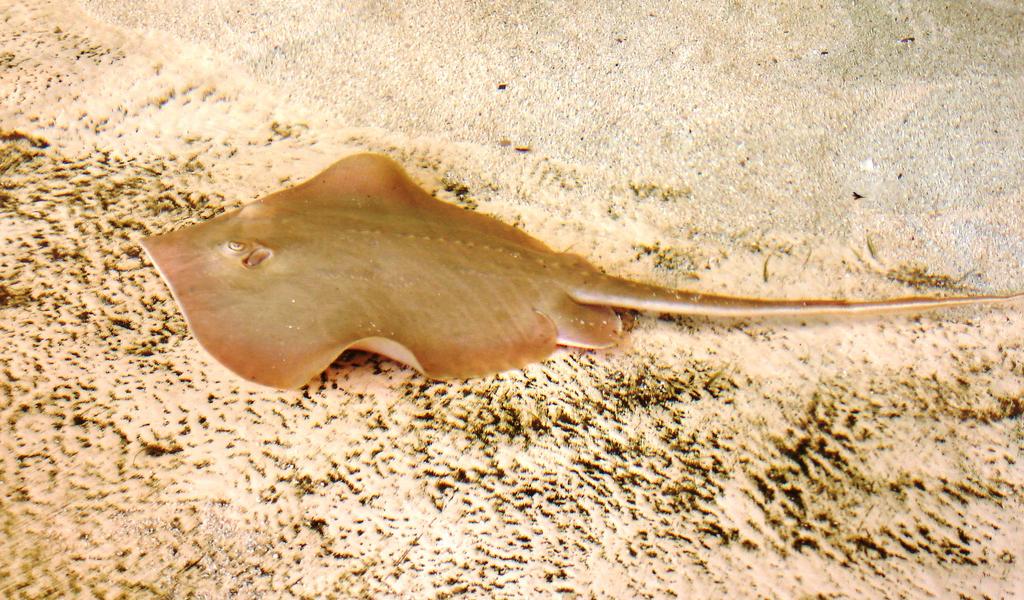
This ray has a diamond-shaped disc that is slightly wider than it is long. Its skin is mostly smooth and plain in colour, ranging from grey to olive-green above and white below. A whip-like tail carries a serrated spine connected to a venom gland. While most individuals are modest in size, some can grow very large. The largest recorded specimen had a fin width exceeding two metres. Older rays may develop a row of bony knobs along their back.
Where it lives
It lives in the northeastern Atlantic Ocean, extending from southern Norway to the Canary Islands. It is also common throughout the Mediterranean and Black Seas. This bottom-dweller prefers calm sandy or muddy areas in shallow water. It can tolerate low salinity and is sometimes found in estuaries. Although it can dive to 200 metres, it usually stays above 60 metres. Seasonal shifts in abundance suggest it moves with changing conditions.
How it lives
The ray often buries itself in sediment during the day and may be more active at night. It hunts for bottom-dwelling prey such as crustaceans, worms and small fish. In some regions, shrimp make up nearly all its diet. It may follow other rays to find food sources. Parasites including flukes and tapeworms inhabit its body. It is not aggressive but will defend itself if threatened.
Breeding and life cycle
Females produce two litters of young each year after a four-month pregnancy. The embryos feed on yolk and then on uterine milk provided by the mother. Births occur in shallow inshore waters, mostly during summer months. Newborns are small, measuring about eight centimetres across. Males mature when they reach roughly 22 to 32 centimetres in width, while females mature slightly later.
Fish and people
Ancient cultures feared its venom, attributing mythical powers to its sting. Today, its wings are sold dried or smoked, and its liver is a delicacy in France. Fishermen catch it incidentally using nets and trawls. It provides material for fishmeal and oil. Welsh traditions once used its liver oil to treat burns. Despite lacking commercial target status, it is heavily impacted by coastal fishing gear.
Status and threats
Populations are declining across its range due to frequent bycatch. It is particularly vulnerable to small-scale coastal fisheries. Surveys suggest it may have disappeared from the Bay of Biscay. The International Union for Conservation of Nature lists it as Vulnerable. Protection measures include marine protected areas in the Balearic Islands. European Union rules also ban trawling near the coast to help conserve stocks.


Questions people ask about Common stingray
Is the common stingray dangerous to humans?
It is not aggressive but has a venomous spine on its tail. A sting causes severe pain and was historically feared. The wound is rarely life-threatening but requires care. Ancient myths exaggerated its power to dissolve stone or kill trees.
What does the common stingray eat?
It feeds mainly on bottom-dwelling crustaceans like shrimp and crabs. It also consumes molluscs, polychaete worms and small bony fishes. Diet composition can change with age and location. It may damage cultured shellfish beds while foraging.
How does the common stingray reproduce?
It is aplacental viviparous, meaning it gives birth to live young. Embryos start with yolk and later receive uterine milk from the mother. Females bear two litters of four to nine pups annually. Births typically happen in shallow water during summer.
Why is the common stingray population declining?
It is frequently caught as bycatch in commercial fisheries. Bottom trawls and gillnets capture large numbers incidentally. Coastal habitats are heavily fished, increasing susceptibility. Surveys show declines in the Mediterranean and Atlantic. It is now assessed as Vulnerable by conservation groups.
Good reading and sources
- Common stingray on WikipediaEncyclopedia
- More photos on Wikimedia CommonsPhotos
- Wikidata recordOpen data
The facts on this page come from the Wikipedia article "Common stingray", written by its contributors and used under the CC BY-SA 4.0 licence, and from its Wikidata record (CC0). EveryFish rewrote the text in its own words, with AI assistance, and compares every page with the article to make sure no passage is copied. It may be reused under the same CC BY-SA 4.0 licence with a link back.
It may contain mistakes, and figures change over time. Nothing here is investment or buying advice. If something is wrong, tell us. Last refreshed 2026-11-15.
Like Common stingray
All rays and skates WorldMangrove whipray
A spotted stingray of Indo-Pacific mangroves and reefs.Ray · Estuaries and mangroves · 1883
 🇺🇸 United States and 1 moreCownose ray
A migratory coastal ray with a distinctive head shape.Ray · Coasts and shelves
 🇬🇧 United Kingdom and 4 moreMarbled electric ray
A benthic electric ray from the eastern Atlantic known for its powerful shocks and mottled brown skin.Ray · Coasts and shelves · 1810
 WorldPink whipray
Large Indo-Pacific stingray with a long tail and pinkish hue.Ray · Coasts and shelves · 1906
More from Dasyatidae
All of them WorldBluespotted ribbontail ray
A small, colourful reef stingray with electric blue spots.Ray · Coasts and shelves · 1775
 🇿🇦 South Africa and 4 moreReticulate whipray
A large spotted stingray from the western Indian Ocean and eastern Mediterranean.Ray · Coasts and shelves · 1789
 🇺🇸 United States and 1 moreAtlantic stingray
Small stingray found in Atlantic coastal waters and fresh rivers.Ray · Rivers and lakes · 1824
 WorldPelagic stingray
The only stingray that lives in the open ocean.Ray · Open ocean · 1832