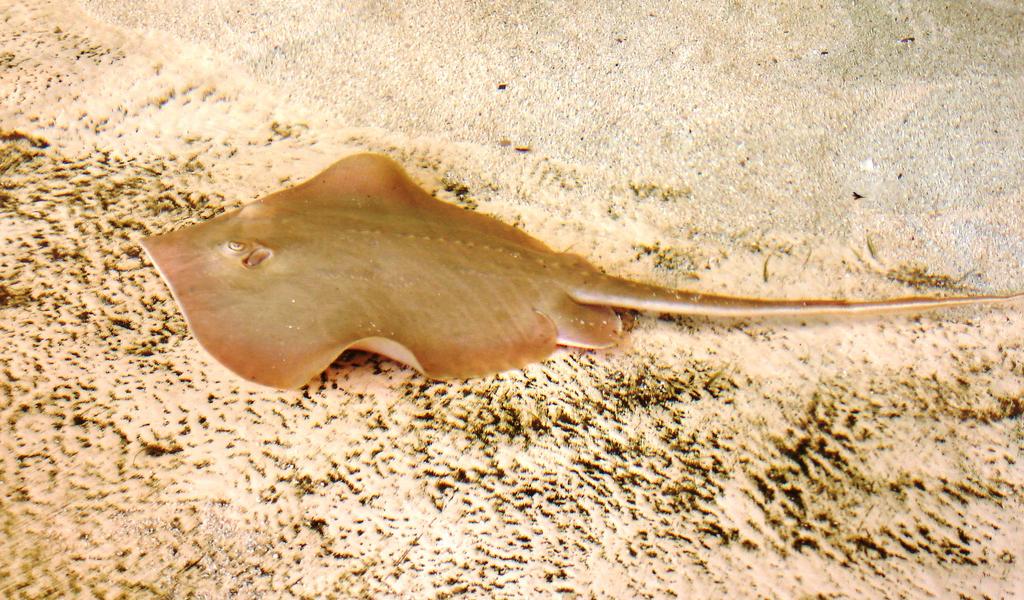
Atlantic stingray
Small stingray found in Atlantic coastal waters and fresh rivers.
This small ray lives along the North American Atlantic coast, from Chesapeake Bay to Mexico. It tolerates fresh water and is the only permanent freshwater elasmobranch population in the region. Listed as Least Concern, it faces low fishing pressure but suffers from poor water quality.
- Only permanent freshwater elasmobranch population in North America
- Reaches maximum length of 61 cm and weight of 4.9 kg
- Males develop sharp curved teeth for gripping females during mating
- Tail spine is replaced annually between June and October
What it is
The Atlantic stingray is a small member of the Dasyatidae family. It features a spade-shaped disk that is slightly wider than it is long, with rounded corners and a notably elongated snout. Adults reach up to 61 cm in length and weigh about 5 kg. The upper surface is brown or yellowish, often with a dark midline stripe, while the underside is pale. A long, whip-like tail carries a serrated spine that regenerates yearly. Larger individuals develop thorny tubercles along their backs.
Where it lives
This species inhabits the western Atlantic Ocean, ranging from Chesapeake Bay south to Florida and into the Gulf of Mexico as far as Campeche, Mexico. It thrives in shallow coastal zones over sand or silt, typically at depths of 2 to 6 metres. Uniquely, it tolerates varying salinity levels and enters freshwater systems like the St. Johns River and Lake Pontchartrain. These river populations represent the only permanent freshwater elasmobranch group in North America. They migrate seasonally to avoid cold, moving offshore in winter.
How it lives
Feeding occurs on the sea floor, where the ray uses electroreceptive organs to locate prey buried in sediment. It faces into currents to wash away sand while hunting for worms, crustaceans, and shellfish. Predators include large sharks such as tiger and bull sharks. In freshwater habitats, American alligators may hunt them. Freshwater individuals host parasites like fish lice. Although they live in rivers, they lack the specialized salt-regulating mechanisms of true river stingrays, relying instead on high urine production to manage osmotic pressure.
Breeding and life cycle
Reproduction is viviparous, with embryos initially fed by yolk sacs before receiving uterine milk from the mother. Mating seasons run from autumn to spring, with males using modified sharp teeth to grip females during courtship. Gestation lasts four to four and a half months. Litters of one to four pups are born in late summer. Newborns measure roughly 10 to 13 cm across. Males mature at a disk width of 20 to 21 cm, while females mature slightly larger at 22 to 24 cm.
Fish and people
The species holds little commercial value for food but is popular in the aquarium trade due to its small size. Accidental encounters can result in painful wounds from the tail spine, though these are rarely fatal. Fishermen often catch them as bycatch in nets targeting flounder or trout, but most are released alive. Conservation groups consider the population stable overall. However, local freshwater groups show signs of stress and reduced reproduction linked to declining water quality in their habitats.
Status and threats
The International Union for Conservation of Nature lists this ray as Least Concern. Threats from targeted fisheries are nonexistent, and bycatch mortality remains low. The primary risk comes from environmental degradation, particularly in freshwater systems where pollution affects health and breeding success. Seasonal migrations help them avoid extreme temperatures, but habitat loss in estuaries and rivers poses a growing challenge to specific local populations.


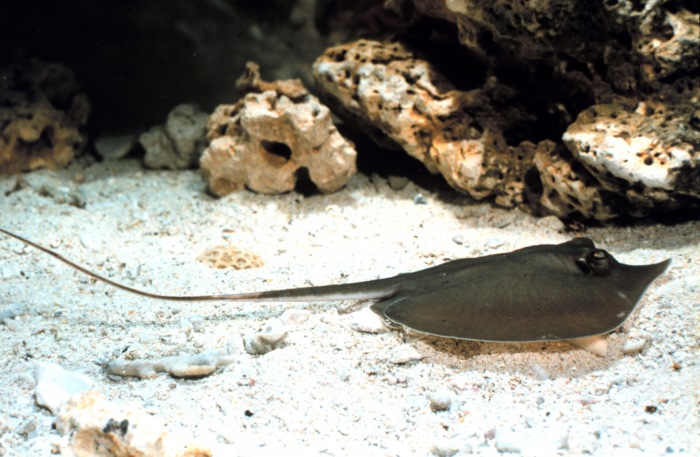
Questions people ask about Atlantic stingray
Can Atlantic stingrays live in fresh water?
Yes, they are euryhaline and can tolerate varying salinities. Populations in the St. Johns River system are the only permanent freshwater elasmobranchs in North America, though they must produce large amounts of dilute urine to cope.
Are Atlantic stingrays dangerous to humans?
They can inflict painful wounds if stepped on due to their serrated tail spine. However, these injuries are rarely life-threatening. The spine is replaced every year, ensuring it remains sharp and effective for defense.
What do Atlantic stingrays eat?
They feed on benthic invertebrates found in sediment, including bivalves, tube anemones, amphipods, crustaceans, and nereid worms. They use electroreceptive organs to detect prey and face currents to clear sand while feeding.
Good reading and sources
- Atlantic stingray on WikipediaEncyclopedia
- More photos on Wikimedia CommonsPhotos
- Wikidata recordOpen data
The facts on this page come from the Wikipedia article "Atlantic stingray", written by its contributors and used under the CC BY-SA 4.0 licence, and from its Wikidata record (CC0). EveryFish rewrote the text in its own words, with AI assistance, and compares every page with the article to make sure no passage is copied. It may be reused under the same CC BY-SA 4.0 licence with a link back.
It may contain mistakes, and figures change over time. Nothing here is investment or buying advice. If something is wrong, tell us. Last refreshed 2026-11-15.
Like Atlantic stingray
All rays and skates 🇺🇸 United States and 2 moreRound stingray
A small coastal ray from the eastern Pacific known for its painful tail spine.Ray · Coasts and shelves
 🇦🇺 AustraliaDwarf sawfish
Smallest sawfish species, native to tropical Australia and New Guinea.Ray · Estuaries and mangroves
 North AmericaYellow stingray
Small, camouflaging stingray of the western Atlantic.Ray · Coasts and shelves · 1816
 🇺🇸 United StatesBig skate
Largest skate in North American Pacific watersRay · Coasts and shelves · 1855
More from Dasyatidae
All of them WorldPelagic stingray
The only stingray that lives in the open ocean.Ray · Open ocean · 1832
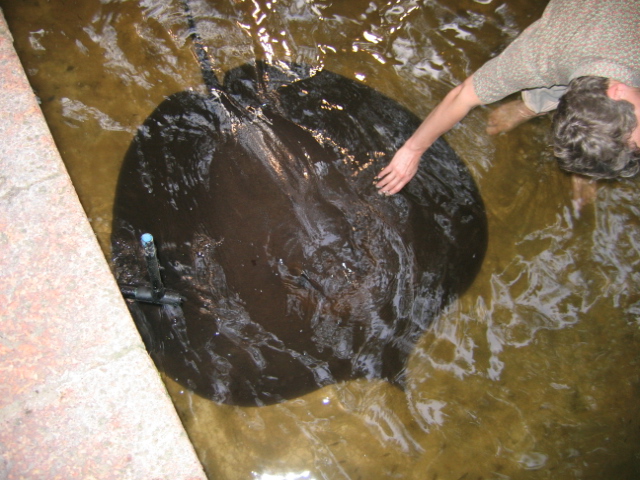 🇹🇭 Thailand and 3 moreGiant freshwater stingray
The widest freshwater fish in the world, found in Southeast Asian rivers.Ray · Rivers and lakes · 1852
 🇿🇦 South Africa and 4 moreReticulate whipray
A large spotted stingray from the western Indian Ocean and eastern Mediterranean.Ray · Coasts and shelves · 1789
 WorldBluespotted ribbontail ray
A small, colourful reef stingray with electric blue spots.Ray · Coasts and shelves · 1775