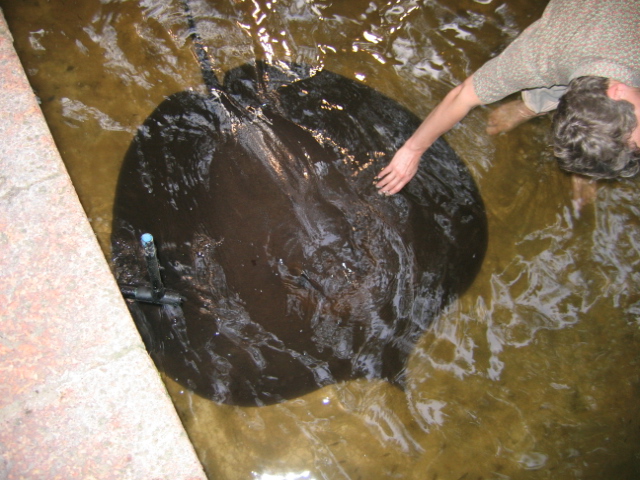
Giant freshwater stingray
The widest freshwater fish in the world, found in Southeast Asian rivers.
This massive ray inhabits large rivers and estuaries across Southeast Asia. It is classified as Endangered by the IUCN due to heavy fishing pressure and habitat loss from dams and development.
- Widest freshwater fish, reaching 2.2 m across.
- Assessed as Endangered by the IUCN.
- Found in the Mekong and Chao Phraya rivers.
- Gives birth to live pups in estuaries.
- Tail spine can pierce bone and causes injury.
What it is
The giant freshwater stingray holds the title for the widest freshwater fish on Earth. Adults can span up to 2.2 metres across and weigh more than 300 kilograms. The body features a thin, oval disc that is broadest at the front, with a sharply pointed snout. The skin is grayish-brown above and white below, marked by dark bands on the rear edges of the fins. A long, whip-like tail carries a single serrated spine capable of piercing bone.
Where it lives
These rays live in major river systems and their connected estuaries in Southeast Asia. Key habitats include the Mekong River, flowing through Thailand and Cambodia, as well as the Chao Phraya, Nan, and Mae Klong rivers. In Borneo, they inhabit the Mahakam, Kinabatangan, and Buket rivers. Historical records suggest a wider past range, including India, but current populations are concentrated in Indochina and parts of Indonesia.
How it lives
They are bottom-dwellers that rest on sandy or muddy substrates. Their diet consists of small fish and invertebrates like crustaceans, which they locate using electroreceptors. They do not migrate between salt and fresh water. Males reach sexual maturity at about 1.1 metres in width.
Breeding and life cycle
Females give birth to live young after nourishing embryos with yolk and later with uterine milk. Litters typically contain one to four pups, each measuring around 30 centimetres across at birth. Pregnant females often gather in estuaries, which likely serve as nurseries. Detailed information regarding female maturation size and other life history traits remains unknown.
Fish and people
Fishers catch these rays for their meat and cartilage, often cutting large specimens into pieces for sale. They are also targeted by sport anglers and kept in public aquariums, though survival in captivity is poor. Conservation efforts have faced challenges; a captive breeding programme in Thailand was halted in the mid-1990s. Habitat degradation from deforestation and land development further complicates their protection.
Status and threats
The International Union for Conservation of Nature lists this species as Endangered. Populations in central Thailand and Cambodia have declined by 30 to 50 percent over recent decades, with some local drops reaching 95 percent. Dams fragment habitats and reduce genetic diversity, while overfishing removes adults before they can reproduce. The average weight of caught rays has decreased significantly since the 1980s.


Questions people ask about Giant freshwater stingray
How big does the giant freshwater stingray get?
It is the widest freshwater fish in the world. Adults can reach 2.2 metres in width and weigh over 300 kilograms. Some reports suggest even larger sizes, making it one of the largest freshwater species globally.
Where does this stingray live?
It inhabits large rivers and estuaries in Southeast Asia. Major locations include the Mekong, Chao Phraya, and Mae Klong rivers in Thailand and Cambodia, as well as rivers in Borneo and Myanmar.
Is the giant freshwater stingray dangerous?
The ray itself is not aggressive. However, its tail has a serrated spine covered in toxic mucus. This sting can pierce bone and cause serious injury to humans who disturb it.
Why is the population declining?
Heavy fishing for food and sport, combined with habitat loss from dams and deforestation, drives the decline. Dams fragment populations, reducing genetic diversity and making recovery difficult.
Good reading and sources
- Giant freshwater stingray on WikipediaEncyclopedia
- More photos on Wikimedia CommonsPhotos
- Wikidata recordOpen data
The facts on this page come from the Wikipedia article "Giant freshwater stingray", written by its contributors and used under the CC BY-SA 4.0 licence, and from its Wikidata record (CC0). EveryFish rewrote the text in its own words, with AI assistance, and compares every page with the article to make sure no passage is copied. It may be reused under the same CC BY-SA 4.0 licence with a link back.
It may contain mistakes, and figures change over time. Nothing here is investment or buying advice. If something is wrong, tell us. Last refreshed 2026-11-15.
Like Giant freshwater stingray
All rays and skates 🇿🇦 South Africa and 4 moreReticulate whipray
A large spotted stingray from the western Indian Ocean and eastern Mediterranean.Ray · Coasts and shelves · 1789
 🇺🇸 United StatesBig skate
Largest skate in North American Pacific watersRay · Coasts and shelves · 1855
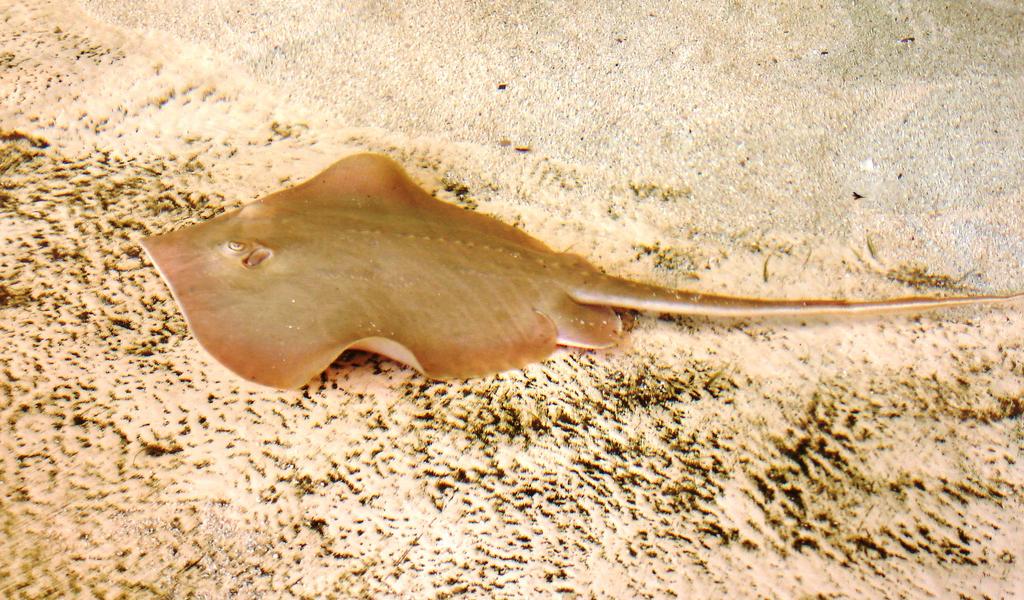 🇺🇸 United States and 1 moreAtlantic stingray
Small stingray found in Atlantic coastal waters and fresh rivers.Ray · Rivers and lakes · 1824
 🇺🇸 United States and 1 moreBat ray
A large eagle ray with wing-like fins found in the eastern Pacific.Ray · Coasts and shelves
More from Dasyatidae
All of them WorldPelagic stingray
The only stingray that lives in the open ocean.Ray · Open ocean · 1832
 WorldMangrove whipray
A spotted stingray of Indo-Pacific mangroves and reefs.Ray · Estuaries and mangroves · 1883
 WorldPink whipray
Large Indo-Pacific stingray with a long tail and pinkish hue.Ray · Coasts and shelves · 1906
 WorldBluespotted ribbontail ray
A small, colourful reef stingray with electric blue spots.Ray · Coasts and shelves · 1775