Blue skate
A large, slow-growing ray native to the northeast Atlantic.
The blue skate is a cartilaginous fish found in the northeast Atlantic and Mediterranean. Once abundant, it is now critically endangered due to overfishing and bycatch. It grows slowly, lives long, and is protected in the European Union.
- Can live for 50 to 100 years
- Reaches maturity at around 11 years old
- Listed as critically endangered by IUCN
- Strictly protected within the European Union
- Lays up to 40 egg cases each summer
What it is
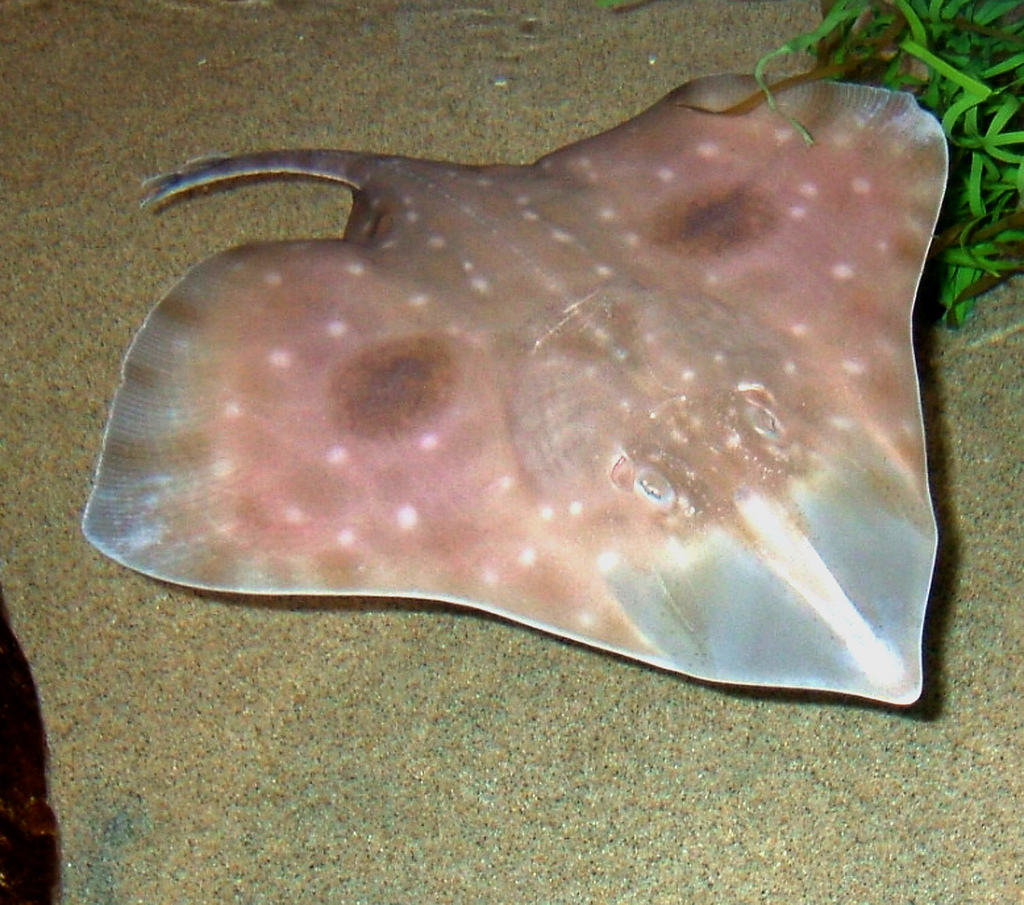
The blue skate is a large ray with a rhombic body shape and a pointed snout. Its upper surface is olive-grey or brown, often marked with spots, while the underside is a lighter blue-grey. A row of spines runs along its tail, typically featuring one or two interdorsal thorns. This cartilaginous fish can grow up to 1.43 metres in length. It belongs to the family Rajidae and was historically grouped with the flapper skate under the name common skate.
Where it lives
This species inhabits the northeast Atlantic Ocean, ranging from Norway and Iceland down to Senegal. Its presence in the Mediterranean Sea is uncertain due to confusion with related species. Blue skates are bottom dwellers that prefer soft seabeds but also live over gravel and rock. They are usually found at depths between 100 and 200 metres, though they can occur as shallow as 30 metres or as deep as 1,000 metres. Populations are now fragmented and depleted across much of this range.
How it lives
As a bottom feeder, the blue skate eats crustaceans, clams, oysters, snails, and worms. It also consumes cephalopods and small to medium-sized fish like sand eels and flatfish. Larger individuals eat bigger prey to sustain their size. While mostly benthic, some skates ascend rapidly from the seabed to catch pelagic fish such as mackerel and herring. Diet varies with size and activity levels. The sex ratio is generally equal, though it may shift based on location and season.
Breeding and life cycle
Blue skates mature slowly, reaching sexual maturity at around 11 years of age. Males mature at about 1.15 metres and females at 1.23 metres. They reproduce only every other year after reaching maturity. Mating occurs in spring, and females lay approximately 40 egg cases during the summer in sandy or muddy flats. These egg cases are up to 25 centimetres long and covered in felted fibres. Eggs develop for two to five months before hatching into juveniles measuring up to 22.3 centimetres.
Fish and people
Fisheries have historically targeted this skate, and it remains vulnerable to incidental capture as bycatch in trawl nets. The species is strictly protected within the European Union, making it illegal for commercial fishers to target or retain it. If caught accidentally, it has a good chance of survival if released. Despite protection, overfishing has caused drastic population declines. It is no longer found in the Baltic Sea. Strongholds remain off western Scotland and in the Celtic Sea.
Status and threats
The International Union for Conservation of Nature lists the blue skate as critically endangered. Its population has collapsed due to direct fishing and bycatch. Recovery is slow because the species lives for up to 100 years and matures late. However, studies of related skates suggest recovery might be possible if pressures are reduced. Misidentification with other skates complicates conservation efforts. Previous records in Norway and the Mediterranean may refer to different species.
Questions people ask about Blue skate
How big does a blue skate get?
The blue skate can reach a maximum length of 1.43 metres, which is about 4 feet 8 inches. It has a rhombic shape with a pointed snout and a tail lined with spines.
Why is the blue skate endangered?
Overfishing and incidental capture as bycatch in trawl fisheries have drastically reduced its numbers. Its slow growth rate and late maturity make it difficult for populations to recover quickly from these losses.
Where do blue skates live?
They are native to the northeast Atlantic, from Norway and Iceland to Senegal. They prefer bottom habitats at depths of 100 to 200 metres, often on soft seabeds, but can be found deeper.
What do blue skates eat?
They are bottom feeders that eat crustaceans, clams, oysters, snails, worms, and cephalopods. They also eat small fish and sometimes rise from the seabed to catch pelagic species like mackerel.
Good reading and sources
The facts on this page come from the Wikipedia article "Blue skate", written by its contributors and used under the CC BY-SA 4.0 licence, and from its Wikidata record (CC0). EveryFish rewrote the text in its own words, with AI assistance, and compares every page with the article to make sure no passage is copied. It may be reused under the same CC BY-SA 4.0 licence with a link back.
It may contain mistakes, and figures change over time. Nothing here is investment or buying advice. If something is wrong, tell us. Last refreshed 2026-11-15.
Like Blue skate
All rays and skates WorldChilean devil ray
A deep-diving oceanic ray with a boxy head.Ray · Open ocean
WorldCommon eagle ray
A large, venomous ray found in the eastern Atlantic and Mediterranean.Ray · Coasts and shelves
 WorldDevil fish
A large Mediterranean ray with a spiny tail and horn-like flaps.Ray · Coasts and shelves
 WorldPelagic stingray
The only stingray that lives in the open ocean.Ray · Open ocean · 1832
More from Rajidae
All of them EuropeThornback ray
A spiny-skinned ray found in European coastal waters.Ray · Coasts and shelves · 1758
 🇺🇸 United StatesBig skate
Largest skate in North American Pacific watersRay · Coasts and shelves · 1855
 WorldSkate
Cartilaginous fish with flat bodies and egg cases, found on sea floors worldwide.Shark · Coasts and shelves
 EuropeBlonde ray
A short-tailed skate found in the Eastern Atlantic and Mediterranean.Ray · Coasts and shelves