
Ganges shark
Critically endangered river shark of South Asia
The Ganges shark is a rare requiem shark living in the rivers of India and Bangladesh. Genetic studies show it includes former species from Borneo and Myanmar. It faces critical endangerment due to habitat loss and fishing.
- Critically endangered with fewer than 250 individuals
- Includes former Borneo and Irrawaddy river shark species
- Adapted to turbid water with minute upward-tilted eyes
- Often confused with the more common bull shark
- Protected under Indian law but enforcement is challenging
What it is
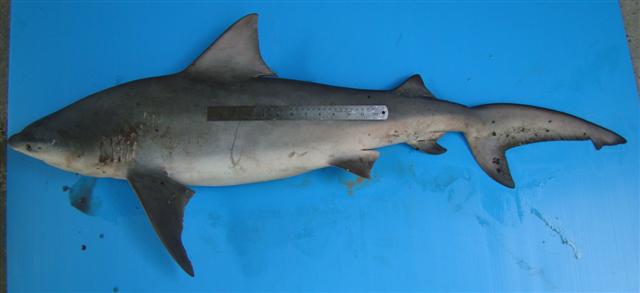
This requiem shark has a stocky build with two spineless dorsal fins. The first dorsal fin starts over the rear third of the pectoral fins. The second dorsal fin is about half the height of the first. Its colour is uniform grey or brown without markings. The snout is short and broadly rounded. Eyes are minute and tilted upwards, an adaptation for low visibility. Upper teeth are triangular and serrated. Lower front teeth have long, hooked cusps with smooth edges.
Where it lives
It lives in the Ganges, Brahmaputra, Hooghly, and Mahanadi river systems in India and Bangladesh. Genetic evidence suggests its range extends to Pakistan, Myanmar, Borneo, and Java. Former distinct species like the Borneo and Irrawaddy river sharks are now considered synonyms. It inhabits middle to lower river reaches and estuaries. No verified marine records exist, though one specimen appeared in a Mumbai market from the Arabian Sea.
How it lives
Feeding habits are largely unknown, but small eyes suggest reliance on smell and electroreception in turbid water. It likely scans upwards for prey silhouetted against sunlight. In the Bay of Bengal, it feeds heavily on bottom-dwelling stingrays. It may move over 100 km in rivers, but this is not for breeding migration. Confusion with the bull shark is common, as both inhabit similar freshwater areas.
Breeding and life cycle
Reproduction is likely viviparous with a yolk-sac placenta, similar to related sharks. Litter size and gestation periods remain unknown. Life history involves slow growth, delayed maturity, and small litters. Newborns are found in fresh water, suggesting birth occurs there. These traits make populations highly vulnerable to exploitation and environmental changes.
Fish and people
Locals often fear it as a man-eater, but most attacks are likely caused by bull sharks. One historical attack in 1868 was attributed to this species. It is caught in gillnets for meat and oil. The oil is used as a fish attractant. Fins may enter the Asian trade. Legal protection exists in India under the Wildlife Protection Act, but enforcement is difficult.
Status and threats
The species is critically endangered with fewer than 250 individuals estimated. Threats include overfishing, pollution, dam construction, and habitat degradation. Mangrove clearing affects its estuarine habitats. Genetic slow change limits adaptation to human impacts. Surveys are urgently needed to assess fishery impacts in the Bay of Bengal.


Questions people ask about Ganges shark
Is the Ganges shark dangerous to humans?
It is widely feared, but most attacks are likely misidentified bull shark incidents. Its slender teeth are suited for fish, not large mammals. Only one historical attack in 1868 was attributed to it.
Where does the Ganges shark live?
It inhabits freshwater and estuarine systems in the Ganges, Brahmaputra, and Hooghly rivers. Genetic data suggests a wider range including Pakistan, Myanmar, and Borneo, but it stays in lower river reaches.
Why is it so rare?
It has slow growth, small litters, and late maturity. Habitat loss from dams and pollution, along with gillnet fishing, has severely reduced numbers. Fewer than 250 are believed to remain.
Good reading and sources
The facts on this page come from the Wikipedia article "Ganges shark", written by its contributors and used under the CC BY-SA 4.0 licence, and from its Wikidata record (CC0). EveryFish rewrote the text in its own words, with AI assistance, and compares every page with the article to make sure no passage is copied. It may be reused under the same CC BY-SA 4.0 licence with a link back.
It may contain mistakes, and figures change over time. Nothing here is investment or buying advice. If something is wrong, tell us. Last refreshed 2026-11-15.
Like Ganges shark
All sharks 🇮🇳 IndiaPondicherry shark
A rare, small grey requiem shark from Indo-Pacific coasts.Shark · Coasts and shelves · 1839
 WorldMilk shark
A small coastal requiem shark found in tropical waters worldwide.Shark · Coasts and shelves · 1837
 WorldPigeye shark
A robust coastal requiem shark often confused with the bull shark.Shark · Coasts and shelves · 1839
 🇦🇺 Australia and 1 moreSpeartooth shark
Rare river shark of northern Australia and New GuineaShark · Rivers and lakes · 1839
More from Carcharhinidae
All of them WorldBlacktip shark
A coastal requiem shark known for spinning leaps and black-tipped fins.Shark · Coasts and shelves · 1839
 WorldSilky shark
A fast, migratory requiem shark found in tropical oceans worldwide.Shark · Open ocean · 1839
 WorldSpinner shark
A fast requiem shark known for spinning leaps out of water.Shark · Coasts and shelves · 1839
 🇮🇳 India and 2 moreSpadenose shark
Small coastal shark with a flat snout and advanced placenta.Shark · Coasts and shelves · 1838