
Speartooth shark
Rare river shark of northern Australia and New Guinea
The speartooth shark is a rare requiem shark found in tropical rivers and coastal waters of northern Australia and New Guinea. It thrives in muddy, turbid environments and faces threats from fishing and habitat loss, leading to its vulnerable conservation status.
- Adults reach lengths of around 2.6 metres
- Found in highly turbid rivers and coastal waters
- Listed as vulnerable by the IUCN
- Relies on electroreception for hunting
- New population discovered in Roper River in 2024
What it is
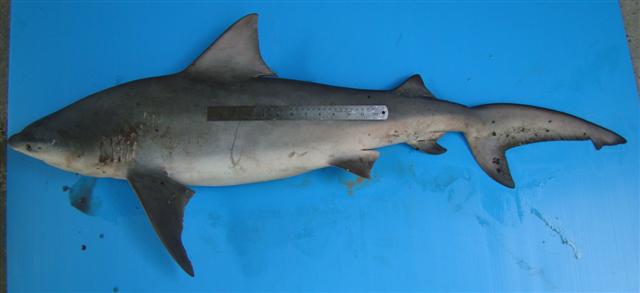
This robust shark has a streamlined grey body with a short, broad snout and tiny eyes. Its upper teeth are triangular and serrated, while lower teeth are narrow and spear-like. A distinctive black blotch marks the underside of each pectoral fin tip. Adults reach about 2.6 metres in length. The species belongs to the requiem shark family and is adapted for life in murky, low-light conditions.
Where it lives
Juveniles inhabit large tropical rivers in northern Australia and New Guinea, often hundreds of kilometres upstream. Key locations include the Adelaide, Alligator, and Fly Rivers. They prefer muddy bottoms with fast tidal currents and high turbidity. Salinity varies from nearly fresh to marine levels. Adults were recently documented in coastal waters off Daru Island. A new population was identified in the Roper River in 2024.
How it lives
The shark moves with tidal currents to conserve energy, showing little activity variation between day and night. It relies on electroreception rather than sight to hunt in dark, muddy water. Prey includes prawns, burrowing gobies, catfish, and other bottom-dwelling fish. Adults may also consume stingrays. Its large second dorsal fin aids manoeuvrability in strong flows.
Breeding and life cycle
Reproduction is viviparous, with a placental connection nourishing embryos after yolk depletion. Birthing likely occurs between October and December. Newborns measure approximately 50 to 59 centimetres. Litter sizes may range from six to seven pups. Young sharks grow at an estimated rate of 19 centimetres per year.
Fish and people
This species does not pose a known danger to humans. It is caught incidentally in gillnets and longlines targeting barramundi. Recreational anglers and bow fishers also capture them. Caught sharks may be used for bait or discarded. Habitat degradation from mining and dredging poses significant threats. Conservation plans exist in Australia, but no regulations restrict capture in Papua New Guinea.
Status and threats
The International Union for Conservation of Nature lists the species as vulnerable due to small populations and restricted range. Estimates suggest fewer than 2,500 mature individuals exist globally. In Australia, it is classified as critically endangered under federal law. Threats include bycatch in fisheries and pollution from mining activities in river systems.

Questions people ask about Speartooth shark
Where does the speartooth shark live?
It inhabits tropical rivers and coastal waters in northern Australia and New Guinea. Juveniles stay in muddy, turbid upstream areas, while adults have been found in near-shore marine environments.
Is the speartooth shark dangerous to humans?
No, it is not known to pose a danger to humans. It is a rare species that primarily feeds on bony fishes and crustaceans in murky, low-visibility waters.
Why is the speartooth shark considered vulnerable?
Its small population, restricted range, and specific habitat needs make it susceptible to threats. Incidental capture in fisheries and habitat degradation from mining are major concerns.
Good reading and sources
- Speartooth shark on WikipediaEncyclopedia
- More photos on Wikimedia CommonsPhotos
- Wikidata recordOpen data
The facts on this page come from the Wikipedia article "Speartooth shark", written by its contributors and used under the CC BY-SA 4.0 licence, and from its Wikidata record (CC0). EveryFish rewrote the text in its own words, with AI assistance, and compares every page with the article to make sure no passage is copied. It may be reused under the same CC BY-SA 4.0 licence with a link back.
It may contain mistakes, and figures change over time. Nothing here is investment or buying advice. If something is wrong, tell us. Last refreshed 2026-11-15.
Like Speartooth shark
All sharks WorldMilk shark
A small coastal requiem shark found in tropical waters worldwide.Shark · Coasts and shelves · 1837
🇦🇺 Australia and 1 moreNorthern river shark
Rare requiem shark of northern Australian and Papuan riversShark · Rivers and lakes · 2008
 WorldBull shark
A stout requiem shark that thrives in fresh and salt water.Shark · Rivers and lakes
 WorldPigeye shark
A robust coastal requiem shark often confused with the bull shark.Shark · Coasts and shelves · 1839
More from Carcharhinidae
All of them WorldSilky shark
A fast, migratory requiem shark found in tropical oceans worldwide.Shark · Open ocean · 1839
 WorldBlacktip shark
A coastal requiem shark known for spinning leaps and black-tipped fins.Shark · Coasts and shelves · 1839
 WorldSpinner shark
A fast requiem shark known for spinning leaps out of water.Shark · Coasts and shelves · 1839
 WorldWhitetip reef shark
Small Indo-Pacific reef shark with white-tipped finsShark · Coasts and shelves · 1837