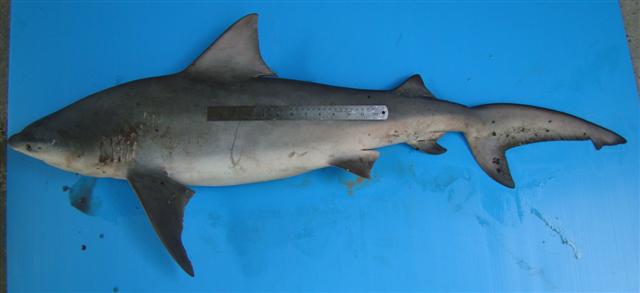
Pigeye shark
A robust coastal requiem shark often confused with the bull shark.
The pigeye shark is a large, grey requiem shark found in warm coastal waters of the Atlantic and Indo-Pacific. It prefers murky, shallow seas with soft bottoms and is an apex predator. Though rare, it faces threats from fishing and habitat changes, leading to a vulnerable conservation status.
- Reaches lengths of up to 2.8 metres
- Often confused with the bull shark
- Caused a fatal ciguatera outbreak in 1993
- Gestation lasts 9 to 12 months
- Listed as vulnerable by the IUCN
What it is
The pigeye shark is a robust requiem shark with a short, blunt snout and small eyes. Its body is grey above and white below, often showing a faint pale band on the flanks. The first dorsal fin is large and triangular, while the second is much smaller. Adults typically measure between 1.9 and 2.5 metres, though some reach 2.8 metres. It closely resembles the bull shark but has fewer vertebrae and different fin proportions. This species lives in warm coastal waters and prefers environments with soft, muddy bottoms.
Where it lives
This shark inhabits tropical and subtropical waters across Eurasia, Africa, and Oceania. In the Atlantic, it ranges from Cape Verde to Namibia, with a rare sighting in the Mediterranean. It is found throughout the Indian Ocean, from South Africa to Australia, and extends into the Pacific as far as China and Micronesia. It stays in coastal zones down to 150 metres depth. Unlike the bull shark, it avoids fresh water but may enter estuaries. Juveniles often remain in localised bays, such as Cleveland Bay in Australia, moving with tides and seasons.
How it lives
An apex predator, the pigeye shark hunts mainly near the sea floor. Its diet includes bony fishes like croakers and flatfish, as well as other sharks, rays, and crustaceans. In South Africa, it consumes more elasmobranchs than elsewhere. It is largely solitary but may gather in small groups. Young sharks face predation from larger species but have low natural mortality rates in nursery areas. Genetic studies show populations in northern Australia are separated by historical land bridges, indicating limited long-distance migration for this species.
Breeding and life cycle
The species is viviparous, meaning embryos develop inside the mother and receive nutrients via a placental connection. Gestation lasts nine months in northern Australia and twelve months off South Africa. Litters contain three to thirteen pups, depending on the region. Newborns are about 60 to 80 centimetres long. Females give birth in sheltered inshore bays, which serve as nurseries for the first few years. Males mature at around 12 years and females at 13. The sharks grow slowly and can live for at least three decades.
Fish and people
Fisheries catch this shark infrequently using gillnets and longlines, valuing its meat and fins. It is potentially dangerous due to its size and teeth. In 2020, a diver in Queensland survived a bite that severed an artery. The shark can accumulate ciguatera toxins from its prey. In 1993, eating pigeye shark meat in Madagascar caused a mass poisoning event with many fatalities. Beach protection nets in South Africa also catch small numbers of these sharks, raising concerns about local population declines.
Status and threats
The International Union for Conservation of Nature lists the pigeye shark as vulnerable globally. Its rarity makes it susceptible to overfishing. In the southwestern Indian Ocean, it is considered near threatened. Data from beach nets in South Africa show a decrease in catch rates and average size between 1978 and 1998, suggesting local depletion. Habitat loss and fishing pressure remain the primary threats to this slow-growing species.


Questions people ask about Pigeye shark
How does the pigeye shark differ from the bull shark?
The pigeye shark has fewer vertebrae before the tail fin and a larger difference in height between its two dorsal fins. It also has a notch in the anal fin that forms an acute angle, whereas the bull shark’s is a right angle. Additionally, the pigeye shark avoids fresh water.
Is the pigeye shark dangerous to humans?
It is considered potentially dangerous due to its large size and sharp teeth. While attacks are rare, one serious incident occurred in 2020 in Australia. The shark is not known for unprovoked aggression but should be treated with caution.
What do pigeye sharks eat?
They are apex predators that feed mainly on bony fishes, other sharks, rays, and crustaceans. They hunt close to the sea floor. In some regions, their diet includes a high proportion of other cartilaginous fishes.
Why is the pigeye shark listed as vulnerable?
The species is rare and slow-growing, making it sensitive to fishing pressure. Catch data from South Africa indicate declining numbers. It is caught for meat and fins, and its limited migration patterns prevent quick recovery of local populations.
Good reading and sources
The facts on this page come from the Wikipedia article "Pigeye shark", written by its contributors and used under the CC BY-SA 4.0 licence, and from its Wikidata record (CC0). EveryFish rewrote the text in its own words, with AI assistance, and compares every page with the article to make sure no passage is copied. It may be reused under the same CC BY-SA 4.0 licence with a link back.
It may contain mistakes, and figures change over time. Nothing here is investment or buying advice. If something is wrong, tell us. Last refreshed 2026-11-15.
Like Pigeye shark
All sharks WorldBlacktip shark
A coastal requiem shark known for spinning leaps and black-tipped fins.Shark · Coasts and shelves · 1839
 WorldMilk shark
A small coastal requiem shark found in tropical waters worldwide.Shark · Coasts and shelves · 1837
 WorldBlacktip reef shark
Small coral reef shark with distinct black fin tipsShark · Coasts and shelves · 1824
 WorldLemon shark
A social, yellow-skinned requiem shark of shallow tropical waters.Shark · Coasts and shelves · 1868
More from Carcharhinidae
All of them WorldSilky shark
A fast, migratory requiem shark found in tropical oceans worldwide.Shark · Open ocean · 1839
 🇦🇺 Australia and 1 moreSpeartooth shark
Rare river shark of northern Australia and New GuineaShark · Rivers and lakes · 1839
 WorldSpinner shark
A fast requiem shark known for spinning leaps out of water.Shark · Coasts and shelves · 1839
 WorldWhitetip reef shark
Small Indo-Pacific reef shark with white-tipped finsShark · Coasts and shelves · 1837