
Spinner shark
A fast requiem shark known for spinning leaps out of water.
The spinner shark is a swift requiem shark found in warm waters worldwide. It feeds by spiralling through fish schools, often jumping clear of the sea. Valued for meat and fins, it faces pressure from commercial fishing and is listed as Vulnerable globally.
- Spins on its axis while feeding, often jumping out of water
- Grows up to 3 metres long and weighs 90 kg
- Listed as Vulnerable by the IUCN due to fishing pressure
- Meat is often marketed as blacktip shark in the US
- Viviparous with litters of 3 to 20 pups every other year
What it is
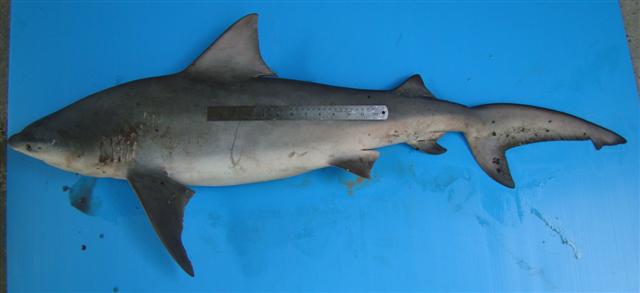
This requiem shark has a slender, streamlined body with a long, pointed snout and small circular eyes. Its colour is grey above, sometimes with a bronze sheen, and white below. Adults display black tips on the second dorsal, pectoral, anal, and lower caudal fins. The first dorsal fin is triangular and set back behind the pectoral fins. It grows up to 3 metres long, though most adults are smaller. The teeth are narrow and serrated in the upper jaw, suited for grasping prey rather than cutting large chunks.
Where it lives
The species inhabits tropical and warm temperate seas across the globe, absent only from the eastern Pacific. In the Atlantic, it ranges from North Carolina to Argentina, including the Gulf of Mexico and Caribbean. Eastern Atlantic populations extend from North Africa to Namibia. Indian Ocean records cover South Africa, Madagascar, the Red Sea, India, and Indonesia. Pacific sightings include Japan, Vietnam, and Australia. Some individuals have migrated through the Suez Canal into the Mediterranean. They occupy coastal shelves and offshore waters down to 100 metres, preferring depths under 30 metres.
How it lives
Swift and active, these sharks often form large schools separated by age and sex. They hunt small bony fish like sardines, herring, and mullet, as well as squid and octopus. A distinctive feeding tactic involves charging vertically through prey schools while spinning on their axis. This momentum frequently launches them out of the water. They also scavenge discards from shrimp trawlers. Juveniles stay in cooler shallow waters, while adults may migrate seasonally, moving inshore during summer and to deeper southern waters in winter.
Breeding and life cycle
Females bear live young after a gestation of 11 to 15 months. Embryos initially rely on a yolk sac, which later forms a placental connection for nutrient transfer. Litters contain three to 20 pups, born in coastal nurseries like bays and estuaries. Newborns measure about 60 to 77 cm. Growth is rapid in the first year, slowing as the shark matures. Males reach maturity at four to five years, while females take seven to eight years. Reproduction typically occurs every other year, with mating taking place in spring and summer.
Fish and people
Commercial fisheries value this shark for its high-quality meat, fins, liver oil, and skin. In the United States, the meat is often sold labelled as blacktip shark. Recreational anglers prize it as a strong fighter that leaps from the sea. While generally not dangerous to humans, excited individuals near food sources may bite. Sixteen unprovoked attacks have been recorded, none fatal. Conservation groups list the species as Vulnerable due to habitat degradation and heavy fishing pressure in coastal zones.
Status and threats
The International Union for Conservation of Nature assesses the global population as Vulnerable. Coastal habits expose the species to human exploitation and environmental damage. In the northwest Atlantic, management falls under the US National Marine Fisheries Service plan for large coastal sharks. Quotas and bag limits aim to control harvest levels. Confusion with the similar blacktip shark complicates accurate population monitoring and reporting in many fisheries.


Questions people ask about Spinner shark
Why is it called the spinner shark?
It earns its name from a unique feeding behaviour. The shark charges vertically through schools of small fish while spinning on its axis. This rapid rotation often carries the animal’s momentum up and out of the water, creating a dramatic spinning leap.
Is the spinner shark dangerous to humans?
It is not usually considered dangerous. Its small teeth are designed for grasping small fish, not cutting large prey. However, it may become aggressive if excited by food, such as during spearfishing. Recorded attacks are rare and non-fatal.
How can you tell it apart from the blacktip shark?
Look at the first dorsal fin. On the spinner shark, this fin is more triangular and positioned further back on the body. Adult spinner sharks also have a black tip on the anal fin, which the blacktip shark lacks.
What do spinner sharks eat?
They primarily consume small bony fishes like sardines, herring, and mullet. They also eat cephalopods such as squid and octopus, and occasionally stingrays. They often hunt in groups, pursuing prey schools at high speed.
Good reading and sources
- Spinner shark on WikipediaEncyclopedia
- More photos on Wikimedia CommonsPhotos
- Wikidata recordOpen data
The facts on this page come from the Wikipedia article "Spinner shark", written by its contributors and used under the CC BY-SA 4.0 licence, and from its Wikidata record (CC0). EveryFish rewrote the text in its own words, with AI assistance, and compares every page with the article to make sure no passage is copied. It may be reused under the same CC BY-SA 4.0 licence with a link back.
It may contain mistakes, and figures change over time. Nothing here is investment or buying advice. If something is wrong, tell us. Last refreshed 2026-11-15.
Like Spinner shark
All sharks WorldMilk shark
A small coastal requiem shark found in tropical waters worldwide.Shark · Coasts and shelves · 1837
 WorldGreat white shark
A large, globally distributed predator known for its size and apex status in marine ecosystems.Shark · Coasts and shelves · 1758
 WorldBroadnose sevengill shark
A large coastal shark with seven gill slits and spotted skin.Shark · Coasts and shelves
 WorldPigeye shark
A robust coastal requiem shark often confused with the bull shark.Shark · Coasts and shelves · 1839
More from Carcharhinidae
All of them 🇦🇺 Australia and 1 moreSpeartooth shark
Rare river shark of northern Australia and New GuineaShark · Rivers and lakes · 1839
 🇺🇸 United States and 4 moreCaribbean reef shark
Large requiem shark of western Atlantic coral reefsShark · Coasts and shelves · 1876
 WorldRequiem shark
A family of migratory, live-bearing sharks found in warm seas worldwide.Shark · Coasts and shelves · 1896
🇦🇺 Australia and 1 moreNorthern river shark
Rare requiem shark of northern Australian and Papuan riversShark · Rivers and lakes · 2008