
Blacktip shark
A coastal requiem shark known for spinning leaps and black-tipped fins.
The blacktip shark is a common coastal predator found in tropical and subtropical waters worldwide. It is valued by commercial fisheries for its meat and fins but faces conservation threats due to slow reproduction.
- Known for spinning leaps out of the water while hunting.
- Has black tips on most fins, giving it its common name.
- Females can reproduce asexually through parthenogenesis.
- Listed as Vulnerable due to overfishing and slow breeding.
- Typically reaches 1.5 m in length in coastal waters.
What it is
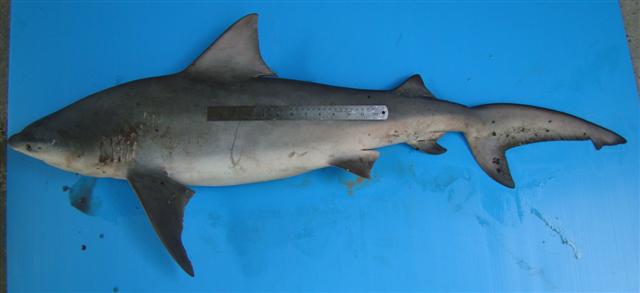
The blacktip shark is a robust requiem shark with a streamlined body and pointed snout. It features long gill slits and no ridge between its dorsal fins. The shark is grey or brown above with a white belly and a distinct lateral stripe. Its most notable feature is the black tips on its pectoral, dorsal, pelvic, and caudal fins, though larger individuals may lack these markings. It typically grows to 1.5 metres but can reach 2.8 metres in length.
Where it lives
This species inhabits tropical and subtropical coastal waters globally. In the Atlantic, it ranges from Massachusetts to Brazil and across to West Africa. It is found throughout the Indian Ocean perimeter and in the Pacific from Japan to Australia and California to Peru. Blacktips prefer shallow waters under 30 metres deep, frequenting muddy bays, lagoons, and coral reef drop-offs. They tolerate low salinity and enter estuaries but do not live in open ocean waters.
How it lives
Blacktip sharks are fast, energetic hunters that often form groups. They feed mainly on small schooling fish like sardines and menhaden, hunting at dawn and dusk. They are known for leaping out of the water while chasing prey or to remove parasites. Despite their speed, they are timid and yield to larger sharks. Juveniles aggregate in nurseries for protection, while adults have no known natural predators.
Breeding and life cycle
Females give birth to live young every other year, with litters of one to ten pups. Gestation lasts 10 to 12 months, during which embryos develop a placental connection. Births occur in shallow coastal nurseries such as those in Florida and Brazil. Females return to their own birthplaces to reproduce. Males mature at four to five years, while females mature later at seven to eight years.
Fish and people
Commercial fisheries target blacktip sharks for their high-quality meat, fins, skin, and liver oil. They are caught using longlines and nets. While generally wary of humans, they can become aggressive near food and are responsible for some shark attacks, mostly minor. Their flesh is marketed fresh, frozen, or salted, and their fins are used in soup.
Status and threats
The International Union for Conservation of Nature lists the blacktip shark as Vulnerable. This status results from its low reproductive rate and high demand in commercial fisheries. Overfishing poses a significant threat to populations, particularly in the northwestern Atlantic where it is a major fishery target.


Questions people ask about Blacktip shark
Are blacktip sharks dangerous to humans?
They are generally timid and wary of people. However, they can become aggressive if food is present. Most recorded attacks result in minor wounds, though they are responsible for a portion of shark incidents in Florida.
What do blacktip sharks eat?
Their diet consists mainly of small schooling fish like sardines, herring, and menhaden. They also consume rays, smaller sharks, crustaceans, and cephalopods, often hunting in groups at dawn or dusk.
How do blacktip sharks reproduce?
They are viviparous, meaning females give birth to live pups. Litters range from one to ten young, born in shallow nursery areas. Females reproduce every other year after a gestation period of about one year.
Good reading and sources
- Blacktip shark on WikipediaEncyclopedia
- More photos on Wikimedia CommonsPhotos
- Wikidata recordOpen data
The facts on this page come from the Wikipedia article "Blacktip shark", written by its contributors and used under the CC BY-SA 4.0 licence, and from its Wikidata record (CC0). EveryFish rewrote the text in its own words, with AI assistance, and compares every page with the article to make sure no passage is copied. It may be reused under the same CC BY-SA 4.0 licence with a link back.
It may contain mistakes, and figures change over time. Nothing here is investment or buying advice. If something is wrong, tell us. Last refreshed 2026-11-15.
Like Blacktip shark
All sharks WorldSpinner shark
A fast requiem shark known for spinning leaps out of water.Shark · Coasts and shelves · 1839
 WorldPigeye shark
A robust coastal requiem shark often confused with the bull shark.Shark · Coasts and shelves · 1839
 WorldSilky shark
A fast, migratory requiem shark found in tropical oceans worldwide.Shark · Open ocean · 1839
 WorldBigeye thresher
Deep-diving shark with huge eyes and a long tail.Shark · Open ocean · 1840
More from Carcharhinidae
All of them 🇦🇺 Australia and 1 moreSpeartooth shark
Rare river shark of northern Australia and New GuineaShark · Rivers and lakes · 1839
 WorldWhitetip reef shark
Small Indo-Pacific reef shark with white-tipped finsShark · Coasts and shelves · 1837
 WorldMilk shark
A small coastal requiem shark found in tropical waters worldwide.Shark · Coasts and shelves · 1837
 WorldSicklefin lemon shark
Large Indo-Pacific requiem shark with sickle-shaped fins.Shark · Coasts and shelves · 1837