
Pondicherry shark
A rare, small grey requiem shark from Indo-Pacific coasts.
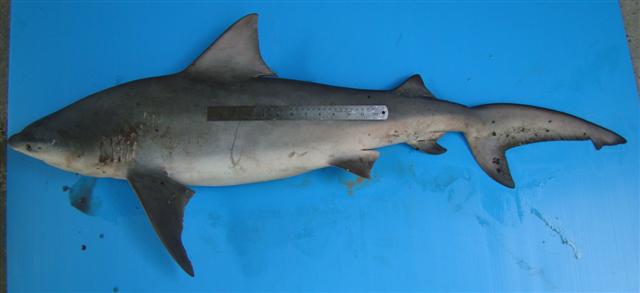
The Pondicherry shark is a critically endangered requiem shark once found across Indo-Pacific waters. It is small, stocky, and grey with distinct black fin tips. Fewer than 20 specimens exist in museums, making its biology largely unknown. Intense fishing pressure likely drove it to near extinction, with the last confirmed sighting in 1979.
- Last confirmed sighting was in India in 1979.
- Fewer than 20 specimens exist in museum collections.
- Distinctive black tips on pectoral and dorsal fins.
- Listed as critically endangered by the IUCN.
- Probably grows no larger than one metre.
What it is
This requiem shark has a robust, stocky build and a moderately long, pointed snout. Its skin is grey above and white below, featuring a pale stripe along the flanks. Distinctive black tips mark the pectoral fins, second dorsal fin, and lower tail lobe. The first dorsal fin is tall with a long free rear tip. Upper teeth are serrated near the base but smooth at the tip. Adults likely reach no more than one metre in length.
Where it lives
Historically, this species inhabited inshore waters across the Indo-Pacific, from the Gulf of Oman to New Guinea. Specimens were collected mainly in India, with others from Borneo, Java, and the Gulf of Oman. Less reliable records exist for Vietnam, the Philippines, and northern Australia. Older reports placed it in rivers like the Hooghli and Saigon, suggesting tolerance for low salinity, though these may have been misidentifications of river sharks.
How it lives
Little is known about its behaviour due to extreme rarity. It likely feeds on small bony fish, squid, and crustaceans. A tapeworm parasite has been documented in this species. As a requiem shark, it is harmless to humans. The scarcity of specimens means most ecological details, such as schooling habits or specific predators, remain unrecorded. It inhabits coastal zones and potentially estuarine environments.
Breeding and life cycle
The shark gives birth to live young. Embryos develop inside the mother and receive nourishment through a placental connection. Specific reproductive details are unknown. The smallest recorded individual was a female measuring 32 cm, which may represent the birth size. Sexual maturity occurs at lengths exceeding 60 cm. The low number of available specimens hinders detailed study of its life cycle.
Fish and people
Fishermen historically caught this shark for its meat. It poses no threat to humans. Fewer than 20 specimens are held in museum collections, most gathered before 1900. Its rarity led to fears of extinction after the last verified sighting in India in 1979. Recent claims of sightings in Sri Lanka and India were largely dismissed as misidentifications of other species, such as bull sharks.
Status and threats
The International Union for Conservation of Nature lists this shark as critically endangered. It is considered one of the most wanted lost species by conservation groups. Heavy, unregulated artisan and commercial fishing across its range likely caused its decline. While thought extinct since the 1970s, occasional unconfirmed reports persist. Conservationists prioritise locating any surviving populations to prevent total loss.


Questions people ask about Pondicherry shark
Is the Pondicherry shark extinct?
It is listed as critically endangered, not extinct. The last verified sighting occurred in 1979 in India. Although some recent reports exist, they were often dismissed as misidentifications. Conservationists continue to search for living populations as part of lost species initiatives.
How big does the Pondicherry shark get?
This small shark likely reaches a maximum length of just over one metre. The smallest known specimen measured 32 cm, which may be close to its birth size. Large adults are extremely rare in scientific collections, making exact maximum sizes uncertain.
Where did the Pondicherry shark live?
It inhabited inshore coastal waters across the Indo-Pacific, from the Gulf of Oman to New Guinea. Most specimens came from India. Some older records suggest it entered rivers, indicating possible tolerance for fresh or brackish water, though these reports may be inaccurate.
Good reading and sources
- Pondicherry shark on WikipediaEncyclopedia
- More photos on Wikimedia CommonsPhotos
- Wikidata recordOpen data
The facts on this page come from the Wikipedia article "Pondicherry shark", written by its contributors and used under the CC BY-SA 4.0 licence, and from its Wikidata record (CC0). EveryFish rewrote the text in its own words, with AI assistance, and compares every page with the article to make sure no passage is copied. It may be reused under the same CC BY-SA 4.0 licence with a link back.
It may contain mistakes, and figures change over time. Nothing here is investment or buying advice. If something is wrong, tell us. Last refreshed 2026-11-15.
Like Pondicherry shark
All sharks WorldGreat hammerhead
The largest hammerhead shark, known for its wide cephalofoil and critically endangered status.Shark · Coasts and shelves · 1837
 WorldMilk shark
A small coastal requiem shark found in tropical waters worldwide.Shark · Coasts and shelves · 1837
 🇺🇸 United States and 3 morePacific angelshark
A flat-bodied ambush shark of the eastern Pacific coast.Shark · Coasts and shelves · 1859
 WorldAngelshark
Flat-bodied sharks that bury themselves in sandy seabeds to ambush prey.Shark · Coasts and shelves · 1758
More from Carcharhinidae
All of them WorldSilky shark
A fast, migratory requiem shark found in tropical oceans worldwide.Shark · Open ocean · 1839
 🇦🇺 Australia and 1 moreSpeartooth shark
Rare river shark of northern Australia and New GuineaShark · Rivers and lakes · 1839
 WorldSpinner shark
A fast requiem shark known for spinning leaps out of water.Shark · Coasts and shelves · 1839
 WorldPigeye shark
A robust coastal requiem shark often confused with the bull shark.Shark · Coasts and shelves · 1839