
Great hammerhead
The largest hammerhead shark, known for its wide cephalofoil and critically endangered status.
The great hammerhead is the biggest member of the hammerhead family, reaching over six metres in length. It inhabits warm oceans globally but faces severe population declines due to finning for soup, leading to a critically endangered classification.
- Maximum recorded length reaches 6.2 metres with weights up to 580 kg.
- Head shape functions as a hydrofoil to pin and disable stingray prey.
- Swims on its side for up to 90% of time to reduce drag and save energy.
- Classified as Critically Endangered by the IUCN due to finning and bycatch.
- Gives birth to live young every two years after an eleven-month gestation.
What it is
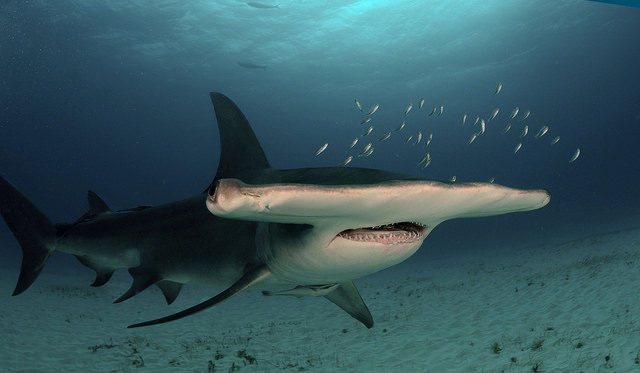
This shark possesses a streamlined body topped by a distinctive head shape called a cephalofoil. The front edge of this structure is nearly straight, setting it apart from other hammerheads. Adults display dark brown or olive upper surfaces that fade to white underneath. Their first dorsal fin stands tall and curved like a sickle, while pelvic fins show strong concave rear edges. Individuals typically measure around four and a half metres, though some females exceed six metres. The skin features diamond-shaped scales with ridges that vary by size.
Where it lives
Populations inhabit tropical oceans across the globe, spanning latitudes from forty degrees north to thirty-seven degrees south. They appear in the Atlantic from North Carolina to Uruguay and Morocco to Senegal. Pacific ranges extend from Baja California to Peru and Ryukyu Islands to Australia. Habitat choices include coral reefs, island terraces, and continental shelves. Depths range from shallow inshore waters under one metre to eighty metres offshore. Seasonal migrations move groups toward higher latitudes during summer months.
How it lives
These sharks act as solitary apex predators, hunting primarily at dawn or dusk. They target stingrays using electroreceptors on their head to detect buried prey. A unique hunting technique involves striking rays with the cephalofoil to immobilize them before biting. Diets also include crabs, squid, jacks, and smaller sharks. Juveniles face predation from bull sharks, while adults encounter no major threats except killer whales. They sometimes swim on their side to reduce drag and save energy.
Breeding and life cycle
Reproduction occurs via viviparity, where embryos develop inside the mother with a placental-like connection after yolk depletion. Mating happens near the surface rather than on the seabed. Females breed every two years, carrying young for eleven months. Litters contain six to fifty-five pups, measuring fifty to seventy centimetres at birth. Young sharks possess rounded head margins distinct from adult straight edges. Sexual maturity arrives at lengths between two and three metres.
Fish and people
Fishermen capture these sharks using longlines, nets, and trawls throughout tropical regions. Their fins hold high value in Asian markets for shark fin soup, driving significant fishing pressure. Meat remains rarely consumed, though skin and liver oil find commercial use. Accidental catches result in mortality rates exceeding ninety percent in some areas. Recreational harvesting bans exist in Queensland, while other Australian jurisdictions permit targeting. Interactions with divers are generally shy, despite historical reputations for aggression.
Status and threats
The species faces critical endangerment due to slow reproduction and heavy fishing exploitation. Populations have dropped significantly since the nineteen nineties, particularly in the northwest Atlantic and Gulf of Mexico. Illegal longline operations in the southwestern Indian Ocean further threaten numbers. Catch rates in the Indian Ocean fell by seventy-three percent between seventeen hundred and seventy-eight and two thousand and three. Conservation efforts struggle because fisheries often group this species with others in catch reports.


Questions people ask about Great hammerhead
What makes the great hammerhead different from other hammerheads?
It has the widest cephalofoil with a nearly straight front margin among hammerheads. Its first dorsal fin is taller and more sickle-shaped. Pelvic fins feature concave rear edges, unlike the straight margins found in scalloped hammerheads.
How does the great hammerhead hunt stingrays?
It uses electroreceptors on its head to find buried rays. The shark strikes the ray with its cephalofoil to immobilize it. It then pins the prey down and bites off sections of the pectoral fins to cripple it.
Why is the great hammerhead critically endangered?
Heavy fishing for valuable fins used in soup drives population declines. Slow reproduction rates limit recovery. High bycatch mortality in commercial fisheries further reduces numbers globally.
Is the great hammerhead dangerous to humans?
While capable of causing injury, attacks are rare. Divers report shy behavior. Only one confirmed provoked bite exists in records, despite historical reputations for aggression.
Good reading and sources
- Great hammerhead on WikipediaEncyclopedia
- More photos on Wikimedia CommonsPhotos
- Wikidata recordOpen data
The facts on this page come from the Wikipedia article "Great hammerhead", written by its contributors and used under the CC BY-SA 4.0 licence, and from its Wikidata record (CC0). EveryFish rewrote the text in its own words, with AI assistance, and compares every page with the article to make sure no passage is copied. It may be reused under the same CC BY-SA 4.0 licence with a link back.
It may contain mistakes, and figures change over time. Nothing here is investment or buying advice. If something is wrong, tell us. Last refreshed 2026-11-15.
Like Great hammerhead
All sharks WorldSchool shark
A temperate houndshark valued for liver oil and meat.Shark · Coasts and shelves
 WorldSicklefin lemon shark
Large Indo-Pacific requiem shark with sickle-shaped fins.Shark · Coasts and shelves · 1837
 WorldWhitetip reef shark
Small Indo-Pacific reef shark with white-tipped finsShark · Coasts and shelves · 1837
 WorldSilky shark
A fast, migratory requiem shark found in tropical oceans worldwide.Shark · Open ocean · 1839
More from Sphyrnidae
All of them South AsiaWinghead shark
A small hammerhead with an exceptionally wide cephalofoil.Shark · Coasts and shelves · 1822
 WorldSmooth hammerhead
Temperate hammerhead shark with a curved head marginShark · Coasts and shelves · 1758
 WorldHammerhead shark
Sharks with T-shaped heads for better vision and sensing prey.Shark · Coasts and shelves
 🇺🇸 United States and 4 moreBonnethead
A small hammerhead shark with a spade-shaped head and omnivorous diet.Shark · Coasts and shelves