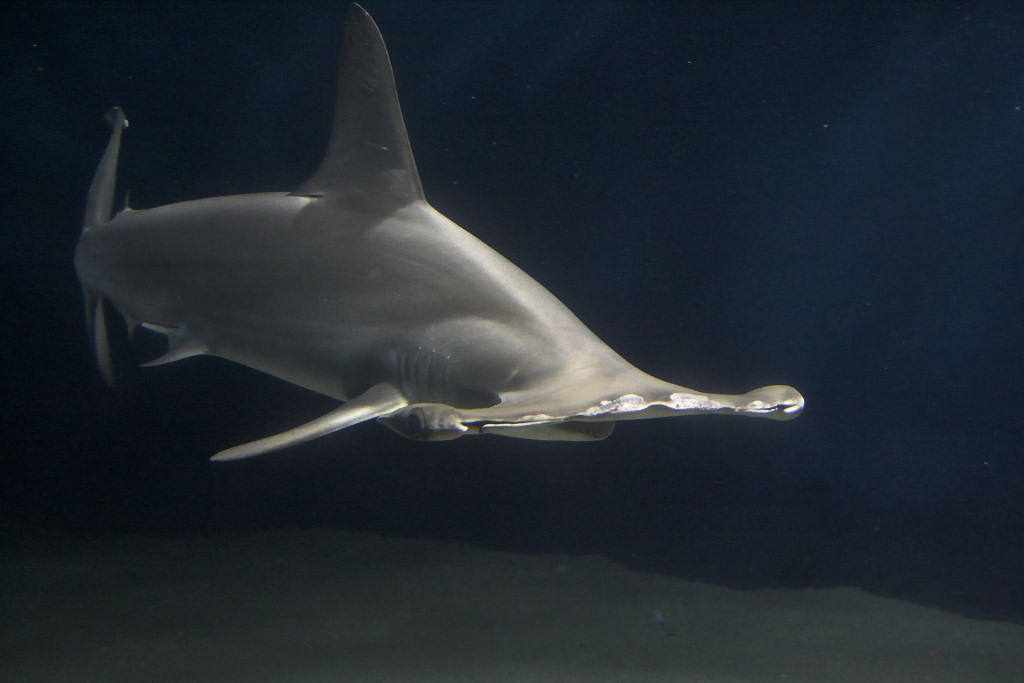
Hammerhead shark
Sharks with T-shaped heads for better vision and sensing prey.
Hammerhead sharks are a family of marine predators known for their flattened, hammer-like heads. They inhabit warm coastal waters globally and use their unique head shape to detect electric fields from prey like stingrays. Some species face endangerment due to overfishing for fins.
- Eyes on head ends allow 360-degree vertical vision.
- Head shape helps pin stingrays to the ocean floor.
- Bonnetheads can reproduce without male partners.
- Great hammerheads average 4 metres in length.
- Fins are highly valued in Asian food markets.
What it is
Hammerhead sharks belong to the family Sphyrnidae. They are named for their distinctive heads, which are flattened and extended sideways into a T-shape called a cephalofoil. Their eyes sit at opposite ends of this structure, providing wide vertical vision. Most species have light grey skin with white bellies for camouflage. The great hammerhead is the largest, averaging four metres in length, while the bonnethead is much smaller. This unique head shape helps them sense prey and manoeuvre in the water.
Where it lives
These sharks live in warm waters across the globe. They prefer coastal areas and continental shelves rather than the open deep ocean. During summer months, some populations migrate to seek cooler temperatures. Young hammerheads often stay in shallow shorelines to avoid larger predators. They are found in tropical regions worldwide, including the Atlantic, Pacific, and Indian Oceans. Their distribution follows warm currents where their preferred prey is abundant.
How it lives
Hammerheads display unusual social behaviour for sharks. Many species form large schools during the day but hunt alone at night. Their diet includes fish, squid, octopus, and crustaceans. Stingrays are a favourite target. The shark uses its broad head to pin rays against the seabed, stunning them before eating. Bonnetheads also consume seagrass, making them partially omnivorous. Great hammerheads may occasionally eat other hammerheads, including their own young.
Breeding and life cycle
Reproduction happens once a year. Males bite females aggressively during mating. These sharks give birth to live young, a method called viviparity. Embryos first feed from a yolk sac. Later, this sac becomes a placenta-like structure that provides nutrients from the mother. Litters usually contain 12 to 15 pups, though great hammerheads can have up to 40. Newborns receive no parental care and must survive independently. Some bonnetheads can reproduce without males through parthenogenesis.
Fish and people
Humans pose the greatest threat to these sharks. They are heavily fished for their fins, which are prized in Asian cuisine. The practice of finning involves cutting off fins and discarding the living animal. Hammerhead meat is eaten in places like Japan and Trinidad. In Hawaii, the hammerhead is respected as a guardian spirit called aumakua. Torres Strait Islanders view it as a totem representing law. Aquariums keep smaller species like the bonnethead, but larger ones are difficult to maintain.
Status and threats
The great and scalloped hammerheads are listed as endangered. Overfishing and high demand for shark fins drive this decline. Their tendency to gather in large groups makes them easy targets for commercial fisheries. Genetic studies show that isolated populations have less diversity, threatening long-term survival. In 2013, international trade regulations under CITES began to protect these species. Conservationists worry that population fragmentation will further reduce their numbers if fishing pressure continues.


Questions people ask about Hammerhead shark
Why do hammerhead sharks have shaped heads?
The T-shaped head, or cephalofoil, spreads out electroreceptors. This allows the shark to detect electric fields from prey over a wider area. It also improves binocular vision and depth perception, helping them spot animals above and below.
Are hammerhead sharks dangerous to humans?
Attacks are rare and unprovoked incidents number only 17 since 1580. No human fatalities have been recorded. Most species are too small to cause serious harm, and they generally do not view humans as prey.
What do hammerhead sharks eat?
They primarily eat fish, squid, octopus, and crustaceans. Stingrays are a specific favourite, which they pin down using their heads. Bonnethead sharks also eat seagrass, making them one of the few omnivorous shark species.
Can hammerhead sharks reproduce without males?
Yes, the bonnethead shark can perform automictic parthenogenesis. In this process, a female's egg fuses with a polar body to create an embryo. This was the first time asexual reproduction was documented in sharks.
Good reading and sources
- Hammerhead shark on WikipediaEncyclopedia
- More photos on Wikimedia CommonsPhotos
- Wikidata recordOpen data
The facts on this page come from the Wikipedia article "Hammerhead shark", written by its contributors and used under the CC BY-SA 4.0 licence, and from its Wikidata record (CC0). EveryFish rewrote the text in its own words, with AI assistance, and compares every page with the article to make sure no passage is copied. It may be reused under the same CC BY-SA 4.0 licence with a link back.
It may contain mistakes, and figures change over time. Nothing here is investment or buying advice. If something is wrong, tell us. Last refreshed 2026-11-15.
Like Hammerhead shark
All sharks WorldBroadnose sevengill shark
A large coastal shark with seven gill slits and spotted skin.Shark · Coasts and shelves
 WorldBasking shark
The second-largest living fish, a slow-moving filter feeder found in temperate oceans worldwide.Shark · Coasts and shelves · 1765
 🇿🇦 South Africa and 4 moreWhale shark
The largest living fish species, a gentle giant of tropical oceans.Shark · Open ocean · 1829
 🇺🇸 United States and 4 moreCaribbean reef shark
Large requiem shark of western Atlantic coral reefsShark · Coasts and shelves · 1876