
Spadenose shark
Small coastal shark with a flat snout and advanced placenta.
The spadenose shark is a small requiem shark found in the tropical Indo-Pacific. It features a unique flattened snout and exhibits highly advanced placental viviparity. Fishers value it for meat and fins, though conservationists list it as near threatened due to heavy coastal fishing pressure.
- Has the most advanced placental connection of any fish.
- Named for its distinctively flattened, triangular snout.
- Forms large schools in shallow coastal waters.
- Meat is processed into gel powder for food uses.
- Listed as near threatened by the IUCN.
What it is
This small, stocky shark belongs to the requiem family. It is best known for its broad head and distinctive trowel-shaped snout, which is highly flattened. The body is bronze-gray on top with a white belly. Its fins are plain, though sometimes darker than the rest of the body. Adults typically reach lengths of 74 cm, making them manageable for local fishers. The eyes and nostrils are small, and the mouth corners sit well behind the eyes. Teeth are blade-like without serrations, suited for gripping slippery prey.
Where it lives
These sharks inhabit the western Indo-Pacific region. Their range extends from Tanzania in the west to Japan and Taiwan in the north. They are common around South and Southeast Asia, including Java and Borneo. They prefer shallow coastal waters, usually staying at depths between 10 and 13 metres. Rocky bottoms are frequent habitats. Reports exist of them in river lower reaches in Malaysia and Sumatra, but it remains unclear if they tolerate fresh water like bull sharks.
How it lives
Spadenose sharks are abundant and often form large schools. They are active predators of small bony fishes such as anchovies, codlets, and Bombay ducks. Their diet also includes invertebrates like shrimp, crabs, and cuttlefish. Parasites such as tapeworms and roundworm larvae have been found in this species. Despite their predatory nature, they are harmless to humans. Their schooling behaviour makes them visible and accessible to coastal fishing operations throughout their range.
Breeding and life cycle
This species displays the most advanced placental connection seen in any fish. Embryos become dependent on the mother at just 3 mm in length. A complex structure called the trophonematal cup facilitates nutrient transfer from the mother’s blood. Females breed year-round with a gestation period of five to six months. Litters contain six to 18 pups, born at 12 to 15 cm long. Males mature at 24 to 36 cm, while females mature slightly larger. Lifespan is short, estimated at five to six years.
Fish and people
Fishers target this shark using gillnets, trawls, and longlines. The meat is consumed locally or used as bait for other species. Fins are prized for shark fin soup. Carcasses are often processed into fishmeal. The meat can also be treated to create gel powder for food supplements or biodegradable packaging. In India and Pakistan, catches are substantial, with hundreds of tons landed annually in some areas. It is a common sight in Chinese coastal markets. The species is harmless to swimmers and divers.
Status and threats
The International Union for Conservation of Nature lists this shark as near threatened. Heavy fishing pressure across its range poses a significant risk. It is frequently caught as bycatch in gillnet fisheries, particularly off Kalimantan. Coastal development threatens its inshore habitat. However, its short reproductive cycle may offer some resilience compared to slower-growing sharks. Despite this, its low number of offspring per litter means populations can decline if overfished. Comprehensive fishery statistics remain lacking for many regions.


Questions people ask about Spadenose shark
Is the spadenose shark dangerous to humans?
No, this species is considered harmless to humans. Despite being a predator of small fish and invertebrates, it does not pose a threat to people. Its small size and diet make it safe for swimmers and divers in its coastal habitat.
What makes its reproduction unique among fish?
It exhibits the most advanced form of placental viviparity known in fish. The embryos develop a complex placental connection to the mother at a very small size, allowing for efficient nutrient and gas exchange through a specialized uterine structure.
Where can you find spadenose sharks?
They live in the tropical Indian and western Pacific Oceans. Their range covers coastal areas from Tanzania to Japan, including South and Southeast Asia. They prefer shallow waters near rocky bottoms and are often found in large schools.
How is the spadenose shark used by people?
It is valued by artisanal and commercial fishers for its meat and fins. The meat is eaten, used as bait, or processed into fishmeal and gel powder. The fins are used for shark fin soup. It is a significant component of fisheries in South and Southeast Asia.
Good reading and sources
- Spadenose shark on WikipediaEncyclopedia
- More photos on Wikimedia CommonsPhotos
- Wikidata recordOpen data
The facts on this page come from the Wikipedia article "Spadenose shark", written by its contributors and used under the CC BY-SA 4.0 licence, and from its Wikidata record (CC0). EveryFish rewrote the text in its own words, with AI assistance, and compares every page with the article to make sure no passage is copied. It may be reused under the same CC BY-SA 4.0 licence with a link back.
It may contain mistakes, and figures change over time. Nothing here is investment or buying advice. If something is wrong, tell us. Last refreshed 2026-11-15.
Like Spadenose shark
All sharks WorldBlacktip shark
A coastal requiem shark known for spinning leaps and black-tipped fins.Shark · Coasts and shelves · 1839
 WorldMilk shark
A small coastal requiem shark found in tropical waters worldwide.Shark · Coasts and shelves · 1837
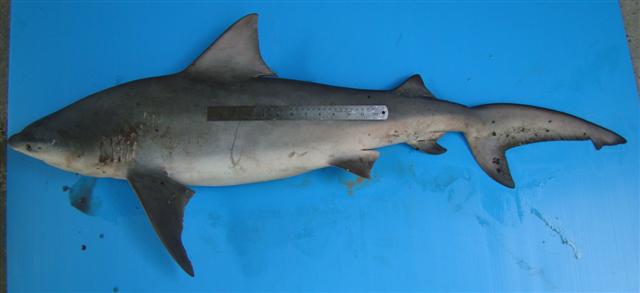 WorldPigeye shark
A robust coastal requiem shark often confused with the bull shark.Shark · Coasts and shelves · 1839
 WorldSicklefin lemon shark
Large Indo-Pacific requiem shark with sickle-shaped fins.Shark · Coasts and shelves · 1837
More from Carcharhinidae
All of them WorldSilky shark
A fast, migratory requiem shark found in tropical oceans worldwide.Shark · Open ocean · 1839
 WorldWhitetip reef shark
Small Indo-Pacific reef shark with white-tipped finsShark · Coasts and shelves · 1837
 WorldSpinner shark
A fast requiem shark known for spinning leaps out of water.Shark · Coasts and shelves · 1839
 🇦🇺 Australia and 1 moreSpeartooth shark
Rare river shark of northern Australia and New GuineaShark · Rivers and lakes · 1839