🇳🇿 Fish of New Zealand
25 fish from New Zealand, best known first.
New Zealand’s vast exclusive economic zone supports a major export-driven fishing sector, managing over 15,000 marine species through a pioneering quota system. The industry balances commercial exports with indigenous rights and faces ongoing challenges from climate change impacts on fish stocks.
- Exclusive economic zone covers 4.1 million square kilometres
- Quota Management System introduced in 1986
- Seafood is fifth largest export earner
- Over 15,000 marine species known to exist
- Māori control over thirty percent of commercial fisheries
Fish of New Zealand
New Zealand operates one of the world’s largest exclusive economic zones, covering 4.1 million square kilometres. This area holds about ten percent of global marine diversity, including many unique species. The fishing industry is a key economic driver, with seafood ranking as the fifth largest export earner. Management relies on a property-rights based Quota Management System introduced in 1986 to prevent overexploitation. The Ministry for Primary Industries oversees these regulations, ensuring sustainable harvest levels while accommodating customary Māori fishing rights.
Notable species
The waters host more than 15,000 known marine species, many of which are migratory or endemic due to isolation. Commercially targeted species include hoki and orange roughy, which gained international demand after northern hemisphere cod fisheries collapsed. Other notable catches involve mussels, salmon, and oysters in aquaculture settings. The high biodiversity includes deep-water varieties found near undersea mountains and trenches. Many species remain untargeted, preserving ecological balance within the complex underwater topography.
Seas and rivers
The coastline spans 15,000 kilometres, featuring coastal estuaries and extensive continental shelves that occupy roughly thirty percent of the exclusive economic zone. Deeper areas contain continental rises, undersea mountain ranges, volcanoes, and the Kermadec Trench, reaching 10,000 metres. These varied habitats support diverse fish populations. Bottom trawling has affected only 4.4 percent of the sea floor between 2008 and 2017, leaving most areas untouched by industrial gear. The isolation of these waters contributes to the distinctiveness of its marine life.
Fishing and farming
Commercial fishing employs thousands across vessels and processing plants, capturing hundreds of thousands of tonnes annually. Recreational anglers contribute significantly, with millions participating occasionally. Aquaculture produces mussels, salmon, and oysters, adding substantial export value. The industry transitioned from domestic supply to exporting over ninety percent of its catch. Historical shifts included joint ventures with foreign fleets and the adoption of mechanised factory trawlers. Current management limits bottom trawling in specific zones to protect seabed ecosystems.
Fish in culture
Māori have held customary fishing rights since the Treaty of Waitangi in 1840, guaranteeing undisturbed possession of fisheries. Legal settlements allowed Māori to acquire significant commercial quotas and marine farming space. Today, they control or influence over thirty percent of the commercial fishing industry. This integration reflects historical claims and modern reconciliation efforts. Traditional practices coexist with contemporary regulatory frameworks, ensuring indigenous participation remains central to resource management and economic benefit distribution.
Today
Climate change poses risks through marine heatwaves, ocean acidification, and shifting fish ranges. Warmer waters affect aquaculture suitability and cause habitat loss for some species. The Ministry for Primary Industries monitors these changes to adapt management strategies. Conservation measures include protections for great white sharks and restrictions on bottom trawling. The industry continues to evolve, balancing economic output with environmental sustainability amid growing global demand for quality whitefish.
The facts in this overview come from the Wikipedia article "Fishing industry in New Zealand", written by its contributors and used under the CC BY-SA 4.0 licence. EveryFish rewrote the text in its own words, with AI assistance, and compares every page with the article to make sure no passage is copied. It may be reused under the same CC BY-SA 4.0 licence with a link back.
 🇳🇿 New ZealandGiant kōkopu
New Zealand's largest freshwater fish, known for its amphidromous life cycle and traditional food value.Other · Rivers and lakes · 1789
 🇳🇿 New ZealandNew Zealand longfin eel
A large, long-lived freshwater eel endemic to New Zealand, known for its extended dorsal fin and endangered status.Eel · Rivers and lakes · 1874
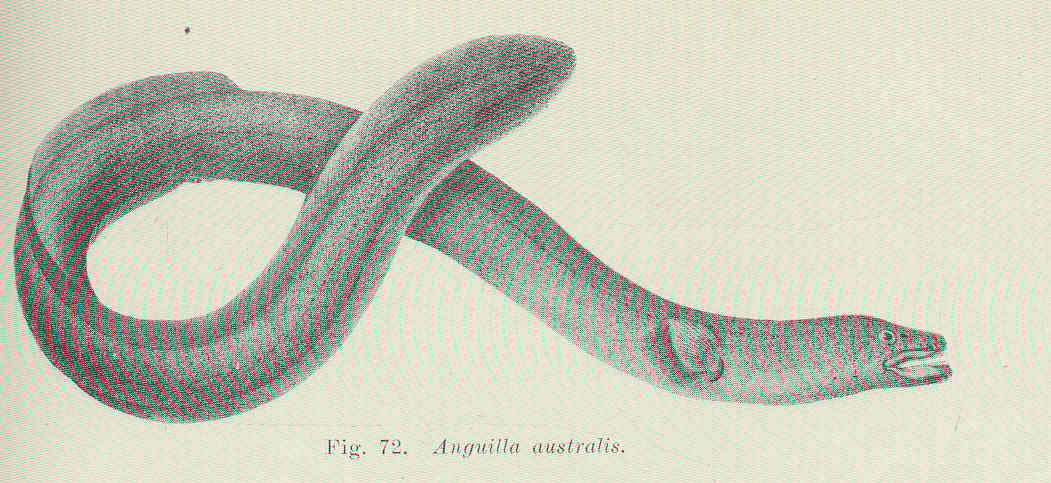 🇦🇺 Australia and 1 moreShort-finned eel
A catadromous eel native to Australia and New Zealand.Eel · Rivers and lakes
 🇨🇳 China and 3 moreGrass carp
Large herbivorous freshwater fish used for weed control and food.Carp · Rivers and lakes
 🇺🇸 United States and 3 moreChinook salmon
The largest Pacific salmon species, prized for size and food value.Salmonid · Rivers and lakes
Photo credits on this page
The small pictures above come from Wikimedia Commons under free licences. Some are cropped to fit.
- New Zealand longfin eel: wild_wind, CC BY 4.0, source
- Giant kōkopu: Blueether, CC BY-SA 3.0, source
- Short-finned eel: Unknown author, Public domain, source
- Grass carp: Hagerty, Ryan/USFWS, Public domain, source
- Chinook salmon: A. Hoen and Co., Public domain, source