
New Zealand longfin eel
A large, long-lived freshwater eel endemic to New Zealand, known for its extended dorsal fin and endangered status.
The New Zealand longfin eel (Anguilla dieffenbachii) is a catadromous fish found only in New Zealand's rivers and lakes. It is the largest eel species in the country and holds cultural significance for Māori, though its populations are declining due to fishing and habitat loss.
- Females can live up to 106 years and weigh 24 kg.
- Juveniles climb vertical surfaces up to 43 metres tall.
- Spawning grounds remain unknown but likely in the South Pacific.
- Māori name the species ōrea for traditional food.
- Commercial catch dropped from 2000 tonnes to under 1100 tonnes.
What it is
This eel is easily recognised by its very long dorsal fin, which covers about two-thirds of its body and starts well forward near the head. Its skin wrinkles distinctly when bent, unlike the smooth skin of the shortfin eel. The mouth extends past the eyes. Females grow much larger than males, reaching lengths over one and a half metres, while males stay under seventy-five centimetres. They have loose skin that allows them to wriggle through tight spaces. This species is the largest freshwater eel found in New Zealand and is unique to the region.
Where it lives
The New Zealand longfin eel lives only in New Zealand, including the Chatham Islands. Juveniles can travel far inland, up to three hundred and sixty-one kilometres from the sea. They climb streams and high-country lakes using surface tension and friction on wet surfaces. Adults prefer shallow water with fast flow or hide under debris and river banks. They inhabit both slow-moving lakes and faster streams, adapting to different parts of the waterway as they grow older.
How it lives
These eels are opportunistic feeders with an omnivorous diet. Young eels eat insect larvae like dragonfly nymphs. As they grow, they consume snails, fish such as galaxiids and trout, and occasionally small ducklings. They move slowly, growing only one or two centimetres per year. Their life cycle involves migrating from fresh water to the ocean to breed. They are excellent climbers as juveniles, allowing them to reach remote inland habitats away from coastal areas.
Breeding and life cycle
Longfin eels migrate thousands of kilometres to spawn in the deep western South Pacific, possibly the South Fiji basin. They breed only once before dying. Each female releases between one and twenty million eggs into deep tropical water. The fertilised eggs hatch into flat, leaf-like larvae called leptocephali. These drift on ocean currents for up to fifteen months back to New Zealand. Upon arrival, they transform into transparent glass eels, then elvers, before moving upstream to mature.
Fish and people
For Māori, this eel, known as ōrea, is a vital traditional food source with deep cultural knowledge surrounding its migration. Commercial fishing began in the 1960s, peaking at two thousand tonnes annually. Quotas were introduced in 2000 and 2004 to manage stocks. Despite being classified as endangered, over one hundred tonnes are still caught yearly for export. Aquaculture attempts failed in the 1970s due to high costs and variable recruitment, though interest has returned recently.
Status and threats
The International Union for Conservation of Nature lists the species as Endangered due to severe population fragmentation and habitat decline. The New Zealand Department of Conservation classifies it as At Risk: Declining. Concerns exist regarding legal recreational killing and use in pet food. While some government panels suggest commercial stocks are stable, scientists question this view given the slow reproduction rate and century-long population drop. Export remains permitted despite conservation warnings.


Questions people ask about New Zealand longfin eel
How can I tell a longfin eel apart from a shortfin eel?
Look at the dorsal fin. On a longfin eel, it is very long, covering two-thirds of the body and starting near the head. On a shortfin eel, the fins are shorter and similar in length. Also, longfin skin wrinkles when bent, while shortfin skin stays smooth.
Where do New Zealand longfin eels go to breed?
They migrate thousands of kilometres from New Zealand to the deep western South Pacific Ocean. The exact location is unknown, though it may be near the South Fiji basin. No larvae have ever been captured there to confirm the site.
Why is aquaculture difficult for this species?
Past farms failed due to high production costs, low market prices, and high mortality rates. Recruitment of young eels is highly variable, influenced by climate patterns like El Niño. No commercial farms operate successfully today despite renewed interest.
What is the conservation status of the New Zealand longfin eel?
The IUCN lists it as Endangered. The New Zealand Department of Conservation calls it At Risk: Declining. Threats include overfishing, habitat loss, and legal recreational killing. Some officials claim stocks are stable, but scientists disagree.
Good reading and sources
- New Zealand longfin eel on WikipediaEncyclopedia
- More photos on Wikimedia CommonsPhotos
- Wikidata recordOpen data
The facts on this page come from the Wikipedia article "New Zealand longfin eel", written by its contributors and used under the CC BY-SA 4.0 licence, and from its Wikidata record (CC0). EveryFish rewrote the text in its own words, with AI assistance, and compares every page with the article to make sure no passage is copied. It may be reused under the same CC BY-SA 4.0 licence with a link back.
It may contain mistakes, and figures change over time. Nothing here is investment or buying advice. If something is wrong, tell us. Last refreshed 2026-11-15.
Like New Zealand longfin eel
All eels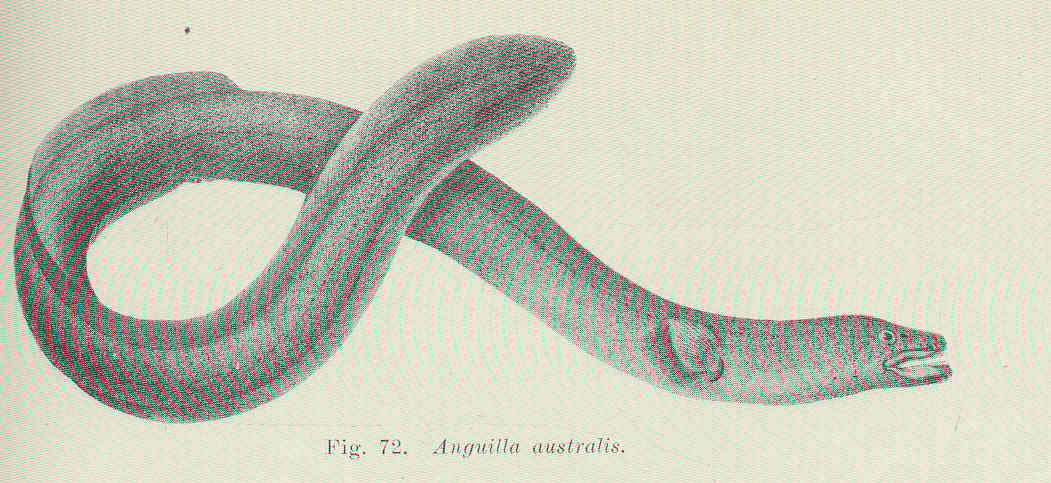 🇦🇺 Australia and 1 moreShort-finned eel
A catadromous eel native to Australia and New Zealand.Eel · Rivers and lakes
 🇨🇳 China and 3 moreAsian swamp eel
A freshwater, air-breathing fish native to Asia and introduced elsewhere.Eel · Rivers and lakes
 🇧🇩 Bangladesh and 4 moreMottled eel
Tropical freshwater eel found in Africa and AsiaEel · Rivers and lakes · 1844
 🇮🇳 India and 4 moreZig-zag eel
A large freshwater spiny eel native to South and Southeast Asia, known for its zigzag pattern and predatory habits.Eel · Rivers and lakes · 1777
