
Chinook salmon
The largest Pacific salmon species, prized for size and food value.
Chinook salmon are anadromous fish native to the North Pacific. They hold records for weight among salmon and are vital to sport fishing and aquaculture industries in regions like New Zealand and the Great Lakes.
- Reaches 150 cm length and 59 kg weight
- Unique black spots on silver tail fins
- Largest producer is New Zealand aquaculture
- Introduced successfully to Great Lakes
- Spawns in deep gravel river beds
What it is
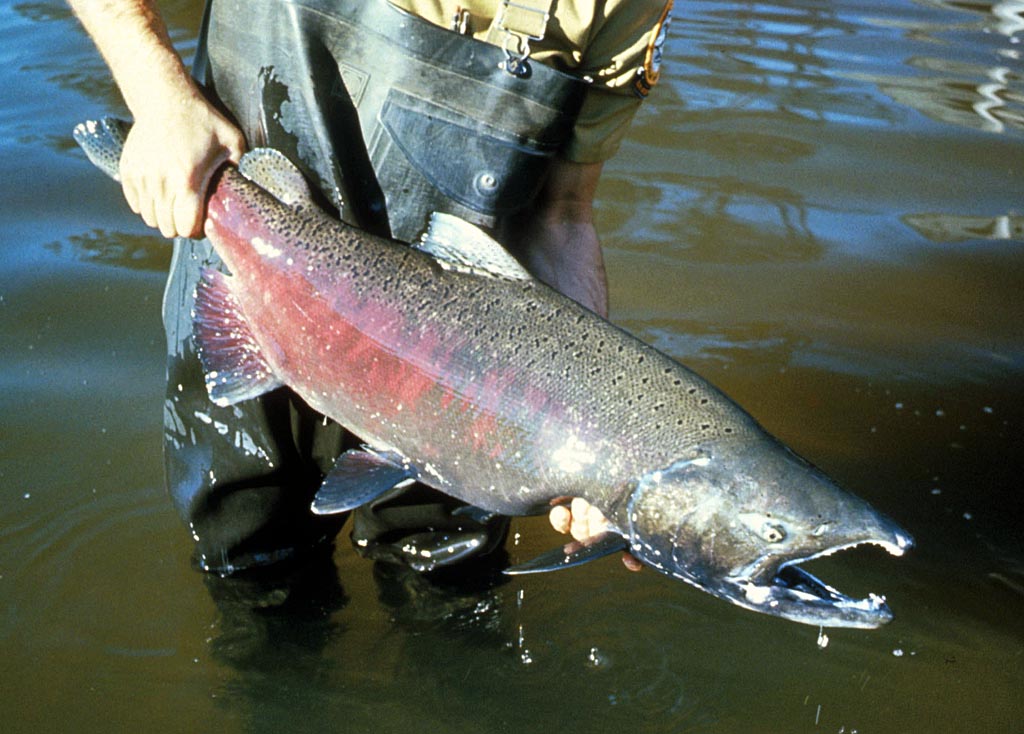
The Chinook salmon is the heaviest member of the Pacific salmon family. Adults display blue-green or purple backs with silvery sides and white bellies. Their tails feature black spots mixed with silver scales, a trait unique among their relatives. A black gum line runs along their jaws. Fish typically measure between 60 and 90 centimetres but can reach lengths of 150 centimetres. Weights average up to 22 kilograms, though larger specimens called Tyee exceed 14 kilograms. The flesh colour varies from pink to white based on diet.
Where it lives
These fish inhabit the North Pacific Ocean and river systems across western North America. Their natural range extends from California to Alaska. Asian populations exist from northern Japan to Siberia. Humans have introduced them to New Zealand, Patagonia, and the Great Lakes. In Michigan, stocked fish thrive in Lake Michigan and its tributaries. Populations have declined significantly in Southern California and parts of the Snake River basin due to habitat loss.
How it lives
Chinook are euryhaline, living in both fresh and salt water. Juveniles feed on crustaceans and insects before migrating to the ocean. Older fish hunt other marine prey. Males develop hooked jaws and canine-like teeth during spawning season. Larger males often secure mating rights over smaller rivals. The species faces threats from dams, pollution, and overfishing. Some populations show signs of recovery while others remain endangered.
Breeding and life cycle
Adults return to freshwater rivers to spawn in deep gravel nests called redds. Spawning occurs between September and December. Females lay eggs in multiple pockets within a nest and guard them for weeks before dying. Eggs hatch after ninety to one hundred fifty days depending on temperature. Young fry stay in streams for twelve to eighteen months. Some mature early as small 'jack' salmon before joining the main migration.
Fish and people
This species is highly valued by sport anglers for its fighting strength. Commercial fisheries harvest wild stocks, though numbers have dropped since the 1990s. New Zealand leads global aquaculture production, exporting millions of dollars worth of farmed fish annually. The meat contains high levels of omega-3 fatty acids. Indigenous peoples historically relied on these fish for sustenance. Modern conservation efforts aim to protect declining coastal runs.


Questions people ask about Chinook salmon
What makes Chinook distinct from other Pacific salmon?
They possess black spots on their tails combined with silver scales, a pattern not found in pink, coho, or chum salmon. They also have a black gum line inside their mouths. As the largest Pacific salmon, they grow significantly heavier than related species.
Where do Chinook salmon live throughout their life cycle?
They begin life in freshwater rivers, migrate to the ocean to grow for several years, and return to their natal rivers to spawn. They require clean, oxygenated water for egg development and productive estuaries for juvenile growth before entering the open sea.
How important is this fish to commercial markets?
Wild capture has declined, but aquaculture plays a major role. New Zealand produces about half of the global supply, exporting primarily to Japan and Australia. The fish commands high prices due to its nutritional content and large size suitable for fillets.
Are all Chinook salmon populations healthy?
No. While some stocks are stable, many face threats from dams, habitat destruction, and overfishing. Coastal populations in California are particularly vulnerable. Conservation programs monitor these groups to prevent extinction and restore historical ranges.
Good reading and sources
- Chinook salmon on WikipediaEncyclopedia
- More photos on Wikimedia CommonsPhotos
- Wikidata recordOpen data
The facts on this page come from the Wikipedia article "Chinook salmon", written by its contributors and used under the CC BY-SA 4.0 licence, and from its Wikidata record (CC0). EveryFish rewrote the text in its own words, with AI assistance, and compares every page with the article to make sure no passage is copied. It may be reused under the same CC BY-SA 4.0 licence with a link back.
It may contain mistakes, and figures change over time. Nothing here is investment or buying advice. If something is wrong, tell us. Last refreshed 2026-11-15.
Like Chinook salmon
All salmon and trout 🇳🇴 Norway and 4 moreAtlantic salmon
A large anadromous fish found in the northern Atlantic Ocean and its rivers.Salmonid · Rivers and lakes · 1758
 🇬🇧 United Kingdom and 3 moreSea trout
Anadromous form of brown trout that migrates between sea and rivers.Salmonid · Between sea and river
 🇷🇺 Russia and 2 moreMasu salmon
Pacific salmonid native to East Asian coasts and rivers.Salmonid · Rivers and lakes
 WorldBrown trout
A widespread salmonid with river, lake and sea forms.Salmonid · Rivers and lakes · 1758