
Brown trout
A widespread salmonid with river, lake and sea forms.
The brown trout is a carnivorous fish native to Europe, West Asia and North Africa. It has been introduced globally as a game fish, often becoming invasive. The species includes river, lake and migratory sea ecotypes that spawn in fresh water.
- Native to Europe, West Asia and North Africa.
- Introduced globally since the 1860s.
- Includes river, lake and sea-dwelling forms.
- Can live up to 20 years.
- Spawns in gravel beds of cold streams.
What it is
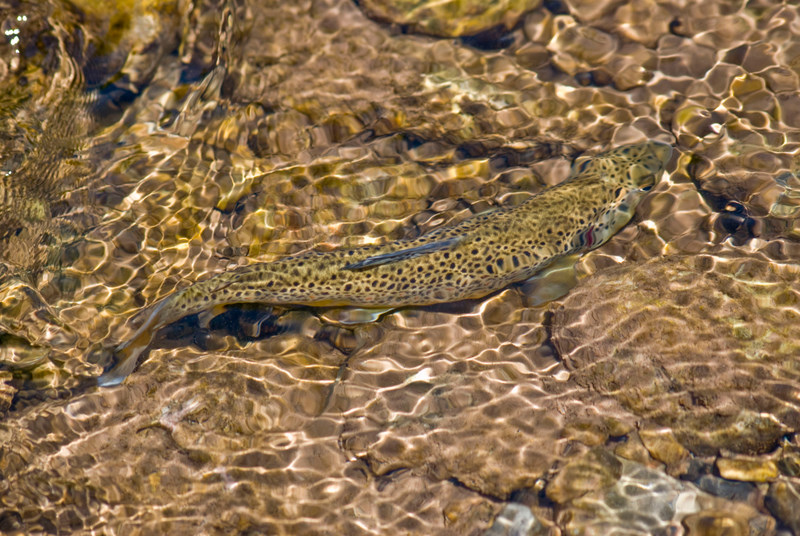
This slender fish has a long head and a large mouth with zig-zag vomerine teeth. Its tail is delta-shaped rather than forked. Colours vary from silver to reddish-brown with dark and red spots on the sides. These spots do not reach the tail. Juveniles show dark blotches and a red margin on the adipose fin. Adults can grow over one metre long and weigh up to 27 kilograms in lakes, though river fish are often much smaller.
Where it lives
Native waters stretch from northern Norway and Russia to the Atlas Mountains in North Africa. The range extends east to Afghanistan and Pakistan. Humans have introduced the species to North and South America, Australasia, Africa and Asia. Self-sustaining populations now exist in many countries outside its original home, including New Zealand, Argentina and the United States.
How it lives
Brown trout are opportunistic feeders active day and night. They eat aquatic invertebrates, crustaceans, molluscs and worms. Larger individuals hunt other fish, frogs and even mice or birds. Diet shifts from insects to fish as they grow. They seek cover near submerged rocks, logs and undercut banks. This structure protects them from predators and extreme temperatures. They prefer well-oxygenated water between 16 and 18 degrees Celsius.
Breeding and life cycle
All forms spawn in fresh water among gravel beds in cold, aerated headstreams. A typical female produces roughly 2,000 eggs per kilogram of body weight. Sea trout migrate to the ocean after juvenile stages but return to rivers to reproduce. River and lake forms migrate only within freshwater systems. Many males die after spawning, and few anadromous females survive to spawn again.
Fish and people
Anglers value this species highly, using flies, lures and bait. It was first introduced to Australia in 1864 and to the United States in 1883. These introductions created popular sport fisheries but also displaced native species. In some regions, it is considered one of the worst invasive species. Local traditions name sea-run forms differently, such as sewin in Wales and finnock in Scotland.
Status and threats
The global population is not endangered, but local stocks face stress. Habitat degradation, pollution and overfishing threaten specific groups. Warm summer water reduces oxygen, causing mass deaths if fish cannot find cooler depths. Removing large females reduces egg counts significantly. Climate change may further reduce suitable cold-water habitats.


Questions people ask about Brown trout
What is the difference between sea trout and brown trout?
They are the same species. Sea trout is the anadromous form that migrates to the ocean. River and lake forms stay in fresh water. All types spawn in freshwater gravel beds.
How big do brown trout get?
Lake forms can reach 140 cm and weigh up to 27 kg. River trout are usually smaller, often under 1 kg. The world record exceeds 20 kg.
Are brown trout invasive?
Yes, outside their native range. Introductions in places like Australia and North America have established wild populations that compete with native species.
What do brown trout eat?
They consume insects, crustaceans, worms and other fish. Large trout may eat frogs, mice and birds. Diet changes from invertebrates to fish as they grow.
Good reading and sources
- A Long Road to World-Class Fly Fishing in New Zealand (Published 2010)The New York Times, Article
- Client ChallengeNature, Article
The facts on this page come from the Wikipedia article "Brown trout", written by its contributors and used under the CC BY-SA 4.0 licence, and from its Wikidata record (CC0). EveryFish rewrote the text in its own words, with AI assistance, and compares every page with the article to make sure no passage is copied. It may be reused under the same CC BY-SA 4.0 licence with a link back.
It may contain mistakes, and figures change over time. Nothing here is investment or buying advice. If something is wrong, tell us. Last refreshed 2026-11-15.
Like Brown trout
All salmon and trout 🇬🇧 United Kingdom and 3 moreSea trout
Anadromous form of brown trout that migrates between sea and rivers.Salmonid · Between sea and river
 🇺🇸 United States and 3 moreSockeye salmon
Anadromous Pacific salmon known for red spawning colour and zooplankton diet.Salmonid · Rivers and lakes · 1792
 🇺🇸 United StatesCutthroat trout
A group of Pacific trout native to western North America, known for red throat markings.Salmonid · Rivers and lakes · 1793
 🇺🇸 United States and 1 moreBrook trout
A colorful freshwater char native to eastern North America, known for its spotted pattern and status as a popular game fSalmonid · Rivers and lakes · 1814
More from Salmonidae
All of them 🇨🇦 Canada and 1 moreArctic grayling
A cold-water salmon relative with a large, colourful dorsal fin.Salmonid · Rivers and lakes · 1776
 🇺🇸 United States and 3 moreDolly Varden trout
A cold-water char native to the North Pacific rim.Salmonid · Rivers and lakes · 1792
 🇬🇧 United Kingdom and 1 moreFerox trout
Large predatory trout native to deep glacial lakes in Britain and Ireland.Salmonid · Rivers and lakes · 1835