
White crappie
North American freshwater fish with vertical body bars
The white crappie is a freshwater fish native to North America, found in lakes and rivers across the continent. It is a popular sport fish known for its silvery colour and tolerance of murky water, with a stable population status.
- Has six dorsal fin spines unlike black crappie
- Tolerates murky water better than black crappie
- Males guard nests during spawning season
- Native to Great Lakes and Mississippi basins
- Record length is 39 cm caught in Mississippi
What it is
The white crappie is a deep-bodied freshwater fish with a flattened shape. Its depth is roughly one-third of its length. The fish displays a silvery colour with green or brown shades on its back and a white belly. Distinctive dark vertical bars run along its sides, numbering between five and ten. This pattern differs from the scattered spots seen on black crappies. The dorsal fin starts further back on the body compared to its relative, and it possesses six spines rather than seven or eight. Small conical teeth line its mouth in two rows.
Where it lives
This species is native to North America, with a range extending from New York and southern Ontario westward to South Dakota. Its distribution reaches southward to Texas. It inhabits the Great Lakes, Hudson Bay, and Mississippi River basins. White crappies thrive in large rivers, reservoirs, and lakes larger than five acres. They are particularly common in low-velocity areas such as river pools and backwaters. The fish tolerates turbid or murky water better than black crappies, often outnumbering them in such conditions and in areas lacking rooted aquatic vegetation.
How it lives
White crappies use a pause-and-travel search strategy, swimming intermittently and hunting while stationary. Larvae and juveniles feed on zooplankton and small invertebrates. Adults, defined as those over 12 centimetres, eat small fish like minnows and young shad, as well as crayfish and hellgrammites. Diet varies by location, including mayflies in Mississippi and gizzard shad in Illinois. In some regions, they consume small carp, yellow perch, and even other crappies. Feeding activity peaks from June to October, slowing in winter.
Breeding and life cycle
Spawning occurs in May and June when water temperatures reach 13 degrees Celsius. Males build bowl-shaped nests on the bottom near brush, rocks, or logs in shallow water. During this period, males develop dark throat colouration. Females lay between 5,000 and 30,000 eggs. Males guard the nests until the fry swim away to ensure genetic success. Fish grow rapidly, reaching 7 to 12 centimetres in their first year. They typically mature in their second or third year.
Fish and people
The white crappie is a valued sport fish. The International Game Fish Association records include a weight record of 2.35 kg caught in Mississippi in 1957, and a length record of 39 cm caught in 2022. The USS Goldring was named after this fish, which is also known locally as goldring or sac-a-lait. Anglers target them in quiet, shallow waters during the day and open water at dawn or dusk.
Status and threats
The species has a large geographic range and a stable population. It is listed as Least Concern for conservation efforts. White crappies generally live for three to four years in unmanaged waters, but can reach six years in managed environments. The maximum lifespan is eight to ten years. Their tolerance for murky water helps them maintain numbers where other species might struggle.


Questions people ask about White crappie
How can you tell a white crappie from a black crappie?
White crappies have five to ten dark vertical bars on their bodies and six dorsal fin spines. Black crappies have randomly scattered spots and seven or eight dorsal spines. White crappies are also slightly more elongated.
What do white crappies eat?
Juveniles eat zooplankton and small invertebrates. Adults feed on small fish like minnows and shad, as well as crayfish and hellgrammites. Their diet varies by location and season, peaking in summer months.
Where do white crappies live?
They are native to North America, found in the Great Lakes, Hudson Bay, and Mississippi River basins. They prefer large lakes, reservoirs, and slow-moving rivers, often thriving in murky water with little vegetation.
When do white crappies spawn?
Spawning takes place in May and June when water temperatures reach 13 degrees Celsius. Males construct nests in shallow water near structure and guard the eggs until the fry hatch and swim away.
Good reading and sources
- White crappie on WikipediaEncyclopedia
- More photos on Wikimedia CommonsPhotos
- Wikidata recordOpen data
The facts on this page come from the Wikipedia article "White crappie", written by its contributors and used under the CC BY-SA 4.0 licence, and from its Wikidata record (CC0). EveryFish rewrote the text in its own words, with AI assistance, and compares every page with the article to make sure no passage is copied. It may be reused under the same CC BY-SA 4.0 licence with a link back.
It may contain mistakes, and figures change over time. Nothing here is investment or buying advice. If something is wrong, tell us. Last refreshed 2026-11-15.
Like White crappie
All perches, basses and snappers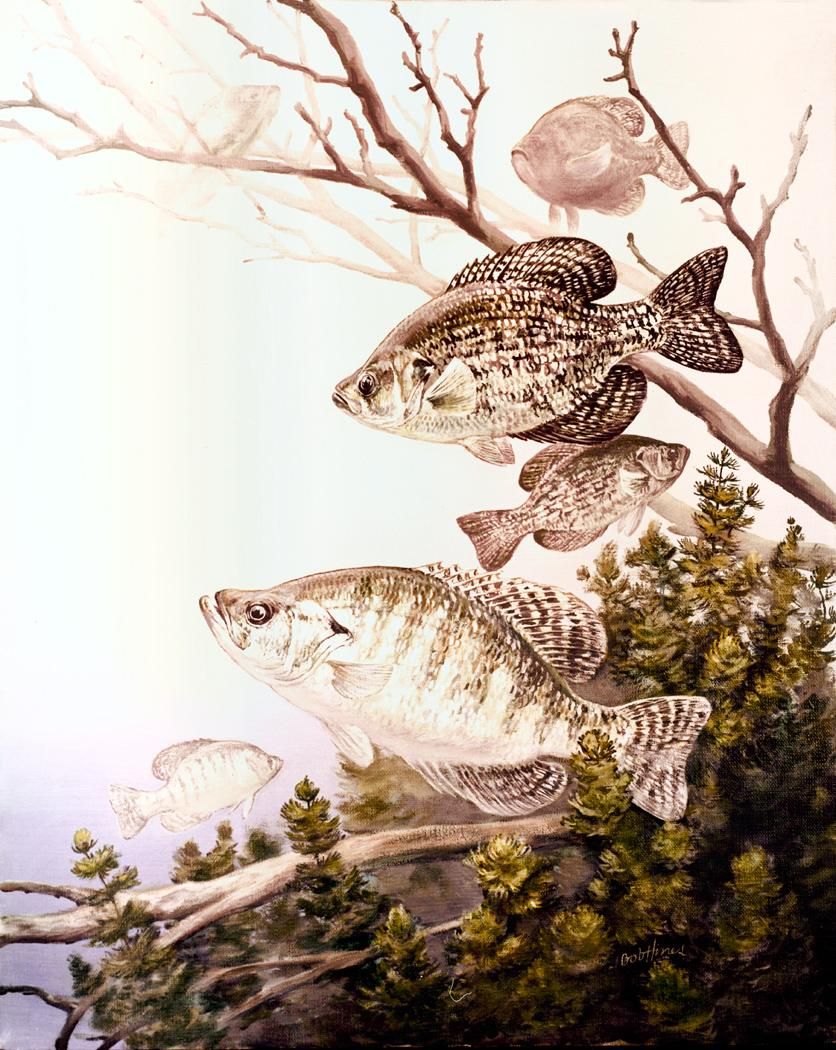 🇺🇸 United StatesCrappie
Two species of North American freshwater sunfish prized by anglers for sport and food.Perch-like · Rivers and lakes
 🇺🇸 United States and 2 moreRock bass
A small, red-eyed freshwater sunfish native to North America.Perch-like · Rivers and lakes
 🇺🇸 United States and 2 morePumpkinseed
A small freshwater fish native to eastern North America, known for its bright colours and red ear flap.Perch-like · Rivers and lakes · 1793
 🇺🇸 United States and 2 moreBluegill
A common North American sunfish known for its blue gill covers and popularity with anglers.Perch-like · Rivers and lakes · 1854
More from Centrarchidae
All of them 🇺🇸 United StatesSpotted bass
A North American freshwater fish known for dark spots below its lateral line.Other · Rivers and lakes
 🇺🇸 United StatesGuadalupe bass
A rare Texas endemic black bass prized by anglers for its fighting spirit.Other · Rivers and lakes
 🇺🇸 United States and 2 moreGreen sunfish
A small, aggressive freshwater fish native to North America, known for its blue-green colour and invasive potential in nPerch-like · Rivers and lakes
 🇺🇸 United StatesRedear sunfish
Freshwater panfish known for crushing snail shells.Perch-like · Rivers and lakes