
Southern stingray
A large, flat whiptail ray of the Western Atlantic.
The southern stingray is a bottom-dwelling fish found in warm waters from New Jersey to Brazil. It uses wing-like fins to swim and a venomous tail spine for defence. This species is popular in tourism and public aquariums due to its docile nature when fed.
- Females reach 150 cm disc width
- Venomous tail spine used for defence
- Nocturnal feeder on sea bed
- Gives live birth after 7-8 months
- Popular tourist attraction in Caribbean
What it is
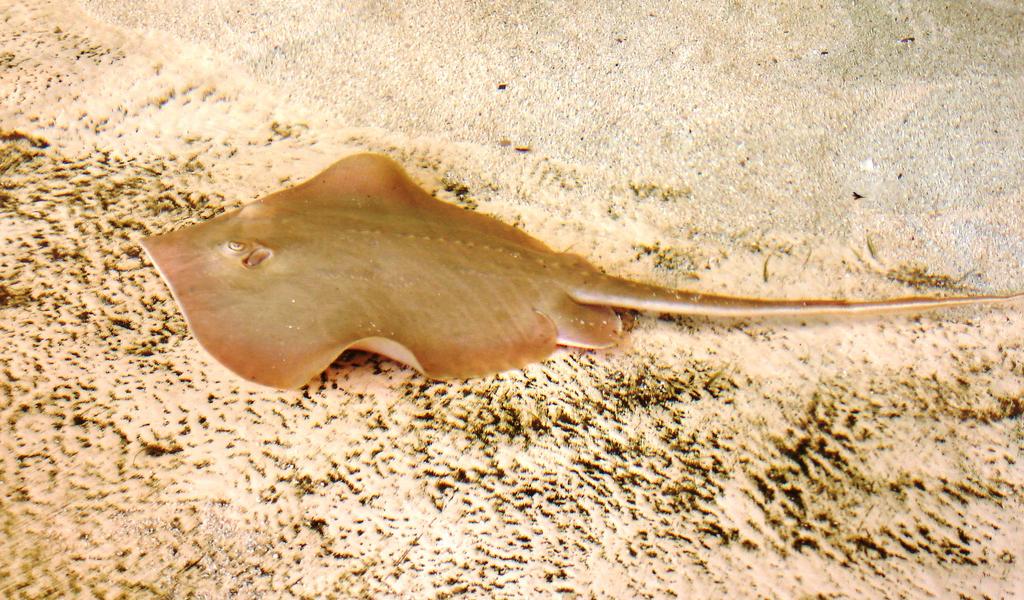
This whiptail stingray has a flat, diamond-shaped body that is more angular than many relatives. Adults display olive brown or green tops with white undersides, while juveniles are dark grey. Wing-like pectoral fins propel it across the ocean floor. A long, serrated spine sits at the base of its slender tail. This spine carries venomous mucus for self-defence. Though painful to humans, the sting is not fatal. Eyes and spiracles sit on top of the head, allowing breathing while buried in sediment.
Where it lives
It inhabits tropical and subtropical waters of the Western Atlantic. The range extends from New Jersey down to southern Brazil. These rays prefer the sea bed in coastal areas. They are often found in shallow systems that serve as nursery grounds. Juveniles have been observed on rock reef surfaces at depths between ten and twenty metres. Specific locations include the Gulf of Mexico and islands such as Grand Cayman.
How it lives
Southern stingrays are nocturnal hunters. They spray water or flap fins to uncover prey hidden in the substrate. Their diet includes small fish, worms, crustaceans, and bivalves. They move with a wave-like motion that aids in escape and foraging. Often solitary or in pairs, they may group for mating or protection. Great hammerhead sharks are known predators. In the Gulf of Mexico, birds follow these rays to eat fish exposed by their digging.
Breeding and life cycle
Females give live birth after fertilised eggs develop inside the body. Embryos first feed from a yolk sac, then from uterine milk. Gestation lasts seven to eight months in the wild. Females reproduce annually, though captive ones may breed twice a year. Litters contain two to ten young. Maturity occurs around five years for females and three for males. Mating involves males biting female fins. Pheromones likely signal readiness to mate after birth.
Fish and people
Tourists hand-feed these rays in the Caribbean, notably at Stingray City. The animals are often docile and allow touching. Concerns exist about how this interaction affects their natural behaviour. They appear in public aquariums and touch pools. Keeping them privately requires massive tanks, as they eat other tank inhabitants. They are hardy but need significant space. Reproduction has been recorded in large public facilities.


Questions people ask about Southern stingray
Is the southern stingray dangerous to humans?
The tail spine is venomous and causes intense pain if stepped on. However, the sting is not fatal to humans. The ray uses it only for self-defence against predators or threats.
What do southern stingrays eat?
They are opportunistic feeders that hunt on the sea bed. Their diet consists of small fishes, worms, crustaceans, and bivalves. They disturb sand to expose hidden prey.
How do southern stingrays reproduce?
They are ovoviviparous, meaning eggs hatch inside the mother. The young receive nutrients from yolk and uterine milk. Females give live birth to litters of two to ten pups.
Where can you see southern stingrays in the wild?
They live in Western Atlantic waters from New Jersey to Brazil. Popular viewing spots include Grand Cayman and Antigua, where they interact with divers and snorkelers.
Good reading and sources
- Southern stingray on WikipediaEncyclopedia
- More photos on Wikimedia CommonsPhotos
- Wikidata recordOpen data
The facts on this page come from the Wikipedia article "Southern stingray", written by its contributors and used under the CC BY-SA 4.0 licence, and from its Wikidata record (CC0). EveryFish rewrote the text in its own words, with AI assistance, and compares every page with the article to make sure no passage is copied. It may be reused under the same CC BY-SA 4.0 licence with a link back.
It may contain mistakes, and figures change over time. Nothing here is investment or buying advice. If something is wrong, tell us. Last refreshed 2026-11-15.
Like Southern stingray
All rays and skates WorldSpotted eagle ray
Tropical ray with white spots and a long tail.Ray · Coasts and shelves · 1790
 WorldBluespotted ribbontail ray
A small, colourful reef stingray with electric blue spots.Ray · Coasts and shelves · 1775
 North AmericaYellow stingray
Small, camouflaging stingray of the western Atlantic.Ray · Coasts and shelves · 1816
 WorldGiant oceanic manta ray
The world's largest ray, a massive filter-feeding predator of tropical oceans.Ray · Coasts and shelves · 1827
More from Dasyatidae
All of them WorldCowtail stingray
Large Indo-Pacific stingray with a distinctive tail fold.Ray · Rivers and lakes
 EuropeCommon stingray
A venomous ray of Atlantic and Mediterranean coastal waters.Ray · Coasts and shelves · 1758
 🇿🇦 South Africa and 4 moreReticulate whipray
A large spotted stingray from the western Indian Ocean and eastern Mediterranean.Ray · Coasts and shelves · 1789
 🇺🇸 United States and 1 moreAtlantic stingray
Small stingray found in Atlantic coastal waters and fresh rivers.Ray · Rivers and lakes · 1824