
Cowtail stingray
Large Indo-Pacific stingray with a distinctive tail fold.
The cowtail stingray is a large marine fish found across the tropical Indo-Pacific. It enters rivers and feeds on bottom-dwelling prey. Fishers target it for its tough skin, used to make shagreen leather, raising concerns about population sustainability due to slow reproduction rates.
- Grows up to 3 metres long and weighs 250 kg
- Enters freshwater rivers up to 2,200 km from sea
- Primary source of shagreen leather for fashion goods
- Rests in rosette groups to detect predators
- Venomous spine can strike over its own back
What it is
This species belongs to the family Dasyatidae and is known for its thick pectoral fin disk. The disk is wider than it is long, with straight front edges and rounded tips. Its snout is blunt, and eyes are small and set far apart. A single venomous spine sits far back on the broad tail. The most striking feature is a large ventral fold on the tail that acts like a flag when swimming. The upper surface is greyish-brown to black, while the underside is white. Adults can grow up to three metres in length and weigh 250 kilograms.
Where it lives
These rays inhabit tropical waters across the Indo-Pacific region. Their range extends from South Africa and the Red Sea eastward to Japan and Australia, including Melanesia and Micronesia. They prefer sandy seabeds and coral reefs at depths up to sixty metres. Unusually for stingrays, they are amphidromous and frequently enter estuaries and freshwater rivers. They are the most common stingray found in fresh water in Southeast Asia, with records from the Ganges River far inland.
How it lives
Cowtail stingrays hunt alone, feeding on bony fish, crustaceans, worms, and molluscs. When threatened, they flee at a forty-five-degree angle to keep predators in view while maximising distance. Natural enemies include hammerhead sharks, requiem sharks, and bottlenose dolphins. In Shark Bay, Australia, they rest in shallow sandy flats during high tide. They often form small groups of three in a rosette pattern with tails pointing outward. This arrangement helps them detect threats from all directions and allows coordinated escape.
Breeding and life cycle
Reproduction is ovoviviparous, meaning embryos develop inside eggs within the mother until hatching. Late-stage embryos receive nutrition from histotroph, or uterine milk, via specialised structures. Females give birth to live young that measure at least eighteen centimetres across. Births occur year-round in some areas, such as the Strait of Malacca. Juvenile rays have more pointed snouts than adults, and their smooth skin quickly develops denticles after birth.
Fish and people
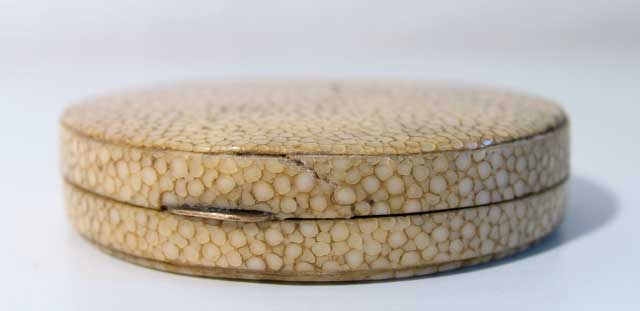
Fishers catch these rays as bycatch in trawls, selling the meat locally. The primary commercial value lies in their skin, which produces shagreen, a high-quality leather. This material has been valued since ancient times for polishing wood and making accessories like wallets. The dorsal tubercles create a nacreous appearance known as pearls in the trade. Since the 1990s, demand for fashion items has driven heavy harvesting in Southeast Asia. The venomous spine can strike backwards, making the animal dangerous to handle.
Status and threats
Populations face significant pressure from unregulated exploitation for the international shagreen market. Because stingrays are slow-reproducing and long-lived, scientists fear that current harvest levels are unsustainable. There are concerns that continued heavy fishing could lead to a collapse in local populations. No specific conservation status is listed in the provided data, but the threat from commercial demand remains a primary concern for their future stability.


Questions people ask about Cowtail stingray
Why is the cowtail stingray dangerous to humans?
It possesses a single venomous spine located far back on its tail. The tail is flexible enough to reach over the ray's back, allowing it to strike anyone attempting to hold it from the front. This makes handling the animal particularly risky compared to other species.
What is shagreen and how is it obtained?
Shagreen is a type of leather made from the tough skin of this ray. The dorsal tubercles, called pearls in the trade, create a unique nacreous texture when rubbed down. It is used for polishing wood and crafting luxury accessories like wallets and pens.
Do cowtail stingrays live in freshwater?
Yes, they are amphidromous and frequently enter estuaries and rivers. They are the most commonly reported stingray in Southeast Asian fresh waters. Records show they can travel up to 2,200 kilometres inland, such as into the Ganges River.
How do cowtail stingrays protect themselves from predators?
When resting, they often form small rosette groups with tails pointing outward. This allows them to monitor all directions for threats. If attacked, they flee at a forty-five-degree angle to keep the predator in sight while escaping efficiently.
Good reading and sources
- Cowtail stingray on WikipediaEncyclopedia
- More photos on Wikimedia CommonsPhotos
- Wikidata recordOpen data
The facts on this page come from the Wikipedia article "Cowtail stingray", written by its contributors and used under the CC BY-SA 4.0 licence, and from its Wikidata record (CC0). EveryFish rewrote the text in its own words, with AI assistance, and compares every page with the article to make sure no passage is copied. It may be reused under the same CC BY-SA 4.0 licence with a link back.
It may contain mistakes, and figures change over time. Nothing here is investment or buying advice. If something is wrong, tell us. Last refreshed 2026-11-15.
Like Cowtail stingray
All rays and skates WorldSawfish
Large rays with a toothed rostrum found in tropical coastal waters.Ray · Coasts and shelves
 🇺🇸 United States and 2 moreRound stingray
A small coastal ray from the eastern Pacific known for its painful tail spine.Ray · Coasts and shelves
 🇦🇺 AustraliaDwarf sawfish
Smallest sawfish species, native to tropical Australia and New Guinea.Ray · Estuaries and mangroves
 🇺🇸 United States and 1 moreCownose ray
A migratory coastal ray with a distinctive head shape.Ray · Coasts and shelves
More from Dasyatidae
All of them WorldSouthern stingray
A large, flat whiptail ray of the Western Atlantic.Ray · Coasts and shelves
 EuropeCommon stingray
A venomous ray of Atlantic and Mediterranean coastal waters.Ray · Coasts and shelves · 1758
 WorldBluespotted ribbontail ray
A small, colourful reef stingray with electric blue spots.Ray · Coasts and shelves · 1775
 🇿🇦 South Africa and 4 moreReticulate whipray
A large spotted stingray from the western Indian Ocean and eastern Mediterranean.Ray · Coasts and shelves · 1789