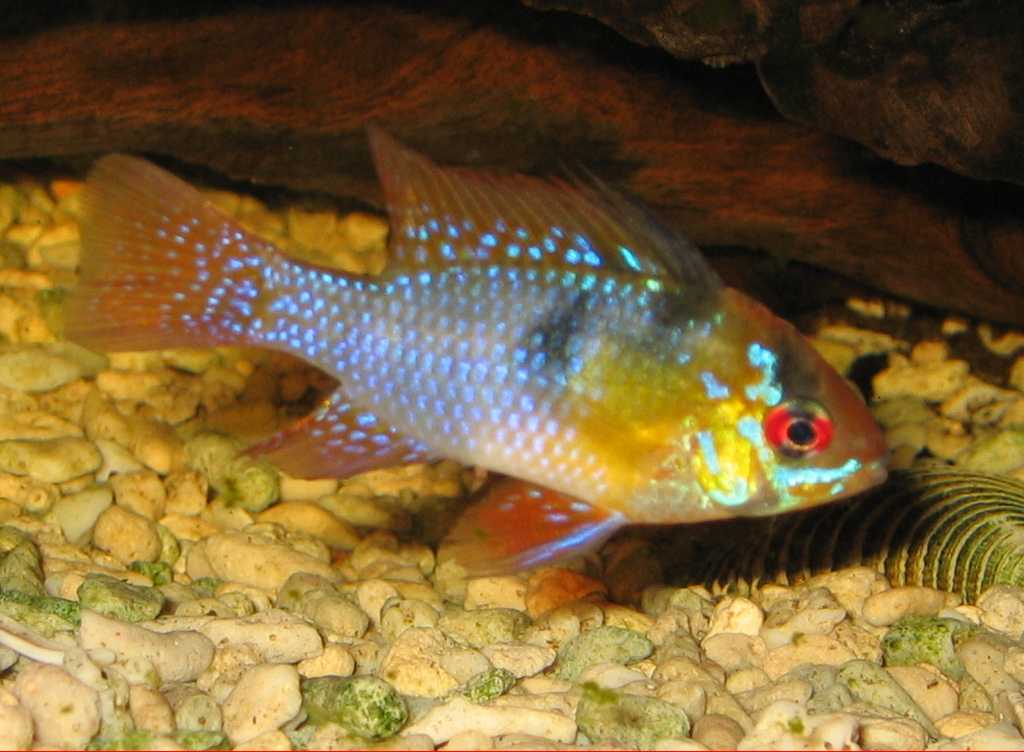
Ram cichlid
Small colourful freshwater fish from South America
The ram cichlid is a small freshwater species native to the Orinoco River basin in Venezuela and Colombia. It is widely kept in home aquariums for its bright colours and manageable size, though captive breeding has produced various colour forms.
- Native to the Orinoco River basin in South America
- Reaches a maximum length of 40 millimetres
- Practices biparental care with both parents tending eggs
- Popular in the tropical freshwater aquarium hobby
- Prefers warm acidic water with low mineral content
What it is
This small cichlid belongs to the family Cichlidae and subfamily Geophaginae. Adults reach lengths between 34 and 40 millimetres. Males are slightly larger than females and often display extended rays on the front of their dorsal fin. Females develop a pink or red blush on their abdomen when ready to spawn. They also show a blue sheen over the spot beneath the dorsal fin, a feature absent in males. The fish is known for its vibrant appearance and compact size.
Where it lives
The species is endemic to the Orinoco River basin. It inhabits the Llanos savannas of Venezuela and Colombia. These fish prefer warm water temperatures ranging from 25.5 to 29.5 degrees Celsius. The water is typically acidic with a pH between 5.2 and 6.7. It flows slowly and contains few dissolved minerals. Tannins often stain the water from clear to dark brown. The fish seeks cover among aquatic or submerged vegetation.
How it lives
Studies on fish behaviour have examined this species. In the wild, they form monogamous pairs once sexually mature. Males do not tolerate other males in their vicinity. They practice biparental brood care, meaning both parents tend to the eggs and defend their territory. After hatching, the larvae remain non-swimming for five days. Parents then escort the young in dense schools while they forage for food.
Breeding and life cycle
Pairs lay small adhesive eggs on flattened stones or in gravel depressions. A typical clutch contains 150 to 300 eggs, though some reports note up to 500. Parents fan water over the eggs to keep them oxygenated. At 29 degrees Celsius, the eggs hatch in approximately 40 hours. Both the male and female participate in caring for the offspring and protecting their breeding site.
Fish and people
This fish is popular in the tropical freshwater community aquarium trade. It is traded under names such as blue ram and butterfly cichlid. Named after collector Manuel Ramirez, it was first described in 1948. Asian breeders have developed colour morphs like gold rams and electric blue variants. Some captive forms, including balloon types, may suffer from health issues or reduced fertility compared to wild specimens.


Questions people ask about Ram cichlid
Where does the ram cichlid come from?
It is endemic to the Orinoco River basin in the savannahs of Venezuela and Colombia. It lives in warm acidic water courses within the Llanos region.
How big do ram cichlids get?
They are small fish, reaching lengths between 34 and 40 millimetres. Males are typically slightly larger than females.
Do ram cichlids care for their young?
Yes, they practice biparental brood care. Both the male and female tend to the eggs and defend the territory. They also escort the young fry after they begin swimming.
What water conditions do they need?
They require warm water between 25.5 and 29.5 degrees Celsius. The water should be acidic with a pH of 5.2 to 6.7 and contain few dissolved minerals.
Good reading and sources
The facts on this page come from the Wikipedia article "Ram cichlid", written by its contributors and used under the CC BY-SA 4.0 licence, and from its Wikidata record (CC0). EveryFish rewrote the text in its own words, with AI assistance, and compares every page with the article to make sure no passage is copied. It may be reused under the same CC BY-SA 4.0 licence with a link back.
It may contain mistakes, and figures change over time. Nothing here is investment or buying advice. If something is wrong, tell us. Last refreshed 2026-11-15.
Like Ram cichlid
All cichlids WorldHaplochromis
A large ray-finned fish genus from East Africa known for rapid evolution and aquarium popularity.Cichlid · Rivers and lakes · 1888
 🇬🇹 Guatemala and 4 moreConvict cichlid
Striped Central American cichlid popular in home aquariumsCichlid · Rivers and lakes · 1867
 🇧🇷 BrazilPterophyllum
A genus of laterally compressed freshwater cichlids known as angelfish.Cichlid · Rivers and lakes · 1824
 Sub-Saharan AfricaPrincess cichlid
A cooperative schooling cichlid from Lake Tanganyika.Cichlid · Rivers and lakes
More from Cichlidae
All of them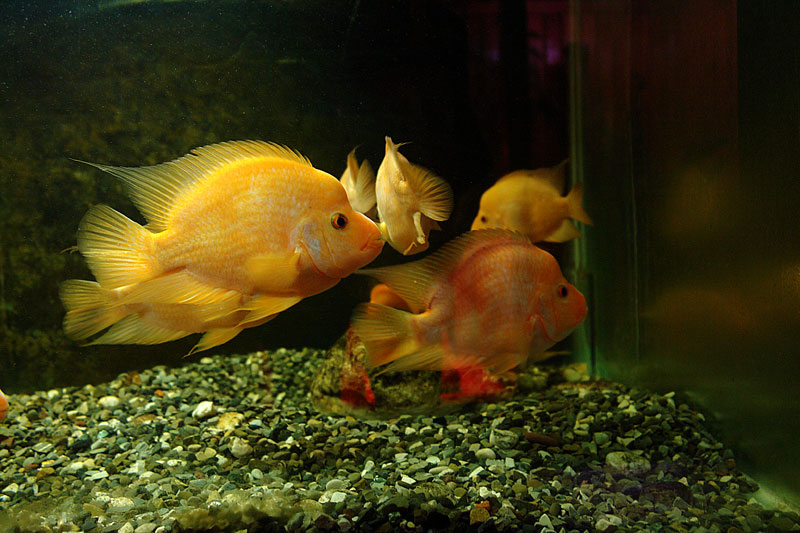 WorldBlood parrot cichlid
A bright orange hybrid cichlid bred for the aquarium trade.Cichlid · Rivers and lakes · 1986
 🇳🇬 Nigeria and 1 moreKribensis
Small colourful cichlid from West AfricaCichlid · Rivers and lakes · 1901
 🇧🇮 Burundi and 3 moreGiant cichlid
The largest living cichlid species, native to Lake Tanganyika in Africa.Cichlid · Rivers and lakes · 1899
 Sub-Saharan AfricaRedbreast tilapia
Herbivorous cichlid from southern African freshwatersCichlid · Rivers and lakes · 1897