
Giant cichlid
The largest living cichlid species, native to Lake Tanganyika in Africa.
This massive freshwater fish is the sole member of its genus and tribe. It inhabits Lake Tanganyika, where adults hunt other fish while juveniles feed on varied matter in shallower waters.
- Largest extant cichlid species, reaching 90 cm.
- Endemic to Lake Tanganyika in Africa.
- Adults eat fish; juveniles eat various foods.
- Only member of genus Boulengerochromis.
- Rarely kept in aquariums due to huge size.
What it is
The giant cichlid stands as the largest known living species within the cichlid family. Males can grow to ninety centimetres, while females reach seventy-five centimetres. This size rivals that of the speckled peacock bass from South America. The fish belongs exclusively to the genus Boulengerochromis and its own tribe. Its body shape supports a life in open water, with fins adapted for swimming in groups. The colouration helps it blend into the lake environment. It remains the only species in its specific taxonomic group.
Where it lives
This fish lives only in Lake Tanganyika, located in central Africa. The lake spans four nations: Burundi, the Democratic Republic of the Congo, Tanzania, and Zambia. Within these borders, the species is relatively common. It prefers coastal zones rather than deep open water. Individuals have been recorded at depths reaching one hundred metres. The habitat varies by age, with younger fish staying closer to shore. Adults often move further out into deeper sections of the lake.
How it lives
Diet changes significantly as the fish matures. Juveniles eat a wide variety of food sources in shallow, rocky areas. These shallows provide cover from predators. Adults switch to eating other fish, becoming primarily piscivorous. They form small groups to hunt in open water, except when breeding. This schooling behaviour aids in finding prey. The shift from omnivore to predator marks their transition to adulthood. Predators likely target the smaller, vulnerable juveniles in the rocks.
Breeding and life cycle
Specific details about spawning habits are not provided in the available records. Adults leave their hunting groups temporarily to reproduce. The process involves pairing off or gathering in specific areas. Young fish require sheltered environments to survive early growth stages. The protective rock-strewn waters serve this purpose for juveniles. Once they mature, they join adult groups in deeper zones. The timing and exact methods of reproduction remain undocumented here.
Fish and people
Local communities may consume this fish as a food source. Its large size makes it a significant catch. Aquarium enthusiasts sometimes seek them out, but they are difficult to keep. Their enormous adult dimensions restrict them to very large public or private tanks. Most home aquaria cannot accommodate such a massive creature. Consequently, they are rarely seen in typical household settings. Their presence in the trade is limited by space requirements alone.
Status and threats
The species is considered least concern by conservation standards. The population appears stable across its range in Lake Tanganyika. Protection measures are not detailed in the provided information. The fish remains common in its native coastal and deeper waters. Continued monitoring ensures its status remains secure.

Questions people ask about Giant cichlid
How big does the giant cichlid get?
Males reach up to ninety centimetres in length. Females grow slightly smaller, reaching seventy-five centimetres. This makes them the largest living species in the cichlid family.
Where is the giant cichlid found?
It lives only in Lake Tanganyika in central Africa. The lake borders Burundi, the Democratic Republic of the Congo, Tanzania, and Zambia. It is endemic to this single large lake system.
What do giant cichlids eat?
Juveniles are omnivores feeding in shallow rocky areas. Adults become piscivorous, meaning they eat other fish. They hunt in small groups in open water away from the shore.
Can I keep a giant cichlid in my tank?
They are occasionally sold but are ill-suited for most homes. Their enormous adult size requires very large public or private aquariums. Standard home tanks cannot accommodate such a massive fish.
Good reading and sources
- Giant cichlid on WikipediaEncyclopedia
- More photos on Wikimedia CommonsPhotos
- Wikidata recordOpen data
The facts on this page come from the Wikipedia article "Giant cichlid", written by its contributors and used under the CC BY-SA 4.0 licence, and from its Wikidata record (CC0). EveryFish rewrote the text in its own words, with AI assistance, and compares every page with the article to make sure no passage is copied. It may be reused under the same CC BY-SA 4.0 licence with a link back.
It may contain mistakes, and figures change over time. Nothing here is investment or buying advice. If something is wrong, tell us. Last refreshed 2026-11-15.
Like Giant cichlid
All cichlids 🇨🇷 Costa Rica and 1 moreMidas cichlid
Large aggressive cichlid from Central AmericaCichlid · Rivers and lakes
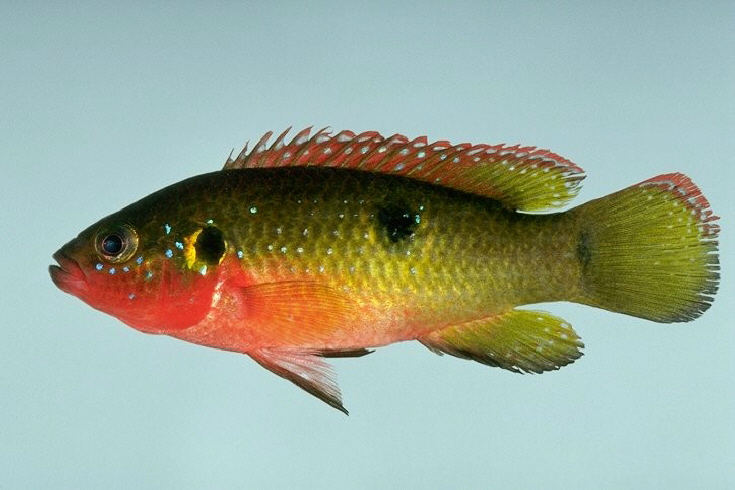 Sub-Saharan AfricaJewel cichlid
Brightly colored African cichlids kept in aquariums for their vivid breeding colours and parental care.Cichlid · Rivers and lakes
 🇭🇳 Honduras and 3 moreJaguar cichlid
Large predatory cichlid from Central American lakesCichlid · Rivers and lakes
 🇧🇷 Brazil and 3 moreSpeckled peacock bass
A large South American cichlid prized for sport and food.Cichlid · Rivers and lakes
More from Cichlidae
All of them 🇳🇬 Nigeria and 1 moreKribensis
Small colourful cichlid from West AfricaCichlid · Rivers and lakes · 1901
 Sub-Saharan AfricaRedbreast tilapia
Herbivorous cichlid from southern African freshwatersCichlid · Rivers and lakes · 1897
 WorldHaplochromis
A large ray-finned fish genus from East Africa known for rapid evolution and aquarium popularity.Cichlid · Rivers and lakes · 1888
 🇬🇹 Guatemala and 4 moreConvict cichlid
Striped Central American cichlid popular in home aquariumsCichlid · Rivers and lakes · 1867