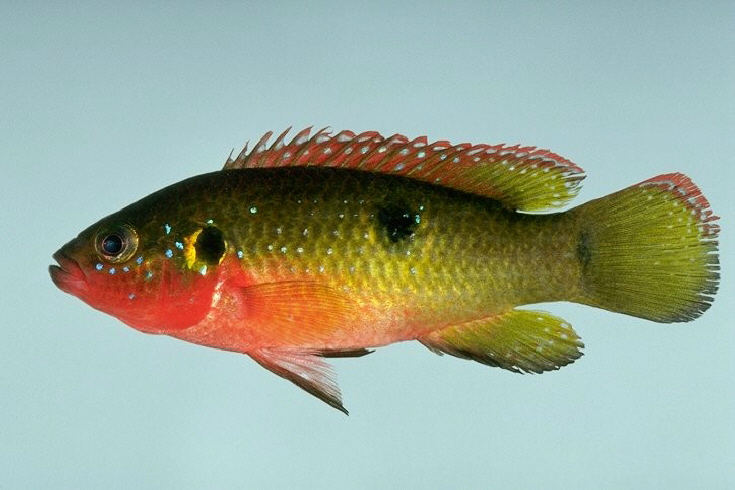
Jewel cichlid
Brightly colored African cichlids kept in aquariums for their vivid breeding colours and parental care.
Jewel cichlids belong to the genus Hemichromis, a group of fish native to Africa. They are popular in the aquarium trade due to their striking appearance and attentive parenting, though they require specific tank conditions.
- Adults range from 6.5 to 26.5 cm in length.
- Native to African freshwater and brackish habitats.
- Both parents guard eggs and raise young fry.
- Popular in aquariums but require spacious tanks.
- Genus split into Hemichromis and Rubricatochromis.
What it is
Jewel cichlids are small freshwater fishes belonging to the genus Hemichromis within the cichlid family. Adults typically measure between 6.5 and 26.5 centimetres, though specimens in captivity often remain slightly smaller. These fish display vivid body colours that intensify during the breeding season. Males usually exhibit brighter hues and more pointed fins than females, although some species show similar brightness in both sexes. The genus comprises two distinct groups: the five-spotted cichlids and the true jewel cichlids, with the latter sometimes classified under the separate genus Rubricatochromis.
Where it lives
These fish originate from Africa, particularly West Africa. Their natural habitats include creeks, streams, rivers, and lakes. They adapt to various water qualities, including brackish-water lagoons. Specific populations inhabit the Nile basin, the Congo River basin, the upper Zambezi, Lake Bosumtwi, and the Guinea region. Introduced populations exist in places like Florida, though these often result from aquarium releases rather than natural dispersal.
How it lives
Jewel cichlids are omnivores that feed on live foods and fish flakes. They exhibit strong territorial behaviour, making them unsuitable for standard community tanks without careful planning. In the wild, they form monogamous pairs. Both parents participate in brood care, guarding eggs laid on flat surfaces such as leaves or stones. This high level of parental investment is characteristic of many cichlids. Their aggressive nature requires adequate swimming space and hiding spots provided by stones and wood in captive settings.
Breeding and life cycle
Breeding involves the formation of monogamous pairs. Females lay eggs on flat substrates like stones or broad leaves. Both male and female parents protect the clutch and assist in raising the young fry. Sexual dimorphism is subtle but present, with males generally displaying more intense colouration and elongated fin rays. In some species, females can be equally vibrant. The breeding process highlights their dedicated parental instincts compared to other fish species.
Fish and people
Jewel cichlids are primarily known as aquarium fish. They are not recommended for beginners due to their aggression and specific spatial requirements. Hobbyists often keep them in monospecies tanks or carefully selected communities with ample territory. Misidentification is common in the trade, with many aquarium stocks labelled as Hemichromis bimaculatus actually being H. letourneuxi or hybrids. Their bright colours make them desirable additions for experienced aquarists willing to provide appropriate tank layouts.
Status and threats
The conservation status of jewel cichlids is generally considered least concern. However, taxonomic confusion persists within the genus, complicating accurate assessment. Several species have been reclassified or split based on genetic studies, such as the distinction of Hemichromis saharae from H. letourneuxi. Undescribed species likely exist in the Guinea region. The aquarium trade contributes to taxonomic uncertainty through hybridization and mislabeling, affecting how populations are understood scientifically.

Questions people ask about Jewel cichlid
What do jewel cichlids eat?
They are omnivores that consume both live foods and fish flakes. Providing a varied diet helps maintain their health and vibrant colouration in captivity.
Are jewel cichlids good for beginner aquarists?
No, they are not suited for beginners. Their innate aggression and need for territory make them challenging for novice hobbyists managing community tanks.
How do jewel cichlids care for their young?
They form monogamous pairs where both parents guard eggs on flat surfaces. They actively participate in raising the fry, demonstrating high parental investment.
Why is there confusion about jewel cichlid species?
Taxonomic resolution is incomplete. Hybridization in the aquarium trade and morphological similarities lead to misidentification, with many stocks mislabeled as specific species.
Good reading and sources
- Jewel cichlid on WikipediaEncyclopedia
- More photos on Wikimedia CommonsPhotos
- Wikidata recordOpen data
The facts on this page come from the Wikipedia article "Jewel cichlid", written by its contributors and used under the CC BY-SA 4.0 licence, and from its Wikidata record (CC0). EveryFish rewrote the text in its own words, with AI assistance, and compares every page with the article to make sure no passage is copied. It may be reused under the same CC BY-SA 4.0 licence with a link back.
It may contain mistakes, and figures change over time. Nothing here is investment or buying advice. If something is wrong, tell us. Last refreshed 2026-11-15.
Like Jewel cichlid
All cichlids 🇺🇸 United States and 1 moreTexas cichlid
The only cichlid native to the United StatesCichlid · Rivers and lakes
 🇨🇷 Costa Rica and 1 moreMidas cichlid
Large aggressive cichlid from Central AmericaCichlid · Rivers and lakes
 🇭🇳 Honduras and 3 moreJaguar cichlid
Large predatory cichlid from Central American lakesCichlid · Rivers and lakes
 🇧🇷 Brazil and 3 moreSpeckled peacock bass
A large South American cichlid prized for sport and food.Cichlid · Rivers and lakes
More from Cichlidae
All of them 🇹🇿 Tanzania and 2 moreSingida tilapia
A cichlid fish native to the Lake Victoria basin in East Africa.Cichlid · Rivers and lakes
 Sub-Saharan AfricaPrincess cichlid
A cooperative schooling cichlid from Lake Tanganyika.Cichlid · Rivers and lakes
 WorldAuratus cichlid
Small, colourful cichlid from Lake MalawiCichlid · Rivers and lakes
 🇧🇷 Brazil and 2 morePeacock bass
Large predatory cichlids from South American rivers known for sport fishing and invasive impact.Cichlid · Rivers and lakes