
Texas cichlid
The only cichlid native to the United States
This freshwater fish is the sole cichlid species indigenous to the United States. It inhabits the Rio Grande drainage and has spread invasively into other southern states. Anglers value it for sport and food in its native range, while conservationists monitor its impact on local ecosystems elsewhere.
- Only cichlid species native to the United States
- Tolerates salinity up to 8 parts per thousand
- Parents jointly defend and care for up to 2,000 eggs
- Invasive in Louisiana and Florida waterways
- Grows up to 33 cm in length
What it is
The Texas cichlid is a freshwater fish distinguished by cream and turquoise spots. Adults can reach lengths of over 33 cm. Males often develop a prominent hump on their heads. This species belongs to the cichlid family and is notable for being the only member of this group native to the United States. It thrives in water temperatures between 20 and 28 degrees Celsius and suffers when temperatures change rapidly.
Where it lives
Native populations live in the lower Rio Grande drainage near Brownsville, Texas, and in northeastern Mexico. Introduced groups have established themselves in the Edwards Plateau rivers of Central Texas, including the San Marcos and Colorado Rivers. The fish has also spread to artificial canals in Florida and the brackish waters of New Orleans, Louisiana. It tolerates salinity levels up to 8 parts per thousand, allowing it to survive in estuaries and bayous where other freshwater fish cannot.
How it lives
This omnivore eats plant matter, detritus, insects, and smaller fish. It acts as an opportunistic carnivore, consuming frogs, water snakes, and fish eggs. The fish uses its skin camouflage to sneak up on prey. It displays aggressive behavior toward native species like largemouth bass and blue crabs, often engaging in tail beating or mouth wrestling. This aggression helps it dominate shallow mating sites and disrupt local food webs.
Breeding and life cycle
Spawning occurs between March and August. Monogamous pairs, usually with a larger male and smaller female, select and clean rocky sites in shallow water. The female releases eggs in small batches while the male fertilizes them, totaling around 2,000 eggs. Both parents care for the offspring. The female fans the eggs while the male patrols the territory. After hatching, the fry stay together with both parents defending them from intruders.
Fish and people
Anglers in South Texas and Mexico catch this fish for sport and food, noting its taste resembles tilapia. It is popular in the aquarium trade due to its iridescent markings. However, it is considered an invasive pest in Florida and Louisiana. In New Orleans, it threatens native fisheries, prompting local competitions to remove them. Despite these efforts, eradication is unlikely due to its rapid breeding cycle and resilience to environmental changes.
Status and threats
The species is invasive in several US states outside its native range. In Louisiana, it has overwhelmed native fish populations in urban bayous. Hurricanes have aided its spread by connecting waterways. Conservation agencies struggle to control it because of its high salt tolerance and short mating cycle. Routine restocking of native species is required to maintain biodiversity in affected areas like Bayou St. John.


Questions people ask about Texas cichlid
Is the Texas cichlid good to eat?
Yes, in its native range of South Texas and northern Mexico, locals consider it excellent eating. Its flavor is often compared to commercially raised tilapia. Anglers catch them using light tackle and various baits, including live crickets or even human food scraps.
Why is it considered invasive in Louisiana?
It outcompetes native fish for shallow mating sites and preys on smaller species like killifish. Its high tolerance for saltwater allows it to thrive in brackish bayous. Hurricanes have further helped it spread through flooded areas, making eradication nearly impossible.
How can I tell if my aquarium fish is a true Texas cichlid?
True Texas cichlids have cream and turquoise spots. Many pet store fish labeled as green Texas cichlids are actually Herichthys carpintis. Red variants are hybrids. Ensure you are buying Herichthys cyanoguttatus if you want the authentic species native to the Rio Grande.
Good reading and sources
- Texas cichlid on WikipediaEncyclopedia
- More photos on Wikimedia CommonsPhotos
- Wikidata recordOpen data
The facts on this page come from the Wikipedia article "Texas cichlid", written by its contributors and used under the CC BY-SA 4.0 licence, and from its Wikidata record (CC0). EveryFish rewrote the text in its own words, with AI assistance, and compares every page with the article to make sure no passage is copied. It may be reused under the same CC BY-SA 4.0 licence with a link back.
It may contain mistakes, and figures change over time. Nothing here is investment or buying advice. If something is wrong, tell us. Last refreshed 2026-11-15.
Like Texas cichlid
All cichlids WorldCichlid
Diverse freshwater fish family known for parental care and rapid evolution.Cichlid · Rivers and lakes · 1835
 🇧🇷 Brazil and 2 morePeacock bass
Large predatory cichlids from South American rivers known for sport fishing and invasive impact.Cichlid · Rivers and lakes
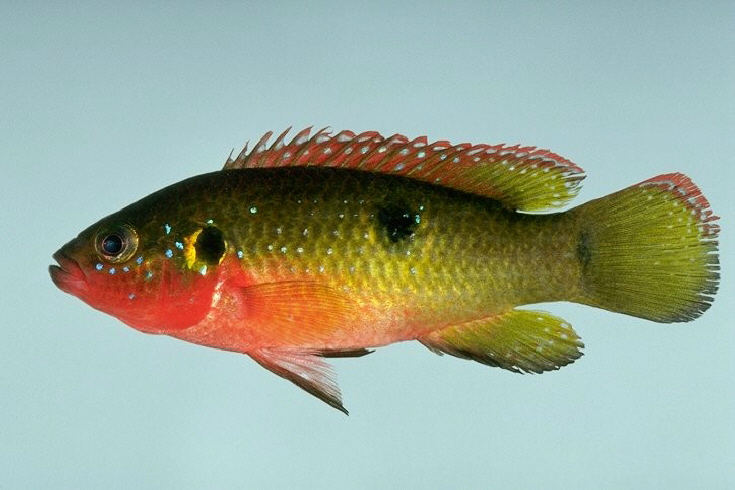 Sub-Saharan AfricaJewel cichlid
Brightly colored African cichlids kept in aquariums for their vivid breeding colours and parental care.Cichlid · Rivers and lakes
 🇧🇷 Brazil and 3 moreSpeckled peacock bass
A large South American cichlid prized for sport and food.Cichlid · Rivers and lakes
More from Cichlidae
All of them 🇹🇿 Tanzania and 2 moreSingida tilapia
A cichlid fish native to the Lake Victoria basin in East Africa.Cichlid · Rivers and lakes
 WorldAuratus cichlid
Small, colourful cichlid from Lake MalawiCichlid · Rivers and lakes
 🇭🇳 Honduras and 3 moreJaguar cichlid
Large predatory cichlid from Central American lakesCichlid · Rivers and lakes
 Sub-Saharan AfricaPrincess cichlid
A cooperative schooling cichlid from Lake Tanganyika.Cichlid · Rivers and lakes